
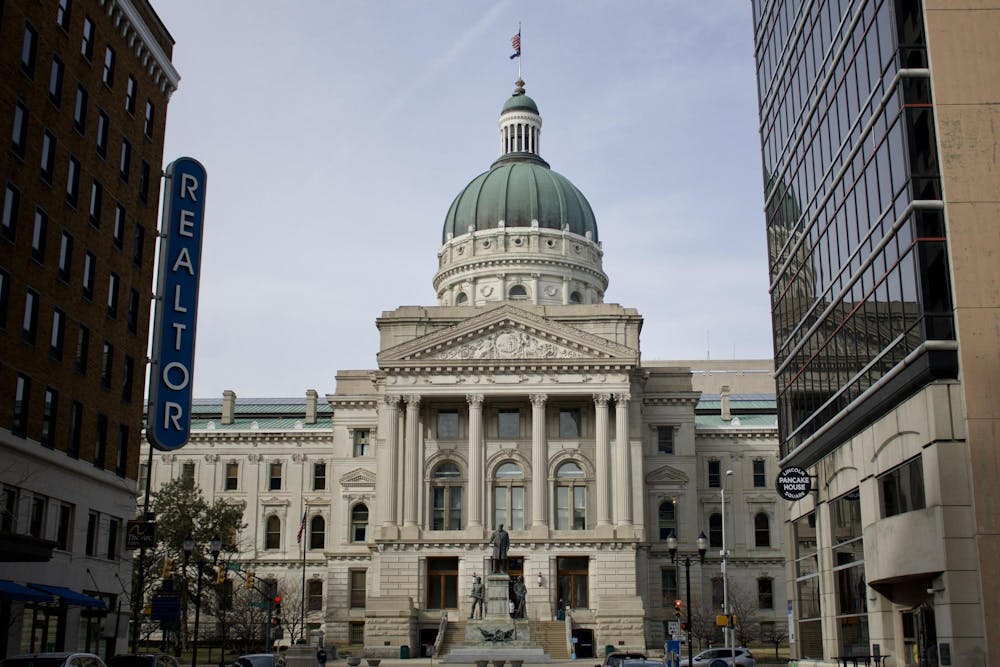
Indiana's short legislative session, during which legislators proposed over 500 bills, ended Feb. 27. The session had an early start in December because of a failed attempt to redistrict Indiana, and reconvened Jan. 5.
Here is a recap of notable bills discussed during the session:
University degree programs in jeopardy
Senate Bill 199 passed the Senate with a 34-14 vote and the House with a 62-32 vote Feb. 27. The bill awaits a signature from the governor.
It will require the Indiana Commission for Higher Education to review universities' degree programs and select those that have median annual earnings below that of a high school graduate, or about $24,000 to $35,000.
Low-earning degree programs will then be further evaluated and either restructured, consolidated or allowed to continue. This bill furthers the state’s control of higher education degree programs following House Enrolled Act 1001, which was passed in May 2025 and required the elimination or consolidation of more than 400 low enrollment degree programs, including 116 at IU Bloomington.
Ban on abortion-inducing drugs
Senate Bill 236 did not reach a vote in the House but passed the Senate in a 35-10 vote.
This bill would have allowed any Hoosier to sue another Hoosier who mails, distributes, delivers, manufactures, provides or prescribes abortion-inducing drugs in Indiana. Under the state’s near-total abortion ban, SB 236 would have put Hoosiers requiring mail-in abortion drugs at legal risk.
SB 236 would have redefined abortion as anything intended to “cause the death of an unborn child,” allowing Hoosiers to bring wrongful death suits on other Hoosiers who help a pregnant person seek abortion care in state.
Immigration law enforcement
Senate Bill 76 passed the House on Feb. 12 with a 61-28 vote and passed the Senate on Feb. 25 with a 37-11 vote. It was signed by the House speaker and Senate president on Feb. 27 and heads to the governor's desk.
The bill will not allow governmental bodies or universities to limit the enforcement of immigration law. This applies to law enforcement carried out by local, state and federal agencies.
SB 76 will also allow Indiana’s attorney general to impose a civil penalty fine of up to $10,000 for each violation of compliance and bring court action against violators.
Gender issues
Targeting transgender Hoosiers, Senate Bill 182 did not get a vote in the House but passed the Senate with a 37-8 vote.
The bill would have required dormitories and restrooms at public schools to be separated based on sex assigned at birth.
Ban on public sleeping
Senate Bill 285, which passed the House with a 53-44 vote and the Senate with a last-minute 28-22 vote, will classify a person knowingly sleeping or camping on public land as committing a Class C misdemeanor.
When someone is found sleeping in a public space, they will be issued a warning. If they are still publicly sleeping 48 hours after their warning within a 300-foot radius of where the warning was issued, they could face up to 60 days of imprisonment and up to a $500 fine.
An exception is if a law enforcement officer determines reasonable grounds for the person to be brought into emergency detention, in which case the person would not be charged with a misdemeanor.
Addressing Indiana’s veterinarian shortage
Partially authored by Sen. Shelli Yoder, who represents Bloomington, Senate Bill 56 will allow the state’s board of veterinary medicine to provide licenses to applicants who have experience and licenses in other states without requiring an exam. The bill comes as a response to Indiana’s veterinarian shortage.
SB 56 had no attempted amendments and passed the Senate with a 49-0 vote and the House with a 94-1 vote.
Food and beverages provided by schools
House Bill 1137 did not receive a vote in the Senate but it passed the House with a 83-7 vote.
The bill would have banned charter and public schools that are part of federally funded or assisted meal programs from providing students with food that contains 13 specific ingredients. The only exception would have been for food being sold at fundraisers that happen at least 30 minutes after the school day ends. The 13 banned ingredients include Red Dye No. 3, Red Dye No. 40, butylated hydroxytoluene (BHT) and other color dyes.
Policy for wireless devices on school premises
Senate Bill 78 passed the House with a 82-13 vote and the Senate with a 36-12 vote. The bill is awaiting the governor’s signature.
The bill will require Indiana schools to either implement a no device policy that will prohibit students from bringing wireless communication devices to school or a storage policy that would require such devices to be powered off and stored in a place inaccessible to students during the school day.
Township merging
Senate Bill 270, which will use townships’ performance metrics to consolidate low-performing townships, passed the House with a 61-35 vote and the Senate with a 34-15 vote.
The performance metrics include, among others, whether the township government provided township assistance in 2023 and 2024 and whether the township government actively manages the emergency medical services and fire protection services within the township.
Township reorganization
House Bill 1315, an alternative township reorganization route to Senate Bill 270, did not get a Senate vote but passed the House with a 55-44 vote.
The bill would have eliminated townships with low populations that did not operate a fire department and did not meet a “minimum level of emergency financial assistance distribution.” A legislative analysis showed about 650 of Indiana’s 1,008 townships would have been forced to consolidate under HB 1315.


