
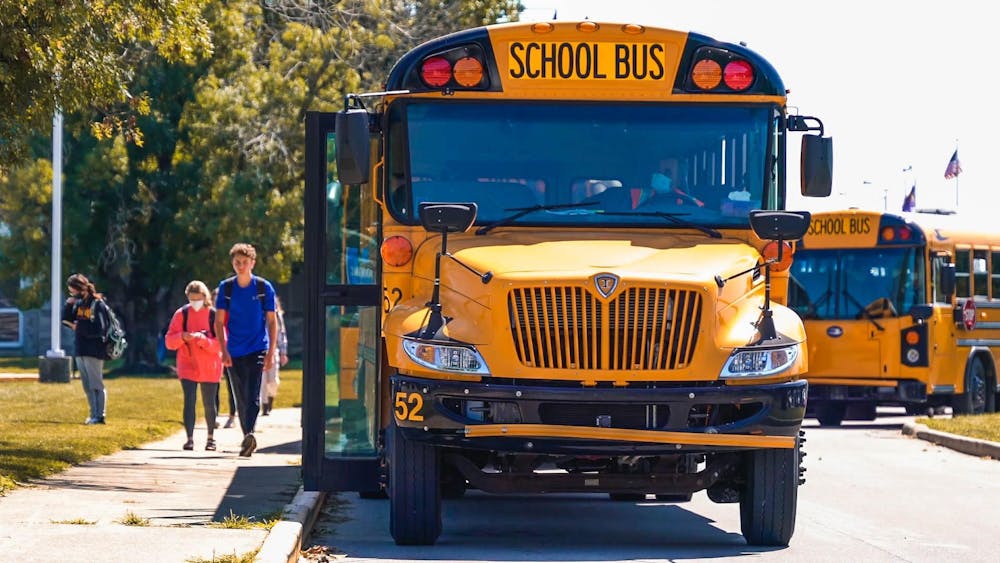
The cafeteria is a lot different than it used to be, said Erich Nolan, a chemistry and biomedical science teacher at Bloomington High School North.
It's quieter. There’s less peer-to-peer interaction. Sometimes he’ll see whole tables of kids all glued to their phones.
But under a bill making its way through the Indiana Senate, students would no longer be allowed to access their devices at any time during the school day.
Senate Bill 78 comes after a 2024 law that first banned phones, tablets and laptops during “instructional time." Devices could be permitted if used for a lesson, in the event of an emergency or as part of an individualized education program.
Monroe County Community School Corporation’s current device policy says “devices must be turned off and stored out of sight during instructional time,” but that students can use their devices during lunch, recess and before and after class.
The new bill would mandate either a no-device policy, where students can’t bring devices into school, or a secure storage policy where the devices must be inaccessible during the school day. Exceptions for IEP plans, health conditions, language translation or emergencies would still be allowed. The bill requires that teacher-directed use of devices for educational purposes occur only on school-supplied devices.
Nolan allows students to use their phones to submit assignments on Canvas, but rarely for anything else. He said he’s watched phones become an increasing distraction over the years and thinks they harm student learning. He’s supportive of schools introducing total bans, but understands the discomfort families may feel.
“[The] expectation that parents have of being able to reach their kids at any time is a, you know, modern expectation,” Nolan said.
Keri Miksza, a board member for the Indiana Coalition for Public Education and a parent with children in the MCCSC system, said she didn’t see much of a change in her children after the first phone ban law went into effect in 2024.
Her kids still messaged her during the school day, she said, coordinating after-school activities. She said sometimes the enforcement of the bill was even left up to the classroom teacher, in case students needed to access apps that weren’t on school-provided laptops.
“I think it’s a good bill, as long as they’re still allowed to keep it in their locker,” Miksza said. “And I do believe local control is where it’s at, because they know best in terms of what is needed in regards to access to cell phones.”
Lucinda Miksza, a senior at Bloomington High School South and Keri Miksza’s daughter, said her teachers aren’t very strict about having phones out in class. She uses it for labs, submitting assignments and research on websites she can’t access on the school-issued laptops.
She said she didn’t notice a change when the 2024 phone ban was enforced, but she said it might be because she’s older.
“Teachers are a little bit less restrictive on it,” she said. “It’s your own responsibility to know when to get off your phone and to be responsible for, like, your own education.”
Lucinda said the bill wouldn’t be a huge deal for her, but thought it might feel awkward to not have a device filling the empty spaces between talking to people. She said many students use their phones to text their parents to pick them up if they don’t want to be at school anymore. If the bill became law, she feels the lack of phones could impact student attendance.
One concern she does have is about having a device in an emergency.
“I feel like one of, like the big irrational fears is like, getting locked out of, like, the classroom when there’s, like a school shooting,” Lucinda said. “What would you do if you didn’t have your cell phone?”
Frank Diaz, an associate professor of music at IU, has a daughter in an MCCSC middle school. She has a phone but isn’t allowed to bring it to school.
Diaz supports limiting phone usage during the school day — and even doesn’t let his students use them during his lectures — but he does have some concerns about coordinating after-school activities and communicating during emergencies.
“Something happens at school, like a school shooting, or there’s a situation where there’s an emergency in which students are locked into a classroom and there’s no way to communicate with them,” Diaz said. “I think I would be incredibly distraught not knowing what’s going on with my kid.”
Angela Shelton, a science teacher at Bloomington High School North, said there are phones in every room and teachers would still have cell phones in case of an emergency. At the high schools, she said, there are panic buttons to immediately call for help. The buttons can notify staff of medical emergencies or initiate lockdowns by sending messages to staff devices and alerting police.
She’s in support of the bill and says phones are still a huge distraction in class, despite the 2024 law.
“They get them at lunch, and then they come into the period after lunch, and everyone has their phone out,” Shelton said. “And kids say things like, when I asked them to put their phones away after lunch, ‘Oh, it’s the worst part of my day,' which makes me sad.”
Shelton said there was an initial decrease in phone usage after the law went into effect, with students saying they were “the most locked in” they’d ever been at school. Now, she says, the phones have slowly crept back out.
It’s hard to enforce if a kid refuses to comply, Shelton said. She could call their parents, but no one’s going to suspend someone for having their phone out, she said.
It’s difficult to watch every student at once and ensure they aren’t using their phones to get AI answers to paper worksheets, Shelton said, and she feels phones have also led to students having shorter attention spans.
When Shelton first started teaching a decade ago, she would have students read an entire book over the summer or Christmas break. Now, she says, she’s lucky if she can get them to read a four-page article.
Statewide tests have found English and language arts proficiency has remained largely stagnant over the past few years, while math has increased. The tests, Indiana’s Learning Evaluation and Assessment Readiness Network, are taken by elementary, middle schoolers and certain high school classes to assess achievement and growth according to state standards.
In a press release, State Sen. Daryl Schmitt, R-Jasper, a supporter of the bill, said that children need to be paying attention to receive the best education possible.
“However, with the increase in technology available to students, this has become increasingly difficult,” he said.
The bill was ordered engrossed Jan. 13 and is scheduled for a third reading Tuesday.


