
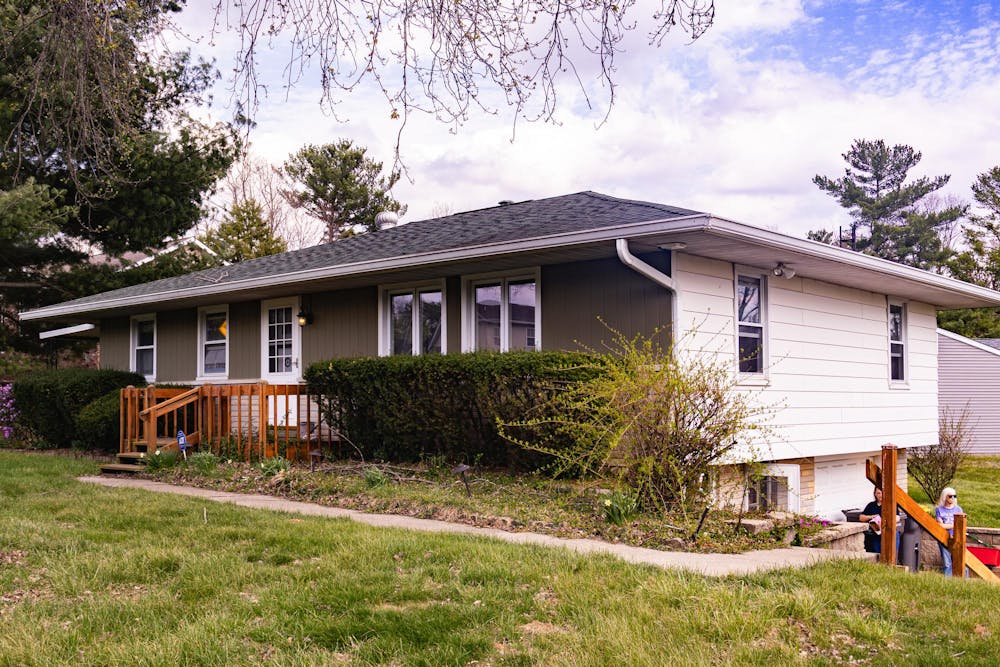
Marilyn Grimes had already lost everything before she found herself in the back of a police car. In that moment, handcuffed and facing a felony, it dawned on her.
She had to get sober.
“I had finally come to that conclusion that where I was going to kill me, and I didn't want to die,” Grimes said.
Now, she’s about 18 years sober from OxyContin, heroin and alcohol. She also directs Courage to Change Sober Living, a Bloomington 12-step sober living environment serving those struggling with substance use. She's open about her journey, in hopes it alleviates shame felt by those in recovery.
“I'm proud of myself that I've accomplished so much after going through all of that, you know,” she said, “and it helps other people, you know, to know that ‘I'm not the baddest one in the room.’”
Grimes’ story reflects a national opioid crisis that, according to local data, may be turning a corner in Monroe County.
The U.S. Centers for Disease Control and Prevention traces it back to the 1990s, when physicians began widely prescribing addictive opioids like oxycodone and hydrocodone to treat pain.
Overdose deaths across the country involving heroin surged in 2010, followed by a third wave of the crisis starting in 2013 driven by synthetic opioids flooding the illicit drug supply.
From January to September last year, 787 Hoosiers lost their lives to opioids, according to the Indiana Department of Health overdose dashboard. A 2019 report by the Indiana Department of Health found that racial disparities exist in drug overdose death rates, with the Black population seeing a quicker rise in recent years.
Grimes and Monroe County Coroner Jeff Hall both pointed to mental health struggles as a driving factor of the opioid crisis in Monroe County.
Monroe County Coroner’s Office data obtained by the Indiana Daily Student shows 41 drug-related deaths in 2025 in Monroe County. Twenty-four deaths, approximately 59% of all drug-related deaths, were related to opioid use, indicating a decrease from 40 opioid-related deaths in 2024.
County data includes deaths investigated by the coroner where the direct result of death was due to a drug-related incident, Hall wrote in an email to the Indiana Daily Student, including deaths linked to opioids. Pending cases are not included.
Opioid-related deaths increased from 2020 to 2022 during the COVID-19 pandemic by 10 deaths, when Monroe County saw 41 opioid-related deaths in 2020 and 51 in 2022. However, county data, ranging from 2018 to 2026 to date, does not indicate a consistent upward or downward trend in nearly a decade.
“It really kind of just goes with different ebbs and flows,” Hall said.
The highest recorded number of opioid-related deaths since 2018 was in 2023 when Monroe County saw 52 deaths, according to county data.
To date, Monroe County has seen 17 deaths associated with drug overdose, with 12, or approximately 70%, being related to opioids this year.
Hall said overdose deaths typically happen by accident and sometimes occur in clusters due to a “bad batch” of drugs entering the county. Bad batches, he said, refers to street drugs that are not what the user thinks they are. Such batches are commonly laced with synthetic drugs like fentanyl, a powerful opiate of which small amounts can be fatal.
He said a common “bad batch” he sees in Monroe County is methamphetamine mixed with fentanyl or derivatives of fentanyl. Typically, overdose-related deaths are caused by a combination of drugs and are commonly classified as accidental overdoses, Hall said.
Hall said six deaths in Monroe County occurred due to a “bad batch” so far in 2026.
“It’s sort of like Russian roulette,” Grimes said. “Your next high could kill you instantly because of the fentanyl.”
Making resources accessible to those struggling with addiction is something Jackie Daniels, director of clinical development at Indiana Center for Recovery, has grown familiar with in her work.
Indiana Center for Recovery is a mental health treatment center that helps treat substance use disorder at 10 locations across Indiana, according to its website.
Having struggled with addiction and an overdose herself, Daniels said she remembers there were weeks when three or four people she knew died from an overdose — something she doesn’t experience as often anymore.
“But I don’t think we’re anywhere near letting our guard down,” she said.
Daniels considers Monroe County a “haven” for recovery because of the availability of harm reduction programs, access to lifesaving medication like Narcan and public awareness about substance use disorder.
Daniels sees stigmas that are “alive and well” about recovery.
“I'm constantly arguing with people on social media, which is probably not a good idea, but I do it anyway, because I feel so passionately about it,” she said, “and a lot of that is this perception of 'us versus them.’”
Stigma can push people to hide their drug use or avoid treatment altogether, Daniels said, and one bad experience can make them unlikely to seek help again.
The City of Bloomington distributed $244,095 last year to address opioid addiction and recovery through its Downtown Outreach Grants. The grants supported nine local nonprofits, including Courage to Change, providing resources like treatment and housing stability.
The grants are funded as a result of multiple settlements Indiana reached with pharmaceutical companies and distributors that were alleged to have contributed to the opioid crisis between 2021-2022. The settlements provide Indiana with more than $1 billion over 18 years to combat the opioid crisis beginning in 2022.
Macy Olds sought treatment at Indiana Center for Recovery after struggling with substance use. Now, graduating from Indiana University with a social work degree this spring, she works as a case manager and group facilitator.
Her recovery inspired her to pursue social work. In the fall, she will return to IU for a master’s degree.
Olds, a self-proclaimed “party kid” in her teens, became addicted to opiates after experimenting with different substances throughout high school and into college. It wasn’t until she sat in a jail cell that a stranger made her realize she needed to change course.
“She had an ankle bracelet plugged into the wall inside of a jail cell, and I told her everything that I had done, and like, all the substances I used,” Olds said, “and she goes, ‘You're gonna die.’”
Having lived it herself, Olds knows how isolating addiction can feel. A big challenge for those with substance use disorder, she said, is the fear of disappointing the people closest to them.
“Don’t shame them and don’t view it as a moral issue,” she said. “Just be a listening ear where they can talk to you and offer to take them to treatment.”
Despite the number of opioid deaths, organizations like Courage to Change continue to work and support those wrestling with substance use disorder.
"Recovery is community," she said. "You can't isolate and get help."



