
Melanie Davis has faced discrimination at work and in public life for being transgender. She said she was outed as transgender at her job in 1999. Over the years, she’s felt unsafe and threatened in public because of her identity.
Davis said she’s fought for trans rights in Indiana for around 30 years. She hosts BloomingOUT, a WFHB talk show that focuses on LGBTQ+ issues and serves as president for the Front Door Community Center of Bloomington, an organization that supports the city’s LGBTQ+ community.
She said Indiana Senate Bill 182 is just another iteration of what she’s trying to fight against.
SB 182 originated as a bill mandating correctional facilities separate inmates based on sex assigned at birth. The bill’s second iteration added language to also require public school restrooms and public university dormitories to be separate based on sex assigned at birth.
Sen. Liz Brown, R-15, introduced the bill Jan. 5. She and Sens. Tyler Johnson, R-14, and Chris Garten, R-45, co-authored the bill. All declined to comment on it.
SB 182 would go into effect July 1, 2026, if it passes the Indiana House of Representatives and Gov. Mike Braun signs off on it. The Senate referred the bill to the House on Jan. 28, where it awaits a vote.
Davis went to the Indiana Statehouse to testify against the bill during its first committee hearing Jan. 21. She said she felt like the senators there had already decided to pass it before listening to her testimony.
“I can explain all day long what being trans is about, why people are transgender,” Davis said. “But if your ideology, if your worldview is already set, and you aren't willing to learn more, then that effort is lost.”
The bill requires public colleges to not require students of different genders to share a room overnight. The bill also has a stipulation streamlining the process of lawsuits against schools which violate certain sections of the proposed legislation.
IU spokesperson Mark Bode did not respond to requests for comment. Monroe County Community School Corporation spokesperson Sarah DeWeese did not respond to requests for comment.
The Indiana Bureau of Motor Vehicles recently announced that Hoosiers will no longer be able to change their gender marker on state-issued IDs starting Thursday. Davis said while the change may seem minor to those unaffected, the impact will be greater than they expect.
“Your IDs are your ability to navigate through and access anything in this world,” Davis said.
Both SB 182 and the BMV change come after Indiana Gov. Mike Braun issued an executive order in March 2025 opposing “modern gender ideology.” The order prohibits state funds from being used to “promote gender ideology” and instructs executive branch agencies to stop using gender-neutral language like “people who menstruate” or “birthing persons.”
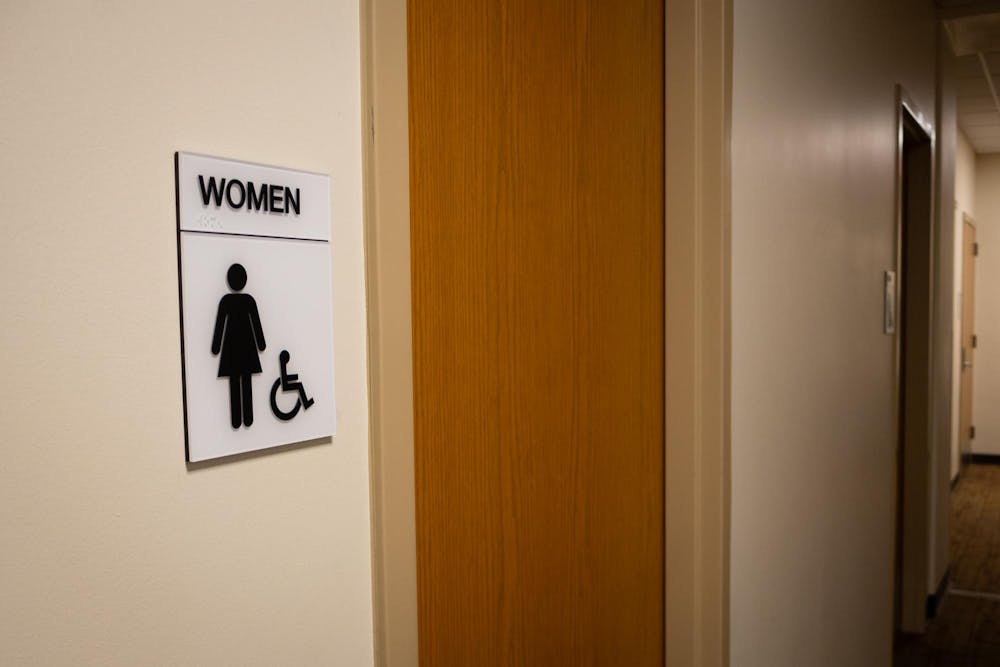
SB 182 requires trans students at public schools to use the bathroom that corresponds with their sex assigned at birth, rather than their gender identity.
“Their daily life is going to be absolutely interrupted,” Davis said. “And they're pretty much removed from public life at that point.”
The American Civil Liberties Union of Indiana opposes the bill’s passing, saying in a statement on its website on Jan. 26 that the bill mandates “discrimination against transgender and intersex people.”
“When trans people are denied correct documents and access to public spaces that reflect their identity, it can result in discrimination, harassment, and even violence in their everyday lives,” ACLU of Indiana spokesperson Laura Forbes said in an email to the Indiana Daily Student. “While bathroom bans claim to protect women, similar laws have led to intimidation and harassment against both trans people and cisgender women who don’t fit society’s narrow expectations for femininity.”
Indiana is estimated to have almost 16,000 transgender youth aged 13-17, and 37,300 trans adults, according to the Williams Institute within the University of California Los Angeles School of Law.
Reef Snodgrass is a trans sophomore at IU. He said he lives in the Spectrum Thematic Community, which is “designed to create a comfortable and supportive environment for all students of all gender and sexual identities,” according to the IU Housing website.
Snodgrass said the bill could directly impact his future living situation.
When freshmen apply for on-campus housing, they have an option to toggle which genders they are comfortable living with, regardless of their assigned sex at birth, IU Residential Programs and Services states on its website. The option doesn’t appear when students apply to live on campus beyond their first year. But if SB 182 passes, that would mandate students living in the dorms must live with someone who was assigned the same sex at birth.
Snodgrass said he believes the legislation misses a crucial point about forcing trans men into women's spaces.
"As a very muscular man, if an 18-year-old girl pulled up, and she was state mandated to room with me, I don't think she would be very comfortable with that," Snodgrass said. "I think they're imagining masculine trans women trying to be in women's spaces and not really thinking about trans masculine people being forced into women's spaces. Either way, you're just forcing men into women's spaces, which is the opposite of what they’re trying to do."
Snodgrass said he has not received any communication from IU about the bill or how it might affect students. This makes sense, he said, because it has yet to be approved by the House and the governor.
"I think most people would agree that it's best for you to be able to room with whoever you select that you're comfortable rooming with and not who the state mandates you to room with," Snodgrass said.
Davis said she maintains hope and encourages others to persevere, despite the bill gaining traction.
"We can live through this,” Davis said. “This is something that we can change. It's already changed and now it's changed back, and we can change again.”


