
From frat suspensions to intellectual diversity investigations, here are 12 news stories that defined Bloomington and IU’s campus this year, as reported by the Indiana Daily Student.
Whitten plagiarism allegations
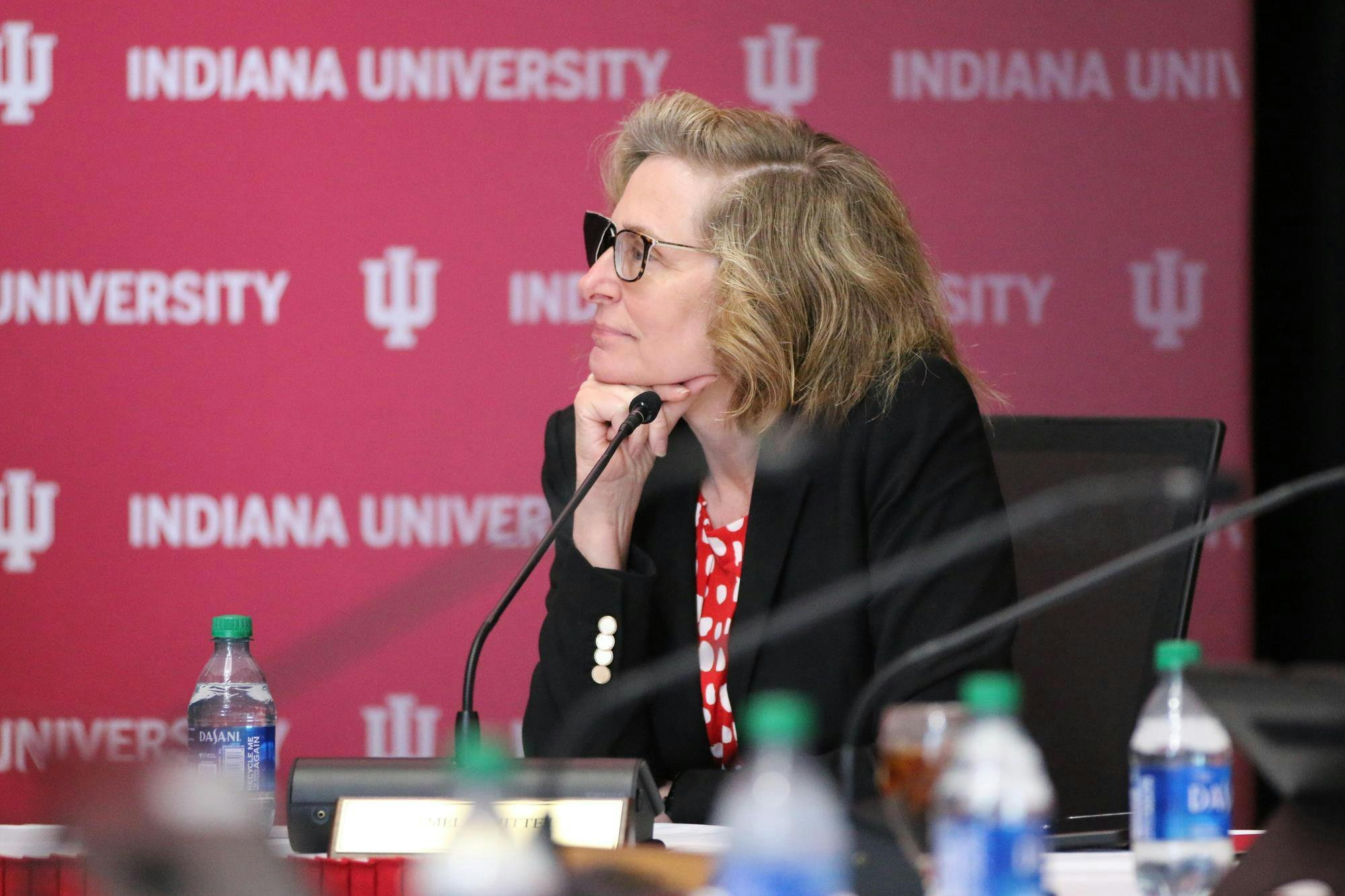
IU President Pamela Whitten is pictured at the IU Board of Trustees meeting June 13, 2024, at the Henke Hall of Champions in Bloomington. Whitten was reappointed as president for five additional years in February.
In January 2025, the IDS reported on plagiarism allegations regarding IU President Pamela Whitten’s 1996 dissertation and 2006 article. Last year, the IDS received a tip about a 52-word example of language taken from a Telemedicine Journal article Whitten co-wrote.
In February, Whitten was reappointed for five more years. Her contract was extended from its original June 2026 expiration date and the IU Board of Trustees voted 8-1 to give her a 28% raise, making her base salary $900,000.
In September 2025, BOT Chair David Hormuth told the IDS in a statement that “no further action will be taken” to inspect or issue more information about the plagiarism allegations. IU has still not released the results from its independent review. Legal experts interviewed by the IDS found no legal mandate halting IU from releasing its findings.
Luddy professor termination, FBI examination
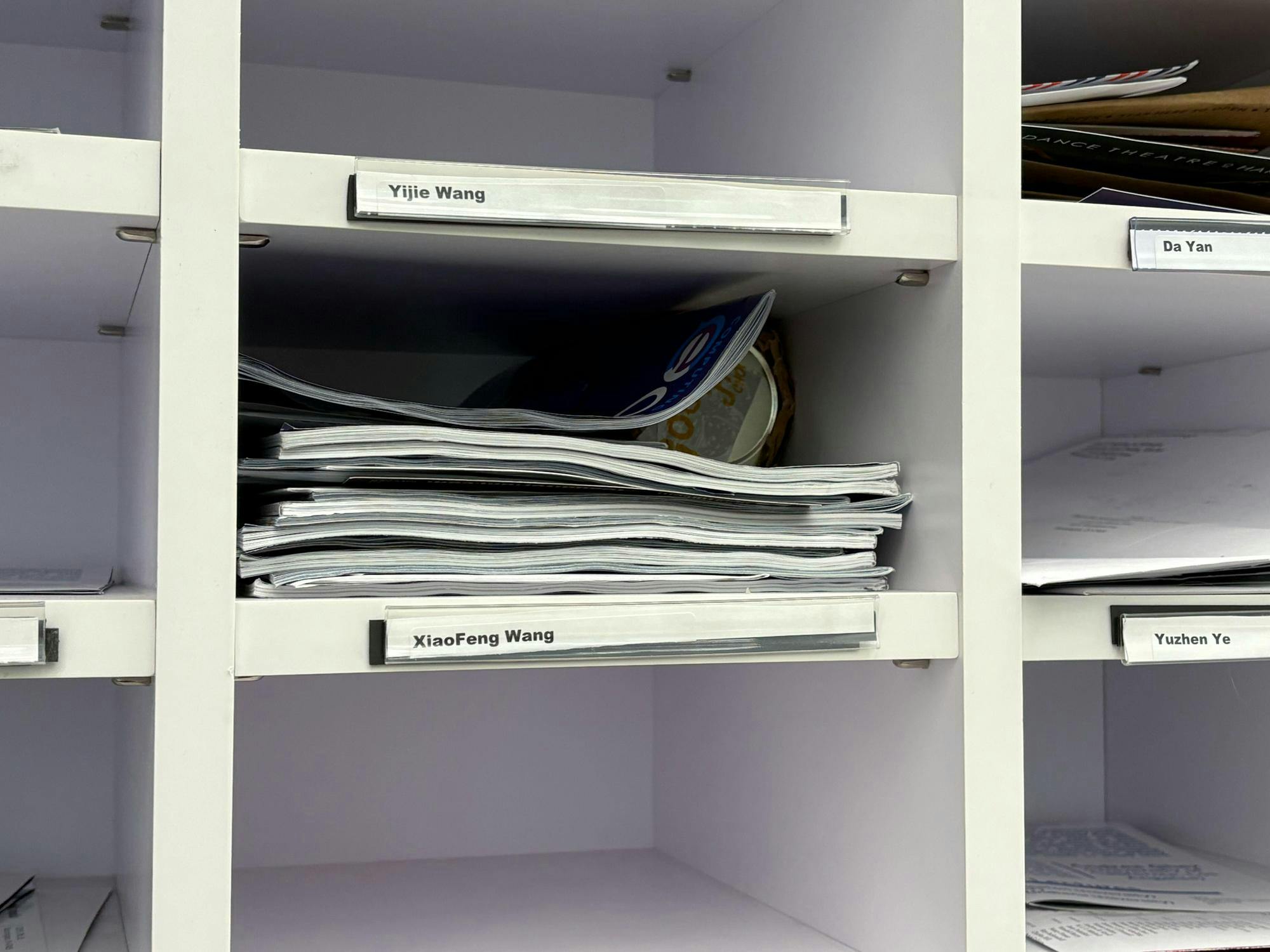
IU professor Xiaofeng Wang's mailbox is pictured April 3, 2025, at Luddy Hall in Bloomington. IU terminated Wang on March 28, the same day the FBI raided his home for unknown reasons.
The FBI searched IU professor Xiaofeng Wang and IU Libraries analyst Nianli Ma’s homes in Bloomington and Carmel on March 28. IU terminated Wang the same day.
A copy of an email IU Provost Rahul Shrivastav sent Wang was given to the IDS by the American Association of University Professors’ IU Bloomington chapter. The email said it was Shrivastav's understanding that Wang had accepted a position at a university in Singapore.
Wang’s wife, Ma, was terminated four days before the FBI search. A source close to Ma said IU did not provide a reason for her dismissal.
As of April, Wang and Ma had not faced any criminal charges. IU computer science faculty and the AAUP condemned Wang’s termination, saying IU didn’t follow due process, and violated its own termination policy.
In October, unsealed court documents revealed 42 items the FBI reportedly seized from the Carmel home. Among these items were flight tickets, printed emails, hand-written notes, hotel information, applications to adjust immigration status in the United States and a partnership agreement with an unnamed tech company.
Diversity, Equity and Inclusion principles lose standing at IU
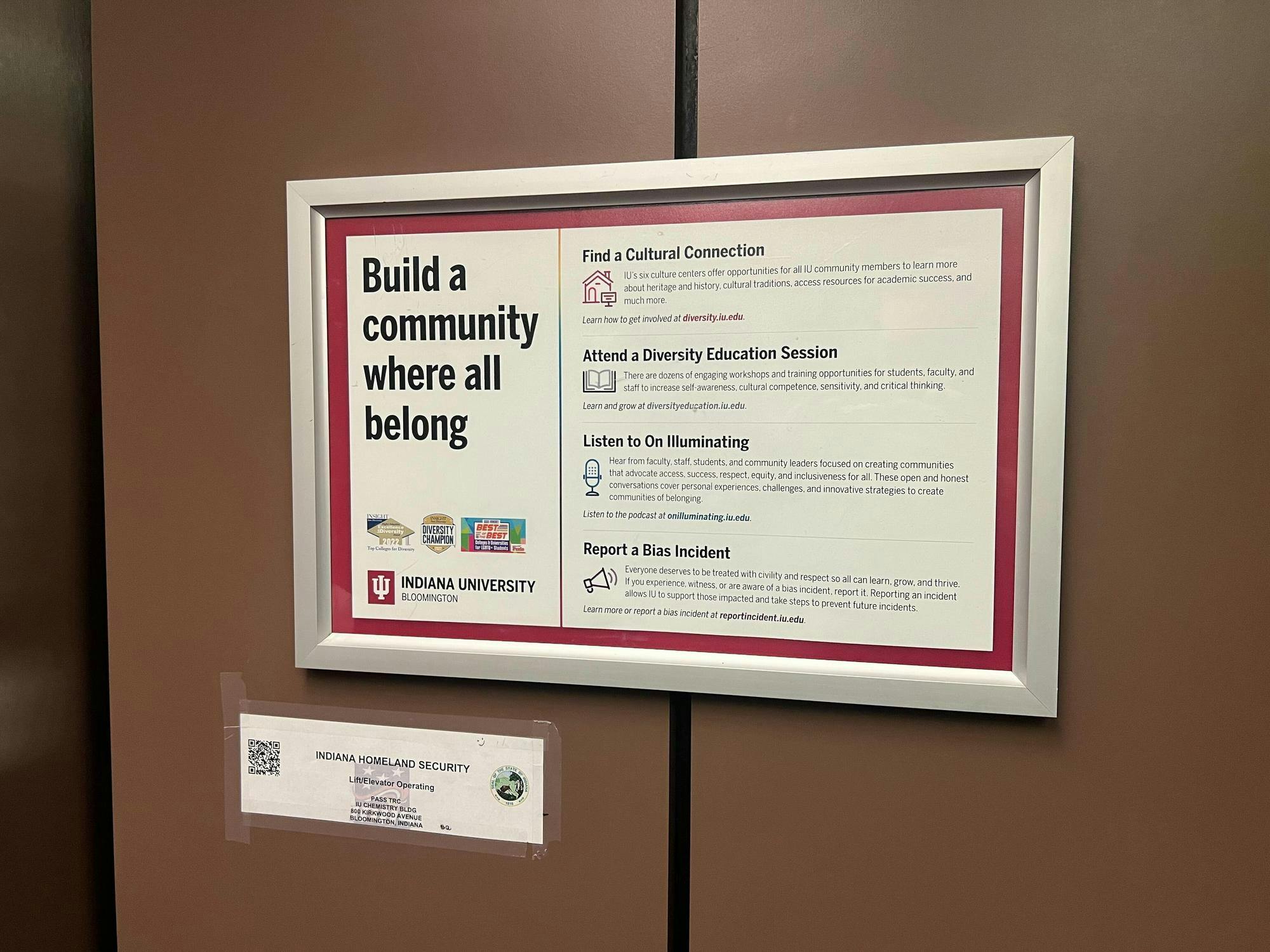
A poster titled “Build a community where all belong” is pictured March 26, 2025, in the Chemistry Building in Bloomington. Several of the same posters across campus were removed and replaced.
In January, Indiana Gov. Mike Braun signed an executive order stating all state agencies must adhere to decisions made in Students for Fair Admissions, Inc. v. President and Fellows of Harvard College.
The order dismantled diversity, equity and inclusion initiatives in Indiana agencies and instructed them against using state funds, property or resources to support DEI programs, specifically targeting those that granted preferential treatment based on race, ethnicity or national origin.
Senate Bill 289 was signed into law in May. This bill forbids state agencies from promoting any policies or activities designed in reference to race, sex, color or ethnicity.
In March, amid continued political pressure targeting DEI, IU made changes to language on its websites and listed six culture centers as departments under the Office of Student Life web page. At the time, they were still listed under the Office of the Vice President for Diversity, Equity and Inclusion website.
IU also changed signage around campus to omit DEI-related phrasing. One poster titled “Build a community where all belong” that was previously displayed in some university buildings and provided resources to diversity education workshops, was removed.
The new posters, titled “Build a community of unity, we can overcome bias together,” focused on bias incidents and removed the word “diversity” entirely.
In May, IU closed the Office of the Vice President for Diversity, Equity and Inclusion, citing compliance with state and federal laws regarding DEI. With this, the Office of Institutional Equity was renamed to the Office of Civil Rights Compliance; a move IU said more accurately reflects the university’s mission.
Immigration enforcement comes to Bloomington
In May, Bloomington community members rallied against U.S. Immigration and Customs Enforcement presence in the city. After reports of ICE agent sightings around Bloomington and confirmation that the Hopkins County Jail in Kentucky had custody of three individuals detained by agents in Bloomington, about 200 people organized outside the courthouse.
In June, the Bloomington community gathered for a candlelight vigil in honor and support of immigrants ICE "disappeared,” meaning deported covertly and without hearings, in the past few months. It was organized by the nationwide organization 50501.
In September, Indiana Attorney General Todd Rokita announced he was investigating the nonprofit Exodus Refugee Immigration, in Bloomington, for alleged labor trafficking and interference with ICE. The American Civil Liberties Union sued Rokita for violating Exodus’ First Amendment right to expression and association.
Braun-appointed trustees
Braun was sworn into office Jan. 13 this year, a change in leadership that led to significant restructuring of IU’s nine-member Board of Trustees.
The BOT governs IU and chooses its president. Eight trustees serve three-year terms, and one, the student trustee, serves a one-year term.
In the early morning April 25, the Indiana House and Senate passed the state budget, House Enrolled Act 1001. The bill housed a last-minute addition that gave Braun total control over the trustees’ selection process and eliminated the three alumni-elected trustee positions.
“The governor may at any time remove and replace a member of the Board of Trustees who was elected by the alumni of Indiana University,” the bill reads.
In response, the ACLU and a former candidate in the canceled alumni-trustee election, Justin Vasel, filed a lawsuit against Braun.
On June 2, Braun removed all three alumni-elected trustees and on the same day appointed their replacements: Sage Steele, James Bopp Jr. and Brian Eagle.
Degree eliminations
The state budget bill also required Indiana higher education institutions’ programs to have at least 15 bachelor’s degree graduates and 10 associate degree graduates. Nearly 250 programs across IU campuses were impacted and either eliminated, suspended or suspended with a commitment to merge or consolidate.
Many of the programs suspended consisted of language and arts-related degrees.
Expressive Activity Policy developments
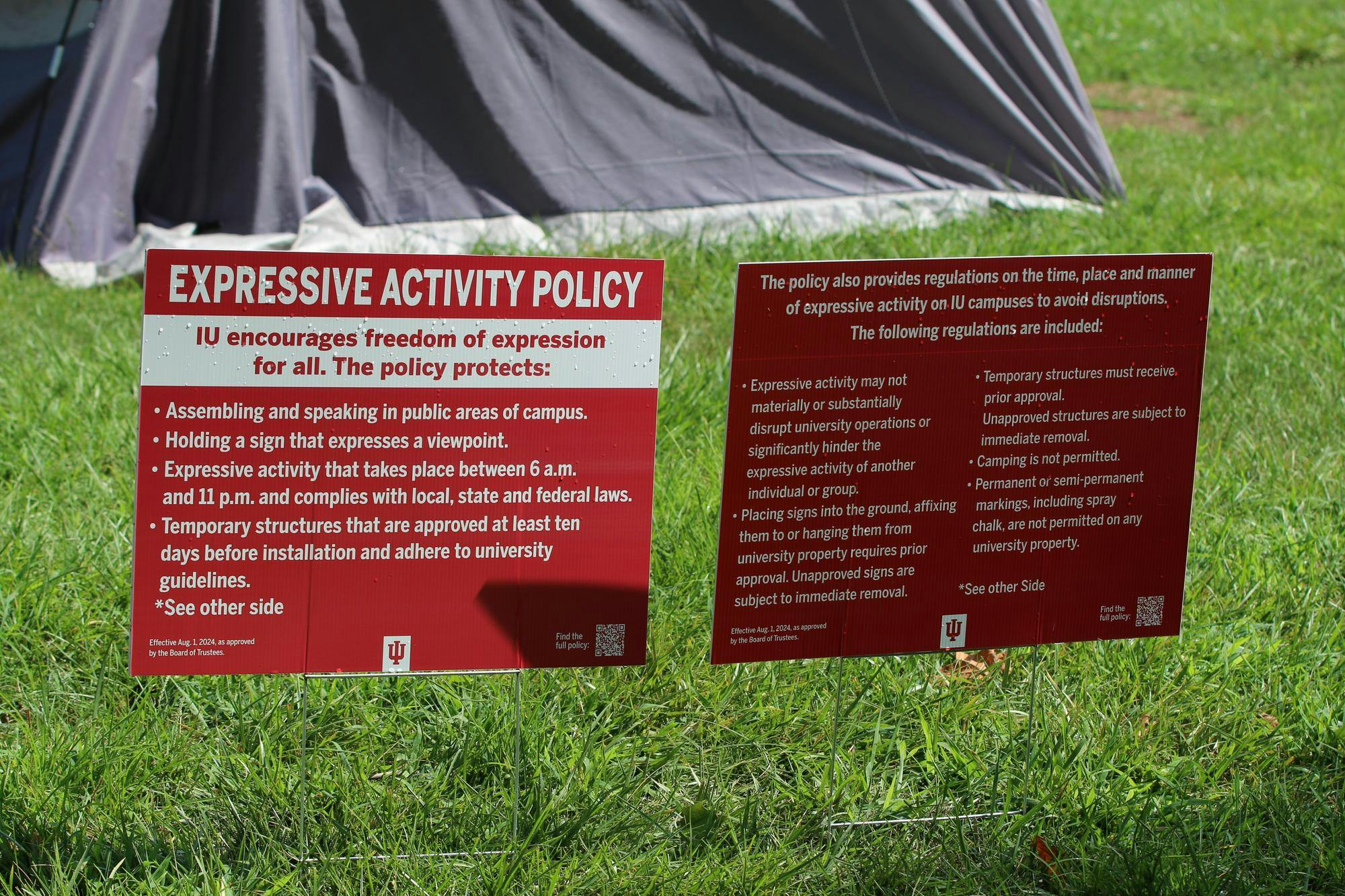
Two signs state the rules of IU's expressive activity policy Aug. 1, 2024, in Dunn Meadow. IU amended the policy in June 2025.
At the end of May, a Southern District Court of Indiana judge granted a preliminary injunction for the plaintiffs in the ACLU of Indiana’s lawsuit against the Trustees of Indiana University.
This decision temporarily barred IU from enforcing parts of its Expressive Activity Policy, which the court said likely violated the First Amendment, “only to the extent it prohibits protesting, making speeches, circulating petitions, and all other unapproved conduct and activities otherwise prohibited on University property without prior permission and between the hours of 11:00 p.m. and 6:00 a.m.”
The next month, the BOT amended the policy, lifting the time restrictions, and decreasing how far in advance requests to use temporary structures had to be made from 10 to seven days.
Along with this, the policy stated event requests for 50-99 people must be made three business days in advance and five business days in advance for events with more than 100 people.
“Our goal, quite frankly, is to continue to try to make the policy better, to continue to receive feedback from the university community and adopt that feedback when it helps us make the policy better,” Vice President and General Counsel Anthony Prather said at the June 12 BOT meeting.
Last month, Whitten asked the University Faculty Council to examine the Chicago Principles, a set of free speech values outlined in a report made by the Committee on Freedom of Expression at the University of Chicago, and make a recommendation on whether IU should adopt the standards.
Local protests
Since President Donald Trump’s inauguration Jan. 20, Bloomington residents have participated in several nationwide protests throughout 2025.
In April, hundreds protested Trump, Elon Musk and actions by the state government outside the Monroe County Courthouse as part of nationwide “Hands Off!” protests.
Later in the month, protesters gathered outside an event at which Sen. Todd Young was speaking — the Greater Bloomington Chamber of Commerce Dignitary Discussion at the Monroe Convention Center. They challenged potential social security and Medicaid cuts, as well as the Department of Government Efficiency.
Days later, about 50 demonstrators set up tables in the Franklin Hall commons for the National Day of Action for Higher Education, which was hosted by the AAUP. The demonstration on IU’s campus was organized by People’s 2030 platform, a coalition of IU students, faculty, staff and organizations, and called for academic freedom.
The day after, demonstrators, joined under 50501, played bagpipes, drummed, chanted and collected food donations for Mother Hubbard’s Cupboard outside the county courthouse. This protest targeted Trump administration funding cuts and immigration policies.
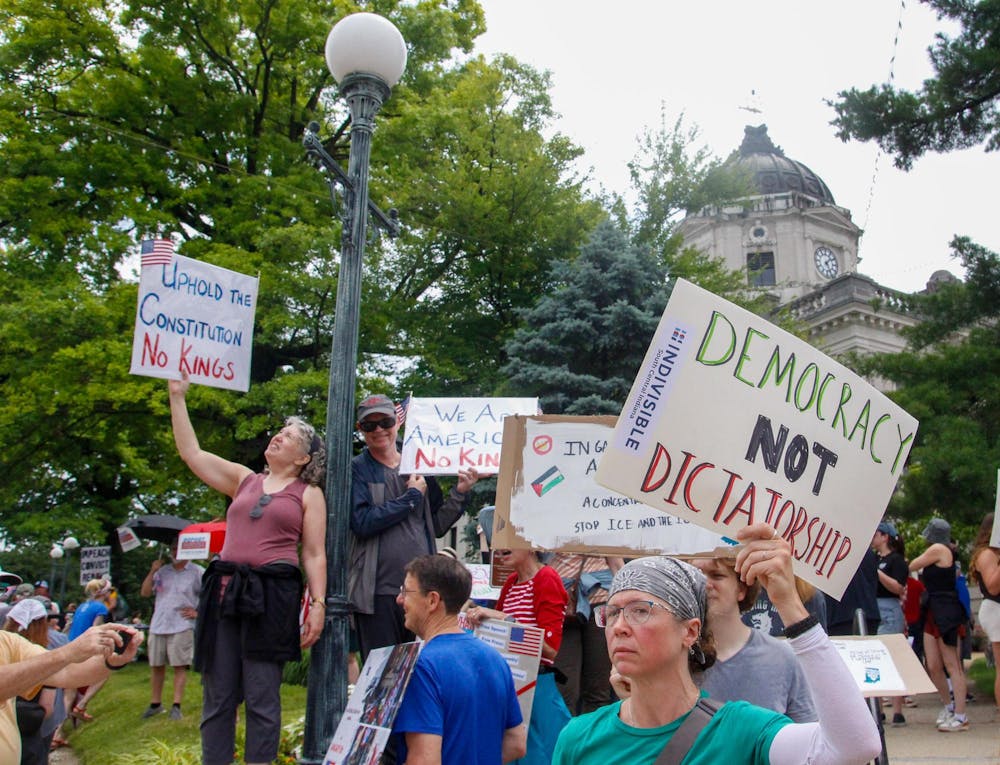
In June, Bloomington joined more than 1,500 cities that hosted their own “No Kings” demonstrations. These echoed the goals of other Trump administration-opposing protests this year.
In September, 50501 returned for another protest against Trump at the courthouse. Demonstrators marched down Kirkwood Avenue and past a protest held by the Indiana Graduate Workers Coalition. The IGWC hosted a union card signing event, while 50501 protesters collected diaper and formula donations.
The next month, No Kings resurged in the city, drawing an estimated 1,300 protesters. The protest was organized by 50501 and various Bloomington advocacy and non-profit groups. The movement’s goal is “uniting people across this country to fight dictatorship together.”
The IDS fight for print editions
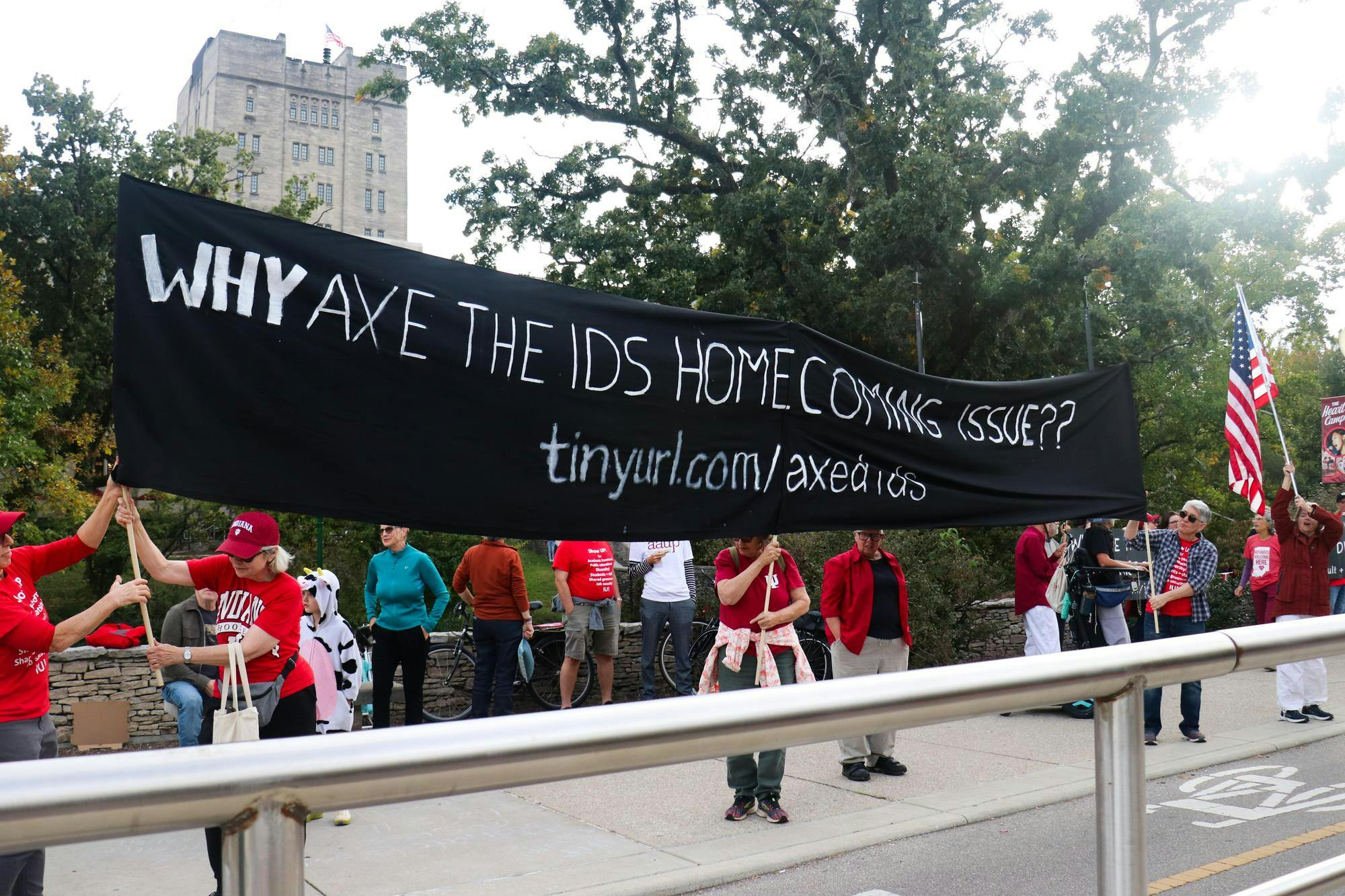
On Oct. 14, Media School Dean David Tolchinsky fired Director of Student Media Jim Rodenbush after he refused to direct the IDS to print no news in the Oct. 16 paper and only include information about homecoming.
In a letter, IDS co-editors-in-chief Mia Hilkowitz and Andrew Miller said the directive defied editorial independence and IU’s Student Media Charter, calling it censorship.
Five days after refusing the directive, Rodenbush received a termination letter. In response, Rodenbush filed a lawsuit against IU, alleging his termination violated the First and Fourteenth Amendments and section nine of the Indiana Constitution.
On Oct. 15, the university cut IDS print editions entirely. Another letter from the editors raised concerns about the future of the IDS' existence if attacks on distribution continued to be framed as budgetary decisions.
The situation attracted national attention. The Student Press Law Center, AAUP, current and retired IU faculty, advocacy organizations, alumni and press associations, among others, decried the print cut.
On Oct. 30, IU backtracked on its decision to cut the print edition. IU Bloomington Chancellor David Reingold sent the IDS editors a letter saying he had given the IDS control over their budget through June 30, 2026, meaning the IDS could continue to print.
The IDS returned to newsstands Nov. 20.
To develop recommendations on IDS editorial and business operations, Tolchinsky created a Task Force on Editorial Independence and Sustainability of the IDS, IU Student Television and WIUX. The task force will deliver recommendations for IU student media in the Spring 2026 semester.
Senate Enrolled Act 202 prompts IU professor investigations

IU professor Benjamin Robinson stands between protesters and a line of police officers armed with riot gear April 25, 2024, in Dunn Meadow in Bloomington. Robinson was investigated for violating intellectual diversity this year.
SEA 202 first took effect July 2024 and mandated a student and employee complaint process be established at universities for faculty who allegedly aren’t upholding free speech and intellectual diversity.
In April 2025, IU Germanic Studies Professor Benjamin Robinson was reported under investigation for violating the latter requirement following a student complaint made in October 2024.
The initial complaint, made through a Bias Incident Report, focused on the professor’s criticisms of IU and Israel.
In early November, IU School of Social Work lecturer Jessica Adams was removed from teaching her class, Diversity, Human Rights and Social Justice, after a student made a complaint to Republican Sen. Jim Banks’ office about a lesson that mentioned white supremacy.
Adams showed the class a graphic displaying a pyramid of white supremacy. She has refuted arguments made by School of Social Work Dean Kalea Benner that she was teaching lessons not based on evidence or widely used.
One of the pyramid’s layers listed phrases including “Make America Great Again” and "Columbus Day” as types of white supremacy.
Adams said the student’s initial complaint said she “verbalized and said that ‘Make America Great Again’ is worse than police violence, and that celebrating Columbus Day is racist and socially unacceptable.”
At an AAUP press conference, Adams said the lesson was used by the National Equity Project and the National Education Association.
On Dec. 5, Adams announced at an AAUP protest she had returned to her classroom the week before, however under the surveillance of school administrators. Adams also said she had been found guilty of violating SEA 202 and would be appealing the verdict.
Organizations on disciplinary status
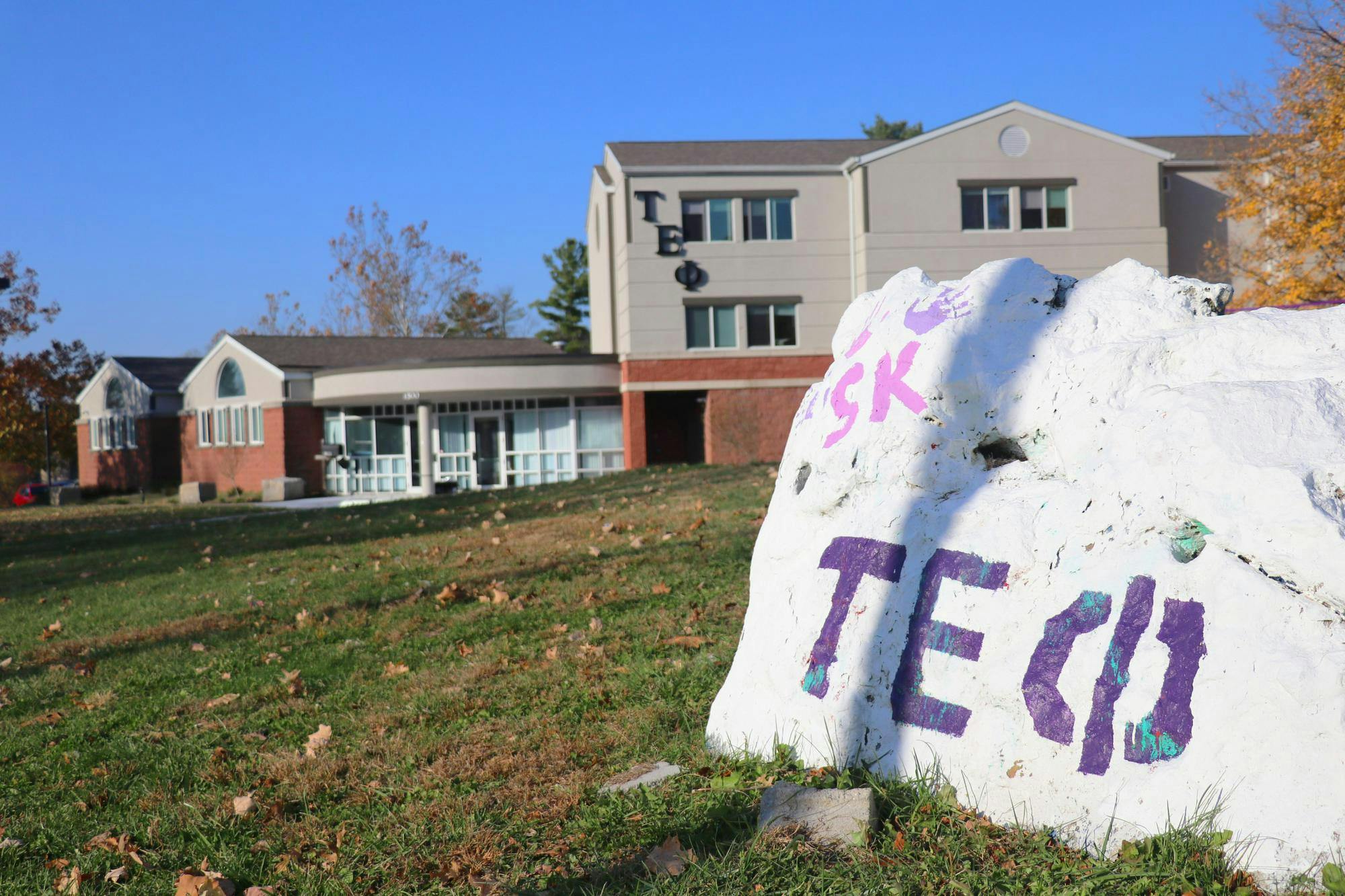
The Tau Epsilon Phi house sits Nov. 14, 2025, on David Baker Avenue in Bloomington. IU suspended all fraternity activities in November.
During the Spring 2025 semester, 18 organizations faced disciplinary statuses. Eleven were for hazing. The next four most common violations were alcohol, endangering others, not complying with IU or Office of Sorority and Fraternity Life directives and sexual harassment.
Over the summer, the Palestine Solidarity Committee was placed on cease and desist until further notice for disorderly conduct.
The IU chapter of Sigma Chi fraternity was suspended for dishonest conduct, endangering others, hazing and physical abuse.
During the Fall 2025 semester so far, five fraternities have been placed on cease and desist, all involving hazing.
Mid-November, the IU Office of Student Life barred 27 fraternities from hosting social events due to misconduct allegations. At the end of the month, IU notified the fraternities “in good standing” with the university that they could resume activities beginning Dec. 1.
Redistricting proposals advance
On Oct. 27, Braun announced state legislators would be called to attend a special session Nov. 3 to redistrict Indiana’s congressional map. This process, which typically follows the U.S. Census’ release every 10 years, redraws electoral district boundaries.
Trump has encouraged Indiana to redraw the maps mid-decade to cinch Republican control in the U.S. House. Indiana legislation was set to begin its regular session Dec. 1 in response to Braun’s call.
However, Senate Pro Tempore Rodric Bray announced Nov. 14 the Senate would not reconvene in December, a month early, due to insufficient votes to move the idea forward. On Nov. 25, Bray announced his chamber would convene Dec. 8, despite earlier statements.
On Dec. 2, Indiana House Republicans announced a proposed map for the redrawn districts. The map, if approved, would split Marion County into four districts and eliminate the 7th Congressional District, a position currently held by Democratic Rep. André Carson.
Rep. Matt Pierce, D-Bloomington, said the redrawn map “completely dilutes the voting power of African American voters within Marion County.”
The Indiana House passed the redistricting bill 57-41 Friday. The Senate is set to meet Monday to decide on the proposal.


