
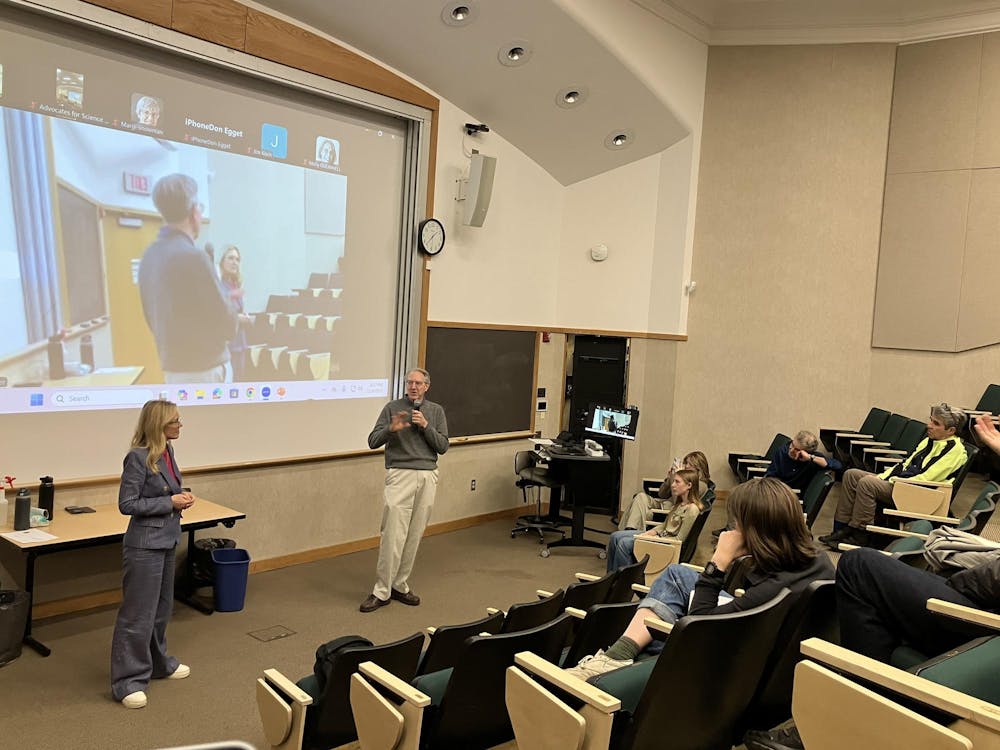
Democrats Sen. Shelli Yoder and Rep. Matt Pierce, who both represent Bloomington in the state legislature, discussed legislative impacts on IU, redistricting and cuts to scientific research at a town hall Wednesday evening.
Concerned Scientists at IU and Advocates for Science at IU organized the town hall, hosted at Myers Hall. These partner organizations write, advocate and educate about scientific advancement at IU and beyond. Co-President Emma Broach helped restart Advocates for Science at IU in January following major budget cuts to scientific research.
“The U.S. has always been known for scientific progress and being super strong in research,” Broach said. “We have so many opportunities. And it's important that we preserve that.”
As Yoder and Pierce discussed current scientific legislation, they highlighted the Indiana Commission for Higher Education’s cuts and consolidations of degree programs. The Commission mandated Indiana public universities cut all bachelor’s degrees with less than 15 graduates a year and graduate programs with less than seven graduates per year.
“This isn't belt tightening,” Yoder said. “This is gutting the heart of research discovery and creativity in our state. These aren't just course catalogs being trimmed. These are career pipelines being severed, faculty being pushed out, future scientists and public servants being told your work doesn't matter.”
IU reported June 30 it would cut or consolidate 249 programs across its campuses.
“When we underfund, undermine and undercut, we're not just hurting IU,” Yoder said. “We're not just hurting Indiana. We're hurting the world, because we cannot lead in agriculture or technology or medicine or respond to the next pandemic, flood or heat wave without institutions like this one.”
Beyond cuts to education, Pierce alleged a lack of respect for scientific facts within the Indiana legislature. He said that during floor debates, “oftentimes the weakest argument you can make are scientific arguments.”
Pierce and Yoder also addressed the recent special session called by Gov. Mike Braun centered around redistricting the state.
Typically, states redistrict every 10 years following the U.S. census, putting Indiana on track to redistrict in 2030. President Trump’s administration put pressure on the Indiana legislature to re-draw district lines early, prompting Braun to call a special session. So far, Republicans are unsure if they will have the votes to approve the re-districting.
Currently 7 out of 9 representatives from Indiana are Republican, where about a quarter of registered voters are Democrats. Indiana lawmakers are concerned that redistricting could be used to secure more House seats for the Republican party.
“This is not how Hoosiers behave,” Pierce said. “You don't rig the game. You go out, you compete, and you do your best, and you see what happens.”
Answering Braun’s call for a special session, Indiana legislation will begin their regular session Dec. 1, a month early.
Both Pierce and Yoder advocated for young people to use their voices and reach out to their legislators if they want to change local policy.
“Indiana can be a place where smart policy meets more courage, but only if we build it,” Yoder said. “So, here's what I need from each of you: We need to continue to speak clearly and speak early.”


