
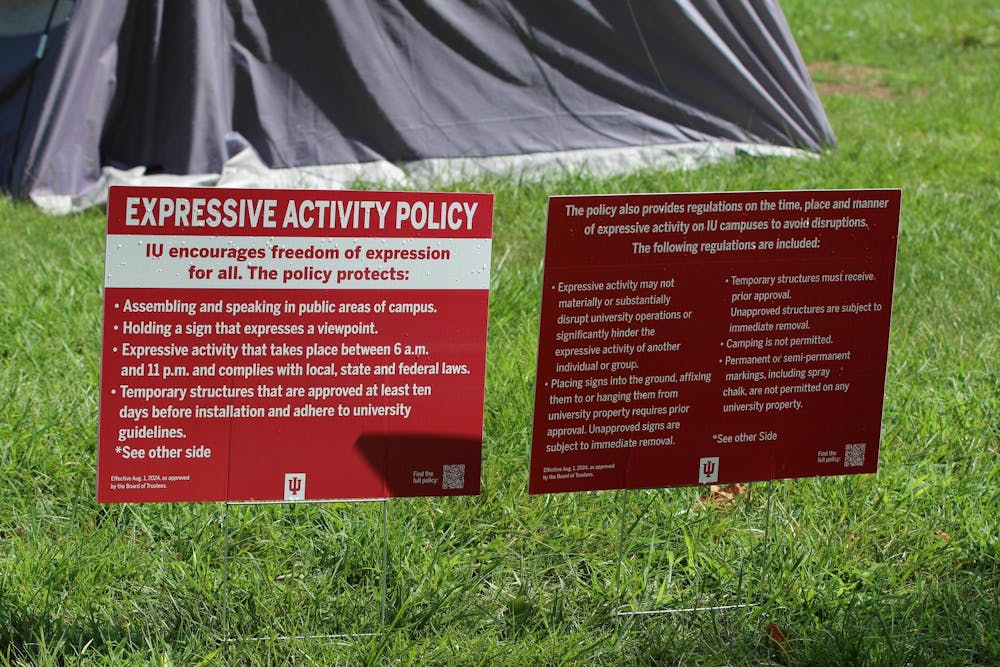
IU will be temporarily prohibited from enforcing part of its expressive activity policy after a Southern District Court of Indiana judge granted a preliminary injunction.
In the decision, the court concluded that the policy likely violated the First Amendment.
The decision was filed on Thursday by Richard Young for the plaintiffs in the ACLU of Indiana’s August 2024 lawsuit against the Trustees of Indiana University. The lawsuit was filed on behalf of 10 plaintiffs, including IU students, faculty, staff and a Bloomington resident.
The lawsuit alleged that IU’s expressive activity policy was overbroad and violated the First Amendment by prohibiting unapproved expressive activity during certain hours.
The preliminary injunction will block enforcement of the expressive activity policy “only to the extent it prohibits protesting, making speeches, circulating petitions, and all other unapproved conduct and activities otherwise prohibited on University property without prior permission and between the hours of 11:00 p.m. and 6:00 a.m.” The policy limitation will be in place as long as the case is ongoing.
“The Policy is likely not narrowly tailored to serve the University’s interest in public safety because it requires permits for small groups,” court documents read. “The University’s interest in public safety is not likely to be implicated by a protest involving two people.”
The injunction does not block IU from enforcing other parts of the policy, such as prohibiting unapproved camping and the temporary installation of structures and marking or signage on university property. The policy was initially put in place in August 2024 following the pro-Palestine encampment on Dunn Meadow last spring.
IU spokesperson Mark Bode told the IDS that IU does not comment on pending litigation.
Editor's note: This story was updated to reflect that the preliminary injunction may not be permanently enforced depending on the result of the case.


