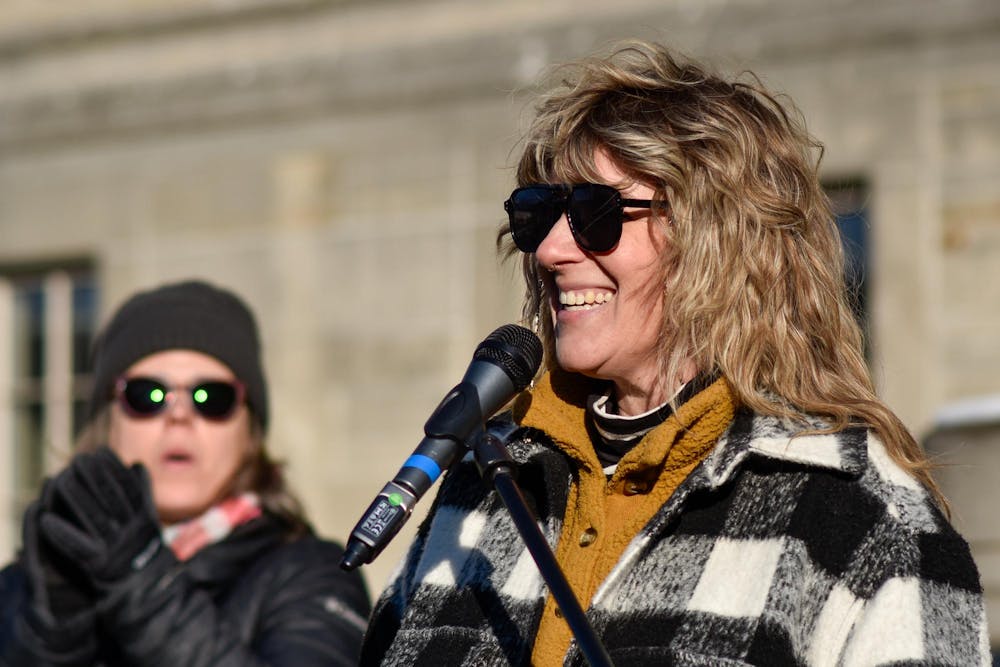
IU School of Social Work lecturer Jessica Adams announced during a protest Friday she returned to her classroom last week. However, she said her classes are being monitored by administrators within the school and that she was found guilty of violating Senate Enrolled Act 202.
Adams shared the news during a protest hosted by the Indiana University Bloomington chapter of the American Association of University Professors. Speakers at the rally said the goal of the protest was to call attention to academic freedom, free speech and “government over-reach,” principles originally outlined in a statement posted to the group’s website Dec. 3.
Senate Enrolled Act 202 is an Indiana law that allows students to report professors who they believe aren’t fostering intellectual diversity, free inquiry and expression. Adams was removed from teaching her Diversity, Human Rights and Social Justice class in late September after a student filed an intellectual diversity complaint following a lesson that included a pyramid graphic listing overt and covert forms of white supremacy. The graphic included Columbus Day and the “Make America Great Again” slogan.
Upon her return to the classroom, Adams said all her classes have been monitored by the School of Social Work’s master’s program director and bachelor’s program director, which she told the crowd was “upsetting" and “humiliating.”
Adams said during the protest that after the investigation following her removal, she had been found guilty of violating SEA 202. She said she plans to appeal the verdict as she believes she was teaching within her rights. She also said she felt her freedom of speech and academic freedom were infringed upon.
“New ideas challenge existing ideas, have difficult discussions around those ideas,” Adams said during the protest. “And this piece of legislation that is supposed to encourage free inquiry essentially collapses and shut down the opportunity for inquiry within my classroom.”
In an interview, Adams said she had an honest conversation about the investigation and the sanction that followed with her students.
“The students seemed very happy to have me back,” Adams said, “but also were really, really upset and disappointed with how their semester had played out having their instructor removed for six weeks.”
David McDonald, professor of folklore and ethnomusicology and president of the IU Bloomington AAUP chapter, started the protest by reading the statement from the chapter’s executive committee.
The statement called on IU Bloomington Chancellor David Reingold and President Pamela Whitten to show evidence they intend to support the Chicago Principles, a set of values centered around freedom of expression. In an undated memo, Whitten asked the University Faculty Council to review the Chicago Principles and make a recommendation on whether the university should adopt the standards.
“This review offers an opportunity to affirm, in a clear and enduring way, Indiana University’s commitment to freedom of thought and expression — the foundation of our excellence in teaching, research, creativity, and service,” Whitten said in the memorandum.
To show its support for the Chicago Principles, the AAUP asked the administration to reverse actions that “violated academic freedom and institutional neutrality,” including removing the sanction on IU professor Benjamin Robinson.
Robinson was investigated following an intellectual diversity complaint that alleged he violated SEA 202 in October 2024. An anonymous bias incident report alleged Robinson spoke of his own arrest in the Dunn Meadow encampment in 2024 after which Robinson was temporarily banned from campus.
The AAUP statement also asked the university to recede the sanction of Adams.
House Enrolled Act 1001 allowed Gov. Mike Braun to remove alumni-elected members of IU’s Board of Trustees and also required faculty to undergo annual productivity reviews. It also requires universities to drop or consolidate degree programs that don’t meet minimum graduation thresholds.
The IUB AAUP statement also called upon the IU administration to challenge more recent changes to degree program proposals.
The Indiana Commission for Higher Education’s Academic Degree Program Application Packet, part of the degree proposal form universities must submit to add a program, asks about how the proposed program would reflect “the core values of American society” and “civic responsibility.” The application also asks if the new degree includes curriculum that “emphasize civic engagement and the duties of citizenship in a free society.”
The IUB AAUP says evaluating degree programs based on their civic responsibility and contribution to American core values allows for "ideological gatekeeping”.
McDonald said IU administration should work with the IUB AAUP in defending academic freedom.
“We must act together to protect not only our own academic freedom, but the intellectual vitality of this university for all the students, scholars, and workers who we are in community with—including those who come after us,” McDonald read aloud from the statement.
Deborah Cohn, an IU faculty member in the department of Spanish and Portuguese, spoke next, reading parts of a letter she recently wrote to the ICHE. The letter raised flags about new degree requirements and questioned the selection of degrees that displayed “core American values.”
“What counts as core values of American society is a fraught and subjective topic,” Cohn said. “Since the founding of the U.S., presumptive ideas of American values have been used to exclude different racial, ethnic, gender, national, religious and other groups from numerous educational, professional, social and other opportunities.”
Cohn urged the ICHE to reply with transparency on its definition of “American values.” She said she hopes for a response but “wouldn’t hold her breath.”
Monroe County NAACP President Jim Sims also talked during the protest about redistricting at the state level, although he said he understands and stands with those fighting for academic freedom at IU. Sims urged onlookers to vote and contact their representatives about redistricting, saying he hopes redistricting does not happen before the 2026 midterms and calling it “one of the most blatant acts of racism” he had seen in his life.
Sims also highlighted the value of speaking out, saying the U.S. Constitution allows for the right to remain silent, but “to remain silent is not right.”