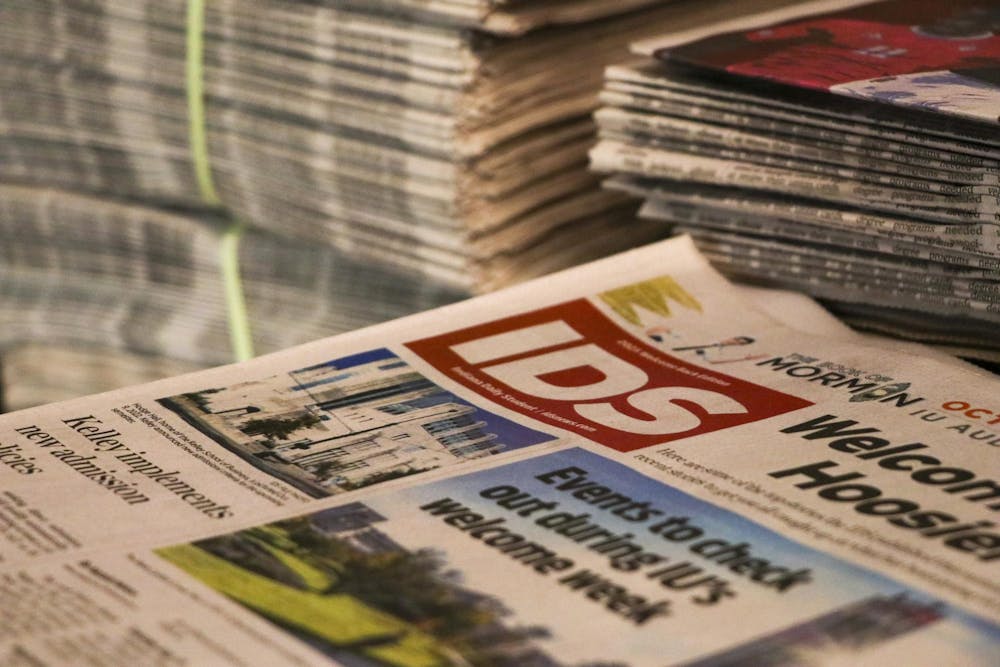
Indiana University has backtracked on its decision to cut future Indiana Daily Student print editions for the rest of the school year. The university has also abandoned its initial illegal directive prohibiting the IDS from printing news.
Our next issue will print Nov. 20.
In a letter to IDS editors Thursday, IU Bloomington Chancellor David Reingold wrote he had “authorized the financial office to allow the IDS, under the supervision of The Media School, to use their established budget through June 30, 2026, as the editors see fit—so long as they remain true to their budgetary parameters.”
A Media School administrator confirmed this means the IDS can continue printing its originally planned editions for the rest of the school year. And we will.
This decision was the correct call, and we’re glad it’s been made. After weeks of negative publicity for the university, of fears in our newsroom and on campus, of confusion, of pushback, we’re now on a solid trajectory toward real solutions for student media.
We’re also grateful Reingold took a first step toward acknowledging the harm his decision caused. But he stopped short of a full apology to the students and faculty whose lives he’s disrupted.
“I recognize and accept that the campus has not handled recent decisions as well as we should have,” he wrote.
We want to make it clear that this is a win for the IDS and for student media across the country.
But we do intend to keep Reingold and other administrators to their word. Thus far, that’s been hard to trust. If IU fired former student media director Jim Rodenbush for supposed poor leadership, what does that mean for the poor leadership of “the campus” in a situation that has likely cost the university millions?
In his letter, Reingold said he wanted to reaffirm his commitment to ensuring “IDS leaders will have a seat at the table as we develop a plan for future operations.” But so far, we’ve seen no action from him or other campus administrators to engage with us.
We’ve requested meetings with both Reingold and IUB Provost Rahul Shrivastav, but they haven’t responded to us. Approached face-to-face, both still skirted questions about their original directive to cut print and prohibit the printing of news, and many other important questions.
We had no consultation in creating The Media School’s committee on editorial independence and financial sustainability. We’re happy student media’s model is rightfully being re-evaluated, but these are the kinds of actions student leaders need to be more involved in — not informed of after the fact.
Additionally, we want a firm commitment from IU and The Media School that they will abide by the recommendations and findings of this committee, unlike their response to the past committee given the same task.
A committee of students, faculty, staff and alumni submitted new recommendations for restructuring student media in spring 2024. Many of that report's recommendations have not been followed up on. We don’t intend for this to happen again.
Reingold’s vague commitments to “mutual respect” and “shared responsibility” mean nothing if these voices are ignored. A letter from Media School faculty published Wednesday said “IU is not seen as a safe place for free and open expression.” Restoring print is a step toward fixing that, but we need more commitments and more action.
Worryingly, the university is still denying wrongdoing in its original directive. Reingold claims the university has “never attempted to censor editorial content, period” — ignoring the clear and deliberate instructions we received to stop printing any news. This is, by definition, censoring editorial content.
The letter sent directly to him by our attorney at the Reporters Committee for Freedom of the Press puts it more straightforward: “Even if IU were somehow driven by financial concerns, that would not entitle administrators to control the IDS’s journalistic decisions. Telling student journalists what they can and cannot include in a newspaper is censorship of ‘editorial content’ by any definition.”
Most important is the question: why publish a separate letter to the IDS, instead of actually meeting with us and our legal counsel? Again, again, again, we need to be involved.
And further: if it was such an important business decision to cut print two days before we were set to publish, why reverse course now?
This is a win for student journalism, for editorial independence and our fight to bring quality journalism to our community — but more is needed. We look forward to being at the table and taking more steps in the right direction.