
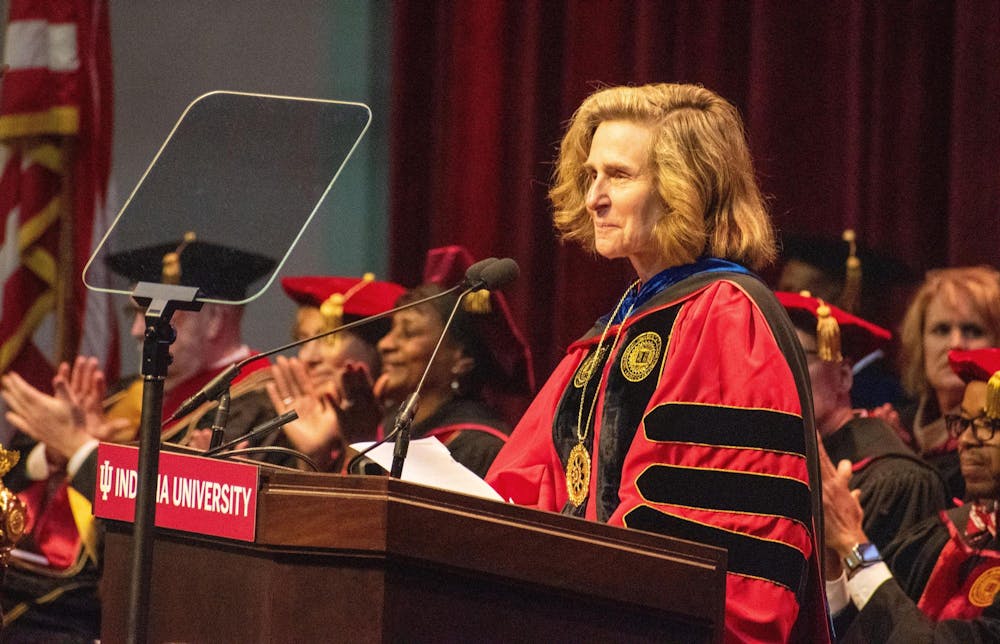
It’s been more than a year since IU commissioned an independent review of plagiarism allegations in IU President Pamela Whitten’s dissertation, and it has released no further details on what the report found.
Despite the Indiana Daily Student’s numerous attempts to learn more about this review and its results — including through public records requests and reaching out directly to IU — the university has released nothing.
But David Hormuth, chair of the IU Board of Trustees, said in a statement to the IDS “no further action will be taken” to investigate or release more information about Whitten’s plagiarism allegations.
“We stand firmly behind the President and her vision, and our priority remains focused on moving the university forward to serve our students and state,” he said in the statement.
Legal experts interviewed by the IDS said there is no legal mandate keeping IU from releasing the review and its findings.
“I would argue that clearing the name of your president with a report that says that the allegations were meritless, logic would lead me to recommend that they release it so that everybody can see that the allegations were meritless and there was nothing to it,” said Stephen Key, former executive director and general counsel for the Hoosier State Press Association.
“So why? Why keep it secret if it’s exonerating the president?”
In January, the Chronicle for Higher Education reported on alleged instances of plagiarism in Whitten’s 1996 dissertation, though experts disagreed about whether these instances constituted plagiarism.
An IU spokesperson told the Chronicle it had hired an independent law firm to review the claims in August 2024 but that the firm found the allegations meritless. IU did not identify the law firm or explain why IU asked for an investigation, and a spokesperson did not respond to the IDS’ request for clarification in January.
In response to the IDS’ most recent request for more information and comments, an IU spokesperson referred to a statement provided previously to the Chronicle in January, which stated the Chronicle’s reporting “recycles assertions" from the independent review. The IDS reached out with 14 questions about the independent review, including asking how much IU spent on the contract with the law firm and whom the review results were shared with.
“These allegations are part of a continued effort to oppose the transformational leadership the IU Board of Trustees have charged the President and her team to pursue,” the statement continued.
In August, the Herald-Times reported on new evidence of potential plagiarism in the dissertation, including what appeared to be an 85-word section lifted from a Minnesota Medicine article almost word-for-word.
Following the report, Indiana Gov. Mike Braun told reporters the IU Board of Trustees should “do the right thing” if the allegations were true. Axios reported days later that Braun had met with Whitten and conversations surrounding the plagiarism allegations came up “very briefly.”
“She acted like that was not an issue and that it was something probably being trumped up by people that were against her for other reasons,” Axios reported Braun told reporters.
A representative for Braun did not respond to questions seeking to clarify the governor’s statements and meeting with Whitten by time of publication.
Since the Chronicle's initial report in January, IU has not released further information on the investigation, including the name of the firm it paid for the review. IU and the Board Trustees had also not issued any other public statements about the allegations — until Hormuth’s statement Wednesday. The university also declined to release the report in response to a public records request from the IDS.
In the Feb. 27 denial, assistant general counsel Taylor Struble described the report as “advisory and deliberative” and subject to attorney-client and attorney-work product privilege.
The IDS requested an invoice for the independent review, and IU general counsel acknowledged the request Aug. 19 but has not yet denied or fulfilled it. Indiana does not have a specific timeframe for when public agencies must produce public records just that it should be within a “reasonable timeframe.”
Stephen Key, former executive director and general counsel for the Hoosier State Press Association, said there are two types of exceptions public entities can use to deny records requests: those that are mandatory and those up to the entity’s discretion. The attorney-client or attorney-work privilege and advisory or deliberative exceptions are the latter.
“In both of (the provisions), it’s purely at the discretion of IU,” Key said. “And there’s nothing that’s preventing IU from releasing this other than their decision not to.”
The Indiana statute Struble cited in the denial allows public agencies to decide if they will release “deliberative material" that are “expressions of opinion or are of a speculative nature, and that are communicated for the purpose of decision making.”
“I would like to have more information about what they mean by deliberative process,” Anthony Fargo, founding director for IU’s Center for International Media Law and Policy Studies, said. “What is the deliberation that is taking place exactly?”
Struble cited Indiana code that gives IU the discretion to release attorney’s “work product.” She also cited code that states records “declared confidential by state statute” cannot be disclosed but did not provide the statute that would clarify why the review is confidential.
Fargo said attorney-client privilege still protects clients, like IU, that are public entities and “usually have some obligations to release information to the public” under state and federal information access laws. This exception allows clients to speak with attorneys without the fear that it will be reported to the authorities, he said.
Key also said IU’s attorney-client privilege is a “very legitimate exception.” This type of exception can protect IU in cases of lawsuits, such as keeping the opposition from requesting records that reveal the university’s strategy for a case. It can also safeguard IU employees or subcontractors, he said.
“(Someone could say) ‘I don’t want to say anything bad about the president if I know it’s going to be public and the president hires me or fires me,” he said. “So, there are reasons why they have these exceptions.”
In the past two years, IU has released other independent reviews that it could have used its discretion to withhold. In July 2024, IU released an independent review of the university’s response to the pro-Palestinian encampment in Dunn Meadow, during which 57 protesters were arrested. Earlier this year, it shared the results of an independent investigation into allegations of sexual misconduct against former Indiana men’s basketball team physician Brad Bomba Sr.
Key said public officials have many reasons why they don’t want to release specific records.
“Sometimes it’s a matter of ignorance of the law,” he said. “There are other times where it’s in their self-interest that they don’t really, you know, that they’re afraid that they’ll be embarrassed by the public knowing what was in a particular document.”
Jack Forrest contributed to this reporting.


