
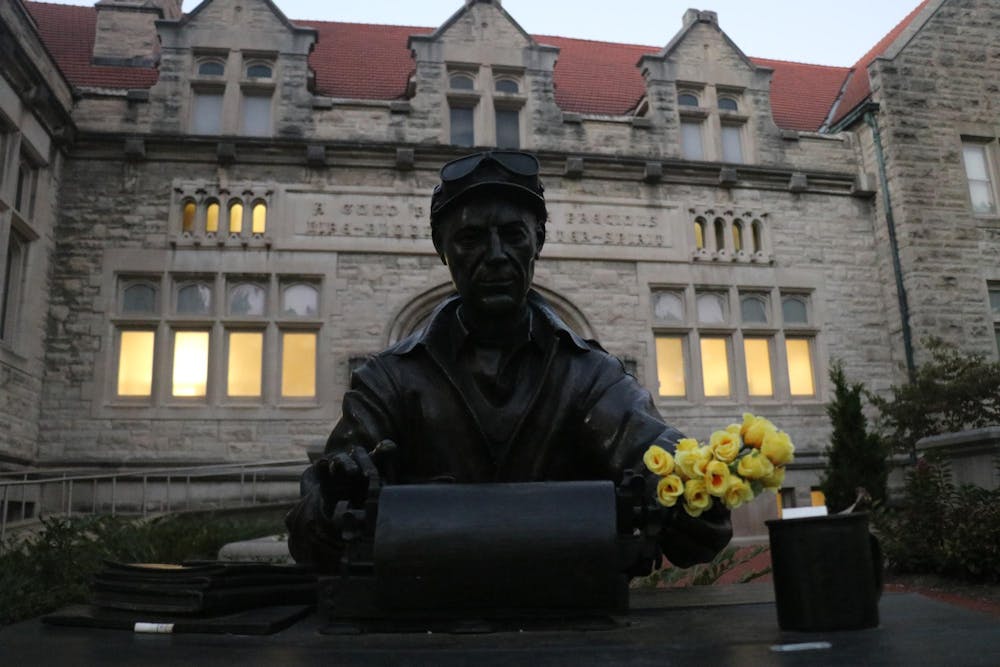
Media School Dean David Tolchinsky terminated Director of Student Media Jim Rodenbush on Tuesday afternoon after he refused to censor the Indiana Daily Student.
Ahead of our Oct. 16 newspaper, which was to include a Homecoming guide inside, the Media School directed us to print no news in the paper, an order blatantly in defiance of our editorial independence and the Student Media Charter.
“... nothing but information about homecoming — no other news at all, and particularly no traditional front page news coverage,” read Rodenbush's Oct. 7 email to the IDS co-editors-in-chief, relaying the IU Media School’s directive.
Telling us what we can and cannot print is unlawful censorship, established by legal precedent surrounding speech law on public college campuses.
Administrators ignored Rodenbush, who said he would not tell us what to print or not print in our paper. In a meeting Sept. 25 with administrators, he said doing so would be censorship.
“How do we frame that, you know, in a way that's not seen as censorship?” Ron McFall, assistant dean of strategy and administration at the Media School, asked in that meeting.
In fact, Rodenbush took his concerns directly to the dean. Someone who oversees the instruction of journalism and should have a comprehensive understanding of censorship.
“Any type of attempt on my end to censor or manipulate any content from a student media outlet is literally against the law,” Rodenbush said during their Oct. 9 meeting. “This is First Amendment stuff.”
We emailed several Media School administrators Monday, asking them for more clarity behind the order and requesting they rescind their directive.
Instead of a clear response, they fired a faculty member.
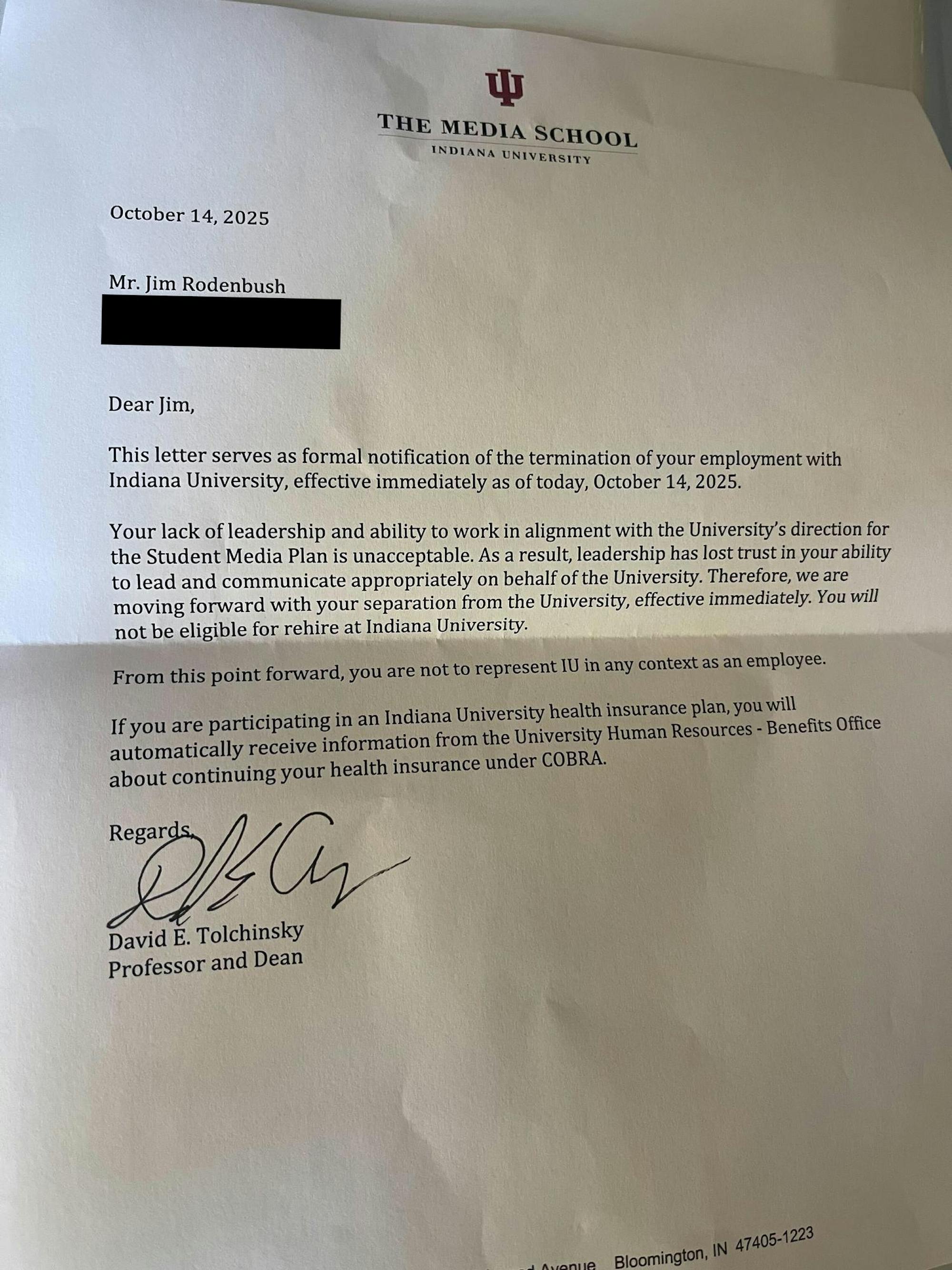
Jim Rodenbush's termination letter is pictured Oct. 14, 2025.
On Tuesday afternoon, they terminated Rodenbush, effective immediately. “Your lack of leadership and ability to work in alignment with the University’s direction for the Student Media Plan is unacceptable,” the termination letter read.
However, other student media leaders whom Rodenbush oversaw decried his termination.
"IUSTV is incredibly worried about the Media School’s decision to terminate staff member Jim Rodenbush. Jim has been nothing but an informative teacher to IUSTV and our members in his capacity as our advisor. Additionally, the context of the termination surrounding the censorship of the IDS gives our organization pause about the future of our publishing capabilities, along with the possible threat of prior review from the Media School and 1st amendment infringements. To lose a valued staff member under the reasoning given is illogical and provides cause for concern as to the future of free expression in student media at The Media School," Indiana University Student Television leadership said in a statement.
"WIUX stands firmly against any form of censorship. The termination of Jim Rodenbush for refusing to compromise journalistic integrity is deeply troubling, and WIUX stands in solidarity with him and the Indiana Daily Student. The Media School’s leadership risks setting a dangerous precedent that threatens the freedom of student voices," said WIUX student radio leadership.
To be clear, the types of stories that run on any of the IDS’ platforms — from our print edition to our website and social media feeds — are at the sole discretion of the editors-in-chief. The IDS has an over 158-year-long history of strong editorial independence, a principle outlined clearly in our Student Media Charter, available for any administrator or member of the public to view. It’s this editorial independence that has allowed us to hold university administrators and those in power across the state to account.
IU and the Media School’s history of supporting our independence is part of why its journalism program was so well-respected for decades. But now, despite this history — and in defiance of decades of court cases protecting student journalists’ editorial independence — IU’s directive to stop printing news is “an expectation, not a suggestion,” according to the order relayed by Rodenbush.
This blatant misunderstanding or disregard of what constitutes “content” and “editorial independence” — foundational concepts students learn during the journalism program’s required media law course — is cause for alarm.
IU will attempt to frame this censorship as a step toward a balanced budget. The IDS, along with the Student Press Law Center and Reporters Committee for Freedom of the Press, see it very differently.
“The Media School’s order limiting the Indiana Daily Student’s print edition to homecoming coverage isn’t a ‘business decision’ — it’s censorship,” the Student Press Law Center said in a statement to the IDS. “This disregards strong First Amendment protections and a long-standing tradition of student editorial independence at Indiana University.”
If administrators disregard our rights as student journalists now, what will stop them from prohibiting the IDS from publishing certain stories on our website and social media, should they deem it appropriate?
Even if administrators choose to interpret this as a business decision, the university is proving itself an irrational actor. Special edition stories don’t drive you to pick up the paper — good journalism does. We could not fill enough pages with engaging, thought-provoking Homecoming stories to justify you picking up our paper.
The Media School, relayed via Rodenbush’s Oct. 7 email, gave the IDS a choice: “As an option, the IDS print edition may be distributed with news in the Bloomington community, but the IDS on campus should contain nothing but the designated special edition.” Never mind the additional costs printing two separate papers would bear. Never mind that this is still censorship.
We’ve heard no rational justification for how cutting news distribution specifically on campus will help our finances. Our three print editions thus far this semester have already generated nearly $11,000 in profit.
When the university frames violating our independence and censoring content to “help” us, we’re left with more questions: Why now?
And who is this supposed to benefit?
It’s not the IDS, which now risks having our future journalism censored. It’s not our reporters, editors, photographers and designers who will have the fear of censorship for doing the right thing looming over them. And it’s not you, our community, who will face another barrier to reading our journalism when it matters more than ever.
And the Student Press Law Center sees it even more clearly.
“If the abrupt ousting of the student media director was related to his refusal to participate in such censorship, the message is clear: IU no longer welcomes a free student press. The Media School must reverse course immediately, before more damage is done to its reputation and to its students’ rights.”


