
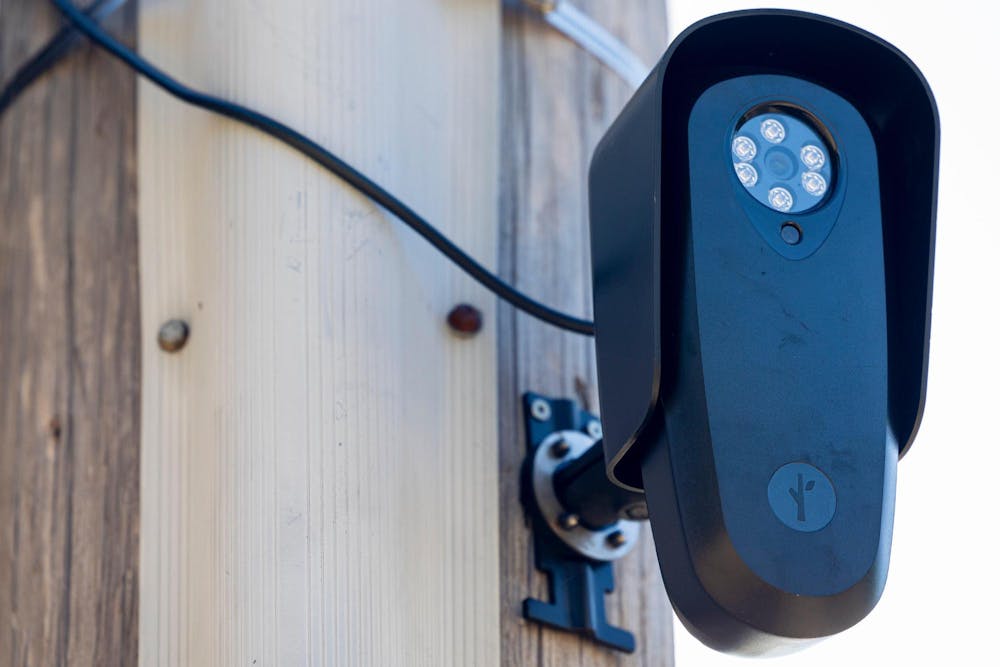
The Bloomington Police Department updated its policies for Flock Safety license plate reader data to prohibit departmental use or sharing of data for immigration and reproductive healthcare investigations.
BPD Flock policies, originally created in July 2025, were updated March 26 to officially prohibit data use for these situations, according to documents obtained by the B Square Bulletin.
In June 2025, a federal court ruling in Texas made it possible for states with abortion bans to issue subpoenas regarding reproductive healthcare obtained legally in a different state. Some lawmakers, such as State Rep. Carey Hamilton, D-Indianapolis, expressed concern that Indiana Attorney General Todd Rokita could use this ruling to prosecute people who travel to other states to receive an abortion prohibited under Indiana law.
Activists, protesters and public officials have called on the city to end its contract with Flock due to allegations from the American Civil Liberties Union and other organizations that the company’s camera data can be accessed by U.S. Immigration and Customs Enforcement or other federal agencies. Flock is involved in multiple ongoing lawsuits regarding privacy, including a recent federal ruling in Norfolk, Virginia.
Monroe County Sheriff Ruben Marté filed a lawsuit Wednesday against Rokita, the most recent in a series of lawsuits between the two parties over immigration detainment. The lawsuit argues that a state law signed by Gov. Mike Braun in March requiring law enforcement agencies to comply with ICE detainer requests is unconstitutional.
Bloomington Communications Director Desiree DeMolina said in an email BPD owns and operates 11 Flock cameras, but the number of cameras throughout the city could be higher due to Flock systems owned by Indiana University and the Monroe County Sheriff’s Office.
BPD’s policy change comes in the wake of 400 demonstrators protesting the city’s use of Flock cameras on Jan. 30 at City Hall.
DeMolina also wrote BPD’s new policy is part of city efforts that began in February to evaluate policies, use and oversight for Flock cameras.
“So far, that work includes explicitly codifying practices that were already in place—such as explicitly prohibiting searches related to reproductive healthcare and immigration status, and clarifying audit standards—so expectations are clear and enforceable,” DeMolina wrote.
At its March 5 meeting, the Bloomington City Council voted unanimously to pass a resolution calling for more oversight of city Flock cameras and specifically requested a report from BPD detailing which officers and agencies can access Flock data.
The city administration will send the council a written briefing of its findings from the report on Wednesday and will share a public report of its full findings on April 22. The city council will have a regular meeting at 6:30 p.m. April 22.


