
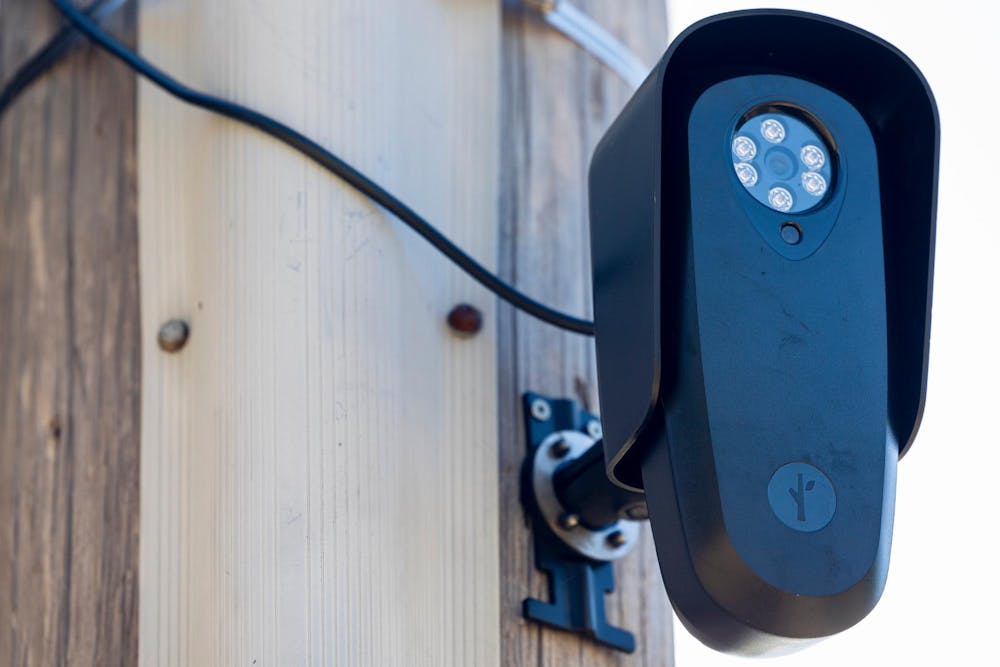
As tensions surrounding immigration enforcement around the country grow, activists and some elected officials are continuing to call for the City of Bloomington to end its contract with Flock Safety, which they allege is sharing license plate data with U.S. Immigration and Customs Enforcement and other federal agencies.
Last month, the city released an unredacted version of its $50,000 contract with the public safety technology company after months of requests, the B Square Bulletin first reported. Now the Bloomington City Council may consider a resolution to outline stricter regulations for surveillance technology in the city.
The release came shortly before about 400 demonstrators protested the city’s contract with Flock on Jan. 30 at City Hall, the same day as a “national shutdown” protest against ICE tactics, encouraging people not to go to school, work or to make purchases.
The ACLU reported in October 2025 that Flock was sharing data from its national license plate scanner network in Massachusetts with ICE. This includes cases where local departments restricted access to just their local officers.
“Having that information available, and especially in today's political climate, where the safeguards on civil liberties are falling swiftly, is problematic,” Bloomington City Councilmember Isabel Piedmont-Smith said. “And I don't want Bloomington to be able to facilitate the removal of people through lack of due process or trampling on their civil liberties.”
Bloomington’s released Flock contract
The unredacted contract was released Jan. 27, after multiple open records requests about Flock yielded heavily redacted versions. The contract released, worth $50,000, is for a mobile security trailer system.
According to Flock’s website, this system comes with two Condor pan tilt zoom cameras, a panoramic video camera, flashing deterrent lights, a two-way “talk down” speaker and access to Flock’s online platform and mobile app.
Bloomington has a total of 40 Flock cameras, according to a September 2025 document from the Pittsboro Police Department.
The document, obtained via a public records request from the Indiana town’s police department by David Maass, a surveillance technology investigative journalist and professor at the University of Nevada, Reno, contains a list of shared Flock safety devices across the country.
The released contract includes a section about footage disclosure that says “...Flock may access, use, preserve and/or disclose the Footage to law enforcement authorities, government officials, and/or third parties…” if it’s a legal requirement or if Flock believes it will detect, prevent or otherwise address issues of security or emergencies.
The contract was signed by the city’s corporation counsel — a member of the legal department — on Dec. 1, 2024.
City Council draft resolution
At the Bloomington City Council’s Feb. 18 meeting, Council President Isak Nti Asare introduced a draft resolution about Bloomington’s use of automatic license plate readers, or ALPRs.
In a letter to his colleagues, Asare acknowledged sharing draft legislation at meetings is unusual, but the goal was to get early engagement.
In this letter, Asare states one of the goals of the resolution is to acknowledge that ALPRs require stronger justification due to their location-linked information collecting.
The resolution would also request that the Bloomington Police Department share a report with the council about who has access to the camera data, and the program’s current rules around auditing and data sharing.
“The deeper issue is whether Bloomington has the institutional capacity to govern technologies that are increasingly common and will continue to be so,” Asare, who is also the co-director of IU’s Cybersecurity and Global Policy Program, wrote in the letter.
The resolution would also state the council’s intent to develop an ordinance outlining rules for the city surrounding surveillance technology and ALPRs, not just Flock cameras specifically.
Bloomington’s next steps
Bloomington Mayor Kerry Thomson first addressed public concerns over Flock data sharing at a virtual town hall Jan. 26. She said she would meet with Flock in February, and that her intentions were to ensure ICE and other law enforcement could not access Bloomington’s data.
The mayor, deputy mayor, chief of police and the city’s corporation counsel met with Flock representatives Feb. 16, Desiree DeMolina, communications director at the Office of the Mayor, said in an email to the Indiana Daily Student.
“We are doing due diligence and will not be rushing into a decision to retain or terminate Flock,” DeMolina wrote. “We will share our findings and any next steps once that evaluation is complete and we have meaningful information to communicate.”
In an open letter written Feb. 12, Piedmont-Smith urged Thomson to cancel the contract, citing the company’s unauthorized placements and failure to deactivate cameras in Cambridge, Massachusetts, and Evanston, Illinois.
Piedmont-Smith wrote that she communicated with an Evanston city councilmember about Evanston’s contract cancellation and the city’s cease and desist sent to Flock. She also wrote that it would be unwise for Bloomington to trust Flock to adhere to the contract restrictions given the company’s history.
“I think the best way forward at this point is to work with the administration to figure out a path forward that can enable our police officers to access whatever information they need to address criminal activity but not put residents at surveillance risk,” Councilmember Hopi Stosberg said in an email to the IDS.


