
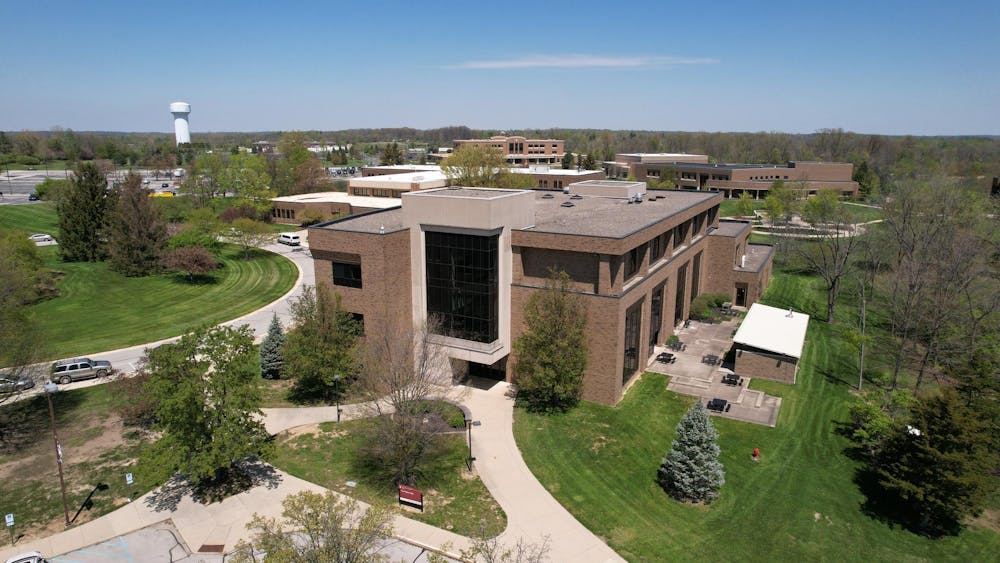
Indiana University East announced a new high school set to launch on its Richmond campus in August, placing teenagers as young as 14 alongside college students in what the university is calling a “college-immersive opportunity.”
The IU East high school, announced on April 24, was developed in partnership with the Indiana Microschool Collaborative, a tuition-free public charter school that helpscreate small-group schools across the state.
Operating out of Tom Raper Hall, the university hopes to enroll up to 60 students in their first year with 25 freshmen, 25 sophomores and 10 juniors. First round applications opened May 7 and closed May 15 before reopening shortly after, with a wait list for additional applicants now forming as enrollment continues through the summer.
IU East Associate Dean of Education Jamie Buffington-Adams, who served as launch facilitator for the program, said the idea originated when IMC CEO George Philhower approached IU East leadership last spring with a vision for a campus-based microschool.
“Campus leadership was just incredibly excited by the idea and by the vision that George laid out,” Buffington-Adams said.
In a statement to the Indiana Daily Student via email, Philhower said the partnership is rooted in a belief that students deserve more flexible and meaningful learning experiences.
“The vision for the school is to create a small high school environment where students can experience a blend of academic learning, college coursework, career-connected opportunities, and strong relationships with caring adults,” Philhower wrote. “Being located on a college campus creates opportunities for students to begin seeing themselves as college students, professionals and leaders much earlier.”
Buffington-Adams said the school is designed to go beyond traditional dual enrollment, an existing school model that allows students to take college courses for creditwhile still attending high school.
Here, students would spend their days on the IU East campus, taking a mix of high school and college-level classes taught by both high school and university instructors.
The curriculum is structured to ramp up over four years. Freshmen start with a few dual-enrollment courses and by junior year, students are expected to take three to four college credit courses per semester and can begin earning work-based learning hours, which connect students with local businesses or Career and Technical Student Organizations to build career skills and community ties.
Seniors carry the same course load and complete a year-long project with a faculty mentor or industry professional.
Through the school, students can earn the new Honors Plus Enrollment Seal, which pre-admits students to top Indiana colleges including IU, and the Honors Plus Employability Seal, which signals advanced workforce readiness.
Students can also earn digital badges to communicate soft skills that don’t show up on a traditional transcript, like communication and collaboration. Civics and AI fluency are also woven into the curriculum.
The school will not field sports teams and students cannot compete through other school districts. Limited arts programming, like choir, pep band, art, sculpting and computer science may be available through IU East.
Beyond that, Buffington-Adams said the extracurricular experience will largely follow students’ lead, from field trips to an on-campus archaeological dig site to prom.
“If we’ve got a group of students that are like, ‘we want to start a garage band,’ I guess we’re going to be starting a garage band,” Buffington-Adams said.
Lunch is provided, though vendors are not finalized. Students are responsible for their own transportation with the university offering to help connect families for carpooling.
The presence of high schoolers on a college campus has drawn some scrutiny online. Buffington-Adams said the concerns have come mostly from commenters, not from families of prospective students.
Buffington-Adams noted that freshmen and sophomores will be placed in “protected course sections,” taught by college professors but separate from traditional college students. IU Legal has also been involved in establishing safeguards for minors on campus.
By the time students are taking open college courses alongside adult students, Buffington-Adams said, they will be juniors — an age group IU East already sees on campus through existing dual-enrollment programs.
Jaxin Bohn, a 2026 IU East graduate, saw both sides. He noted that while parents on Facebook were enthusiastic, some students might have a different reaction, particularly around cost.
“We’re paying a lot of money to go there,” Bohn said. “If we have people who just graduated, who are 17 or 18, and then have people across the way getting free college classes on top of a free, really good public education, that might cause some disdain.”
IU East students also raised other concerns, according to Buffington-Adams, primarily around how the high school’s presence might affect campus clubs and student government.
Buffington-Adams said the school plans to run parallel student life structures, with its own student government and clubs, to keep the two populations mostly separate. Some shared spaces, like all-campus events, may bring students together.
Bohn said the program could be good overall, saying it makes more sense at a commuter school like IU East than it would on larger college campuses.
“It’s not a party school, there’s no fraternities, there’s no on-campus living,” Bohn said. “In a way, it kind of is like a public-school experience.”
He added that administrators have more work to do before classes begin in August, noting that students received little communication about the program and calling onthe university to be clearer about how the addition would affect day-to-day life.
Before school starts, the program plans to hold individual intake interviews with every enrolled family, sitting down to learn about each student’s academic history, strengths and goals. Families interested in enrolling can submit a family interest form through the IMC for more information.


