
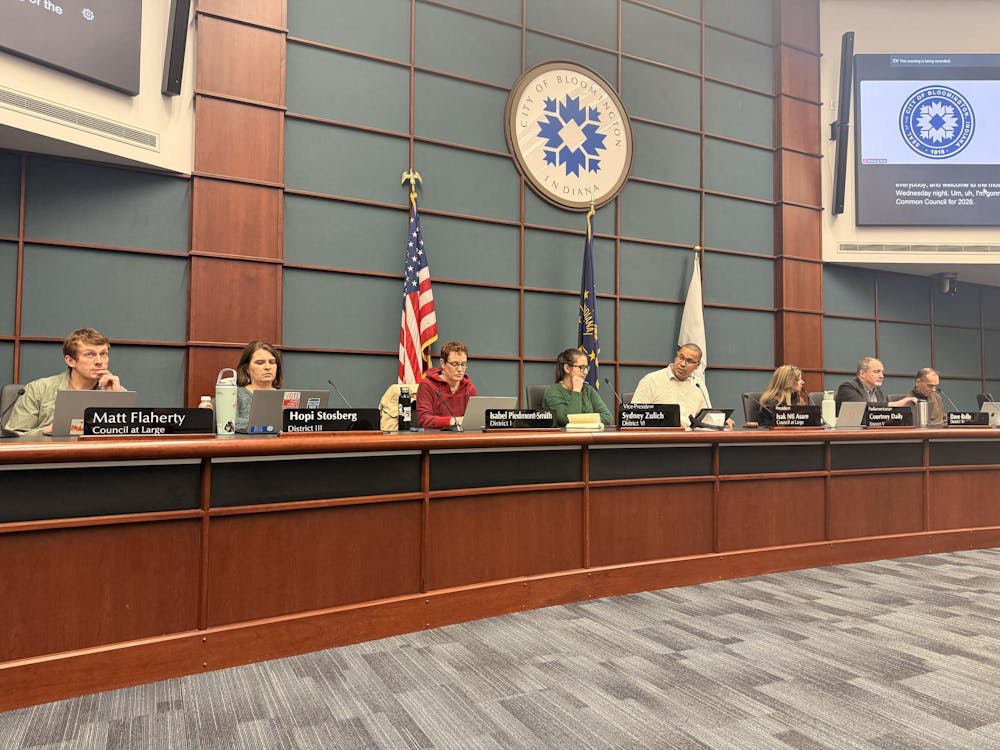
The Bloomington City Council unanimously passed a resolution calling for greater oversight of the city’s use of Flock cameras and delayed consideration of an affordable housing development Wednesday.
The roughly four-hour meeting drew up to 50 Bloomington residents to City Hall.
Bloomington has more than 40 Flock cameras, according to a September 2025 document from the Pittsboro Police Department. The city’s contract with the company was signed in December 2024. After initial records requests by a resident returned multiple heavily redacted versions of the contract, the city released it in full Jan. 27.
The dozens of residents packing the meeting called on the city to end its contract with surveillance company Flock Safety. The resolution, introduced by Council President Isak Nti Asare at the council’s Feb. 18 meeting, requests a report from the Bloomington Police Department on which officers and agencies have access to Flock camera data.
The resolution also states the council’s intent to develop an ordinance governing city use of surveillance technology going forward. Asare emphasized the ordinance would apply regardless of the vendor, noting the city needs mechanisms to govern all types of new surveillance technologies that enter the market.
Asare said the resolution establishes transparency standards, and that it sets a higher standard of oversight for technologies that collect large amounts of location data.
Ahead of the meeting, Bloomington’s chapter of the Democratic Socialists of America encouraged residents to pack City Hall. It called on the council to cancel its Flock contract and argued on Instagram that the technology could be used by U.S. Immigration and Customs Enforcement “to attack poor and immigrant communities.”
These worries reflect a report from the American Civil Liberties Union in October 2025 that in its default contract, Flock can share license plate data with ICE through its national camera network.
Bloomington resident Hayden Bean told the Indiana Daily Student he supported a full cut on Bloomington’s Flock contract and raised concerns about corporate influence.
“The thing that concerns me is how Flock is a big third party company,” Bean said. “It seems like there’s a lot of monetary things involved with how the councils across the nation are handling this problem.”
The resolution was passed unanimously, with all councilmembers in attendance, alongside an amendment establishing a deadline of six weeks for the Bloomington Police Department and the mayor’s office to file a joint report on who can access data from the cameras.
“The goal of the resolution was just to start the process of fact finding, to set the right context in which we’re going to act,” Asare said after the meeting.
Sarah Owen, community engagement coordinator at Exodus Refugee Immigration in Bloomington, said she was satisfied with the council's decision to pass the resolution.
“I heard it referred to so many times as a first step,” Owen said. “I find that encouraging because that means there’s more work to be done by the city council.”
The council also voted to delay further consideration of Ordinance 2026-06, zoning changes for Hopewell, a city-led plan to redevelop around 6.3 acres of land formerly used by the IU Health Bloomington Hospital. Hopewell was made as a test run for zoning and subdivision reforms that could guide future updates to the city-wide Unified Development Ordinance, which regulates land use and development in the City of Bloomington’s planning jurisdiction.
The council had delayed a vote on the ordinance at its Feb. 18 meeting.
During public comment, Mayor Kerry Thomson, who attended during the discussion on Hopewell South, urged the council to take action on the project.
“If you approve this development tonight, we still wouldn’t be able to break ground on homes until the fall,” Thomson said. “If this takes a step longer, we will miss the entire building season and these homes will realistically increase in cost by 5 to 10%.”
Anna Greene, a resident on a large property on the east side of Bloomington, spoke in support of the new neighborhood plan.
“This is like the blueprint of how dense housing can work for everybody,” Greene said before the meeting. “I think there’s a lot of reactive fear because people just are afraid of something new.”
After a 45-minute public comment period, in which the common consensus among Bloomington residents was approval, the council voted 6-3 to move the ordinance to March 25 for continued discussion.


