
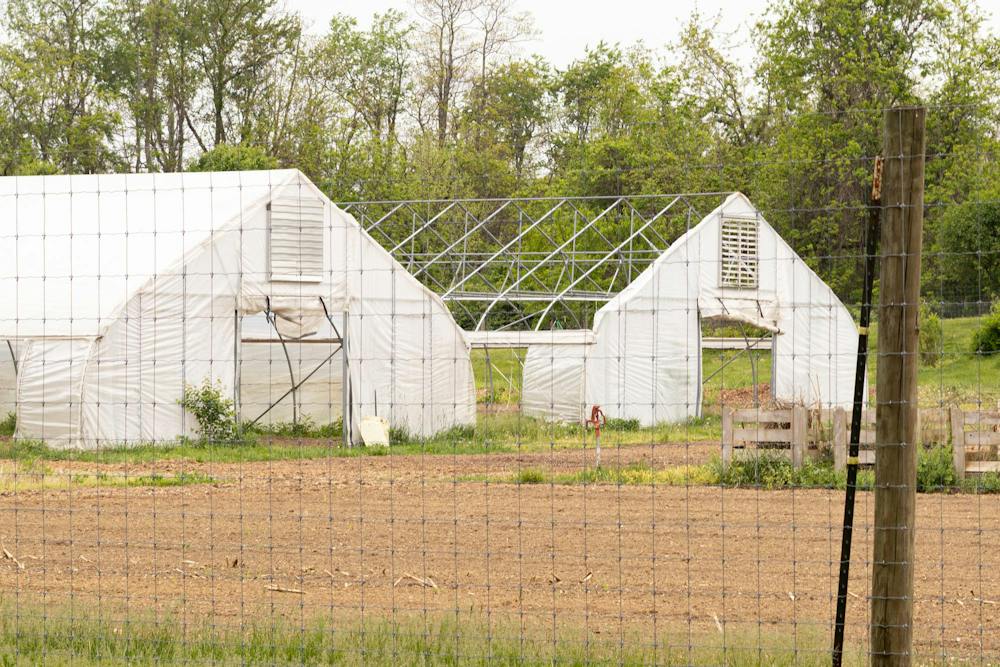
The Indiana University Campus Farm at Hinkle-Garton has now found new life under the Sobremesa Foundation.
The IU Campus Farm originally provided students with hands-on farming experience and was a key feature of the IU Food Institute, which ended operations in 2023. Management of the Campus Farm transferred to the Ostrom Workshop Food and Agrarian Systems Program until its closure in 2025.
Juan Carlos Arango and Robert Frew, co-founders of the foundation, now lease the 5-acre property from Bloomington Restorations Inc., the historic preservation non-profit that serves Monroe County. They renamed the property the Daisy Garton Community Farm and resumed operations in June.
The farm’s original purpose was to teach students about regenerative farming practices, provide fresh produce to IU dining halls and donate produce to the Bloomington community through local organizations such as the Crimson Cupboard Food Pantry and Bloomington Farm Stop Collective.
Arango said the Sobremesa Foundation is working to continue the regenerative agriculture approach and commitment to donating produce while adding their own unique programs.
Arango and Frew, who met as students at IU, became interested in permaculture, a holistic approach to gardening that aims to create self-sustaining ecosystems, after volunteering to build backyard habitats in Bloomington for the National Wildlife Federation.
“After that experience with nature and supporting wildlife, we figured, ‘Why don’t we try something on a bigger scale and actually see what it would be like to buy a piece of land that’s open?’” Frew said.
With help from activists and experts they met at a sustainability event, Arango and Frew opened the Sobremesa Farm, located at 4781 N. Mt. Gilead Road, in 2013.
Initial efforts focused on mitigating climate concerns at a local level by planting non-native trees, fruits, nuts and berries that typically grow in warmer climates in the South.
“We were trying to stay ahead of climate change,” Frew said. “We knew eventually that this was going to be the conditions here in Bloomington.”
The Sobremesa Farm, which the foundation still operates, has struggled with its location, which is difficult for people who rely on public transit, walking or biking to access.
The convenient location of the Daisy Garton Community Farm is what drew Arango and Frew to the property in the first place.
According to their website, Arango and Frew have partnered with Exodus Refugee since 2022, providing agricultural skills training. This has reframed their approach to farming as therapeutic for refugees.
“It was an opportunity for them to heal also after some of the trauma that they experienced,” Arango said.
With the new farm, Arango and Frew initially hoped to create a paid internship program for refugees, but said a lack of funds led them to the current volunteer model.
“The idea is that all participants — and it's open to anybody, refugees, immigrants, locals — will farm together and share responsibilities together,” Arango said.
Frew said funding has been a struggle, and the farm relies on volunteer work and donations from partners including Duke Energy, Marbleseed and the Wylie House Museum.
Matt Hamilton, IU doctoral student and Daisy Garton Community Farm volunteer, heard about the farm through his apartment management. Looking to spend more time outdoors, Hamilton began volunteering with his wife in April.
“People from IU, people not from IU — I’ve gotten to have really nice, close contact with people around me,” he said. “You feel like you've done something that connects you to other people around you, literally your neighbors.”
Hamilton said the majority of volunteers at the farm live within walking distance and often volunteer with their families. Despite the farm’s previous associations with IU, Hamilton said, it sees little participation from students. The one exception has been class visits arranged by IU professor James Farmer, who previously oversaw the IU Food Institute and Campus Farm.
Frew said he and Arango have talked with multiple departments at IU about involving graduate and postdoctoral research students in the farm.
Carrying on the IU Campus Farm’s traditions, the farm has continued donating to local food pantries, particularly Pantry 279 and Community Kitchen. Additionally, the farm hosts free workshops, such as Incubator Farmer training for aspiring agricultural entrepreneurs, classroom visits and a recent kimchi demonstration using their Napa cabbage.
Community members can also purchase produce from the farm. A farm stand operates from 3-7 p.m. Wednesdays and is open through Oct. 28. The farm also offers Community Supported Agriculture, a model where residents pay a subscription fee and receive a weekly share of crops produced.
“The goal of it all was to provide food to the community at a low price — at a market which has prices that are not typically found at a farmer's market,” Arango said. “They're much closer to Aldi-style prices. We want to provide food for anybody.”
In his time volunteering at the farm, Hamilton said he has developed a new appreciation for the effort and collaboration put into farming.
“This is kind of luxurious in a way, right?” Hamilton said. “It's right across the street. We can do it when we feel like it. There's other people to pitch in. No, we're not getting paid. We can take home some produce.”


