
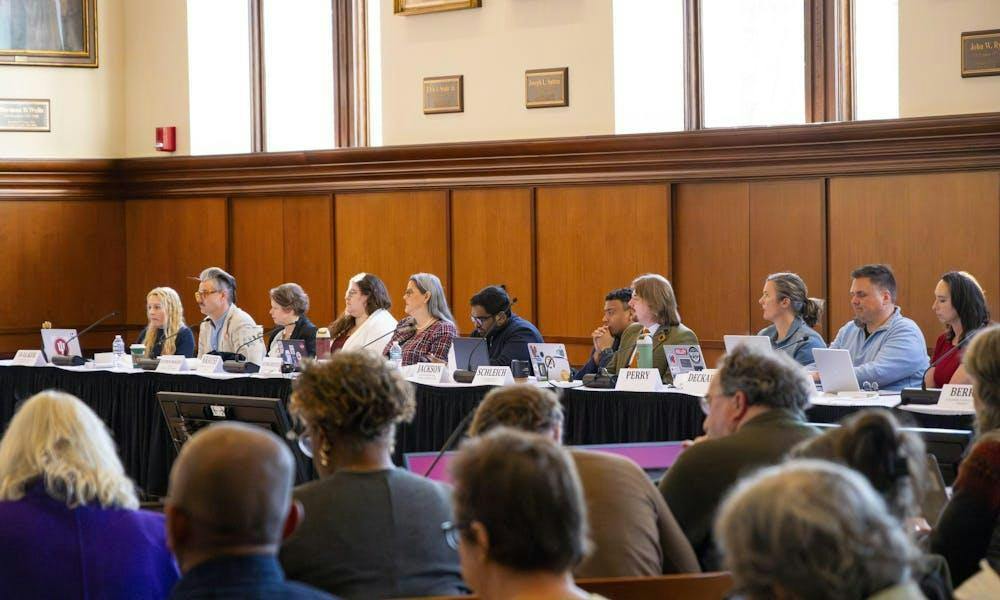
At the first Bloomington Faculty Council meeting of the year Tuesday in Presidents Hall, faculty discussed free speech issues and raised concerns about Indiana University’s response to rising enrollment. Faculty also expressed concerns regarding the university’s financial transparency.
Financial transparency
Theatre and drama professor Andrew Hopson questioned why faculty benefits were reduced by 10% last year despite a report commissioned by IU Bloomington’s American Association of University Professors chapter, which found IU’s finances were in good standing, with a near doubling of reserve money in just four years and soaring enrollment resulting in more tuition money.
“You want to know where your retirement benefits went?” another faculty member said. “It’s sitting in that cash account right now.”
Chancellor David Reingold said the reduction in benefits occurred before he was appointed in June 2025, but the decision was made internally due to an anticipated decline in state and federal funds.
Russian history professor Andy Bruno presented on behalf of the AAUP at the meeting and noted that despite increasing enrollment, IU has not significantly increased money spent on instruction and lags behind its Big Ten peers in faculty salaries, while administrative spending has increased 61.7% since 2017.
Bruno also criticized recent state interventions in higher education. In March 2026, the governor signed Indiana Senate Bill 199 into law, which will put low-earning degree programs in jeopardy.
“There’s a misalignment with how much money the state gives versus how much control they are reserving over the decisions of the university,” he said.
Infrastructure and hiring
IU student enrollment is increasing — this year, all of IU’s campuses boast over 90,000 students, and a record 16,911 new undergraduate students. But faculty at the meeting said the university isn’t increasing the number of classrooms, faculty, graduate students and advisors to keep pace.
“I have been here for five years, and I have yet to see a plan for how to support an ever-growing student body with fewer and fewer resources,” history professor Sara Gregg said. “I think that is a crucial element for reestablishing trust with the faculty and staff of this university.”
Her comment received a round of applause from the assembled faculty.
Economics professor Gerhard Glomm said potential professors “want to see a sign of hope, that departments can grow, that their research mission is supported and that our teaching is rewarded at levels which are comparable to our peers.”
He joked that the university might have to relabel the hiring committee as a “trying-to-hire committee.” He said IU’s lower salaries put it at a competitive disadvantage with other universities.
Interim provost John Ciorciari claimed IU hiring rates are higher than peer institutions and pointed to the Faculty 100 and Faculty Strategic Hiring Initiative as university efforts to prioritize hiring.
Spanish professor Manuel Díaz-Campos raised concerns about these initiatives, which use university-wide funds to hire professors rather than the typical department budget. Díaz-Campos said these initiatives use up the university’s budget, resulting in less money available for regular hires. Ciorciari replied that he wants to work with departments to address both broader institutional and narrower department priorities.
Other items
Following free-speech controversies on campus, the IU Board of Trustees voted in February 2026 to adopt the Chicago Principles, a set of guidelines that aim to protect free speech on college campuses.
Reingold offered an update on the University Faculty Council and Academic Leadership Council Task Force, which were tasked with designing and coordinating implementation of the principles. The task force released a report in July covering programming, organizational structure and policy.
The report recommends orientation programming to set early expectations around free speech, as well as faculty workshops and a model for the language that professors can use to share the principles in their syllabi.
The task force called for each IU campus to appoint a campus lead who will facilitate periodic meetings and communicate with the other campus leads; IU Bloomington’s lead is political science professor Aurelian Craiutu.
Finally, the report recommends a series of conversations involving faculty and students to develop a set of principles that can be used in the future to evaluate new university policies.
The BFC also passed a resolution recommending students in the military and veterans be allowed to register for classes early — a privilege previously reserved only for student-athletes and members of Reserve Officers’ Training Corp.
IU’s Center for Military and Veteran Studies estimates that less than 300 active-duty military or veteran students are registered at IU. Early registration will allow these students to complete their degree before their federal educational benefits expire. BFC’s Educational Policies Committee does not believe the new resolution will have an adverse effect on the rest of the student body.
The next BFC meeting will be 2:30-4:30 p.m. Oct. 13 at Presidents Hall inside Franklin Hall.


