Three years ago, the Indiana University Food Institute’s $80,000 operating budget was cut by the College of Arts and Sciences, co-founder and former Director Carl Ipsen said.
Once known as “one of the tastiest places on campus for students and faculty,” according to a 2023 IU News Story, the institute introduced students to the field of food studies. It hosted a range of group cooking and food demonstrations, visiting scholars and collaborations with local farmers, IU Dining and student organizations across campus.
In a meeting with the Jane McLeod, former executive associate dean of the College of Arts and Sciences in March 2023, Ipsen and Interim Director James Farmer were told the institute would lose their entire funding, Ipsen said.
“We went away quietly,” Ipsen said.
Founded around 2016, the institute operated out of a house on Park Avenue for roughly six years, supported by the College of Arts and Sciences. It hosted a food studies certificate program, supported graduate research and ran initiatives like the Real Food Challenge, an effort to push IU’s dining toward more sustainable sourcing.
At its peak, Ipsen said, the institute had built a strong community of students, faculty, local farmers and dining staff who previously had rarely talked to one another otherwise.
Steven Barnes, executive director of the College of Arts and Sciences communications and marketing, told the Herald-Times the decision to cut the institute was to “steward College resources and prioritize our critical investments in graduate education.”
The announcement came shortly after IU’s graduate workers went on strike in 2022, with IU President Pamela Whitten and former Provost Rahul Shrivastav agreeing to raise graduate student stipends, but said millions would likely need to be diverted elsewhere to cover the costs, according to the Herald-Times.
Farmer said the rent for the institute's house on Park Avenue also increased, leaving the college with little choice but to close the institute.
“It’s the kind of initiative that only survives because of the support of the university,” Ipsen said. “I like to think it’s the kind of thing a university should do, but they didn’t agree with me.”
To try and stay afloat, the institute sought support funding from other departments, Ipsen said, but nobody was willing.
When the institute closed, Barnes said the institute's programming would be redistributed across campus, according to The Herald-Times.
Ipsen said some of the research activity moved into the Ostrom Workshop’s Food and Agrarian Systems program, a social food hub on campus that connects researchers and practitioners related to food and agricultural systems. Still, he said all the hands-on programming that had defined the institute is gone.
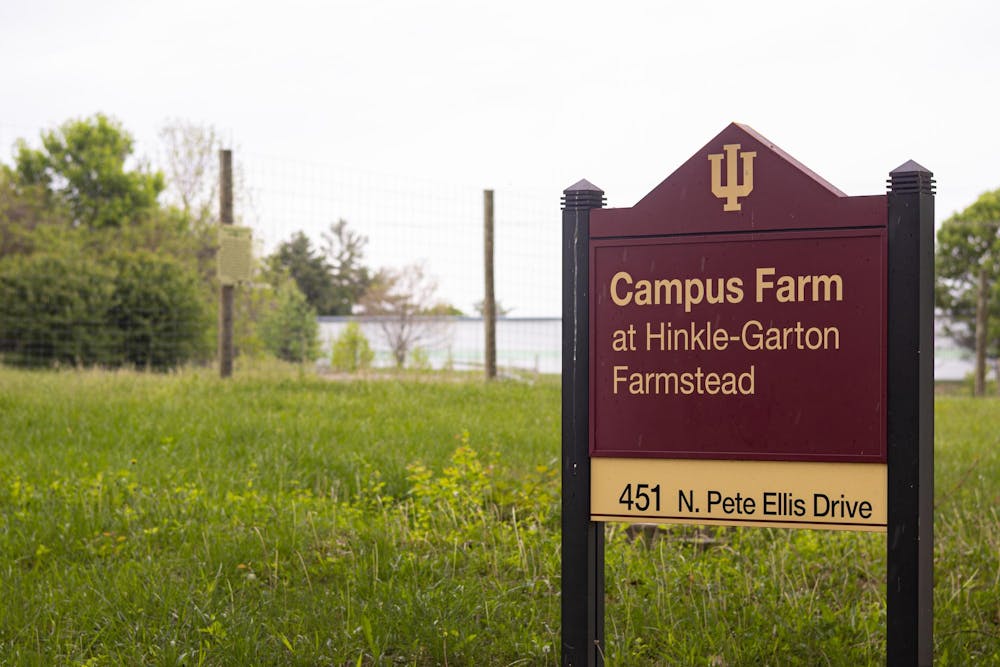
The IU Campus Farm at Hinkle-Garton, a separate initiative that collaborated closely with the institute, followed a similar trajectory and in spring 2025, the farm went on hiatus with no plan to bring it back.
Launched in fall 2017 with a $50,000 grant from the IU Office of Sustainability, the farm was co-founded by Farmer and Hilltop Garden and Nature Center’s Coordinator Lea Woodard. Located at 451 N. Pete Ellis Drive, the property spanned 10 agricultural acres and offered students hands-on experience in regenerative agriculture, organic food production and food justice.
The farm focused on specialty crop production, growing vegetables like tomatoes, okra and squash alongside fruit trees and flowers. Its produce was distributed to students via the Crimson Cupboard Food Pantry, Campus Kitchen at IU and IU Dining, to the public through the Bloomington Farm Stop Collective and to food-insecure residents through donations to local organizations.
The Campus Kitchen, a student-run organization that aims to reduce waste and student food insecurity on campus, closed in spring 2023 due to lack of student involvement, the kitchen’s faculty advisor Olga Kalentzidou said in an email to the Indiana Daily Student.
At the height of the farm, it served roughly 1,200 students annually, supported by campus funding that typically ranged from $35,000 to $47,000 per year, Farmer said. That support steadily declined after the pandemic when distributing the produce became harder.
“Funding was a little more precarious,” Farmer said. “Different administrators have different priorities, and it seemed like food systems was one of an earlier administration’s.”
Farmer said he spent years seeking contributions from individual departments and schools across campus to fill the funding gap, but it was never enough.
Beyond production, the farm served as a hands-on learning environment open to the broader campus. Students could volunteer or intern, welcoming community members looking to pick fresh produce directly.
Emma Bolinger, an IU senior who worked at the farm during the 2023 growing season, said the experience felt meaningful.
“Knowing that food is going to food pantries to feed the unhoused people in the community and the people who don’t have a lot of fresh fruits and vegetables — that was really rewarding,” Bolinger said.
Bolinger said she was unaware the farm had closed and hopes the university considers bringing it back.
“It was a really good resource for students and the community,” Bolinger said. “I’m just disappointed to see it not being funded anymore.”
Claire Storz, a senior studying social work who volunteered at the farm once, said her classmate discovered the closure while looking into local agricultural resources for a group project.
“They had let us just take home all of these veggies, and we even got to take home some fresh flowers,” Storz said. “Hearing that it closed down, I was very upset.”
Storz, who has spent the semester researching micro-farms and food insecurity, said the farm’s closure represents a tangible loss for students who are struggling financially.
“These micro-farms are providing them with free or reduced cost fresh fruits and veggies to help keep them healthy,” Storz said.
She said the impact of losing fresh produce extends beyond students.
“I work with kids and I see a lot of them don’t always have access to fresh produce, and I can see how it affects them,” Storz said. “When we have snacks that are oranges or apples, you can see how excited they get.”
Storz said she would like to see more community gardens and micro-farms implemented across Bloomington and hopes IU finds a way to bring it back.
For students who want to stay involved, Farmer pointed to the Healing Garden at Hilltop and the Bloomington’s Community Orchard as alternatives for hands-on food and growing experiences.