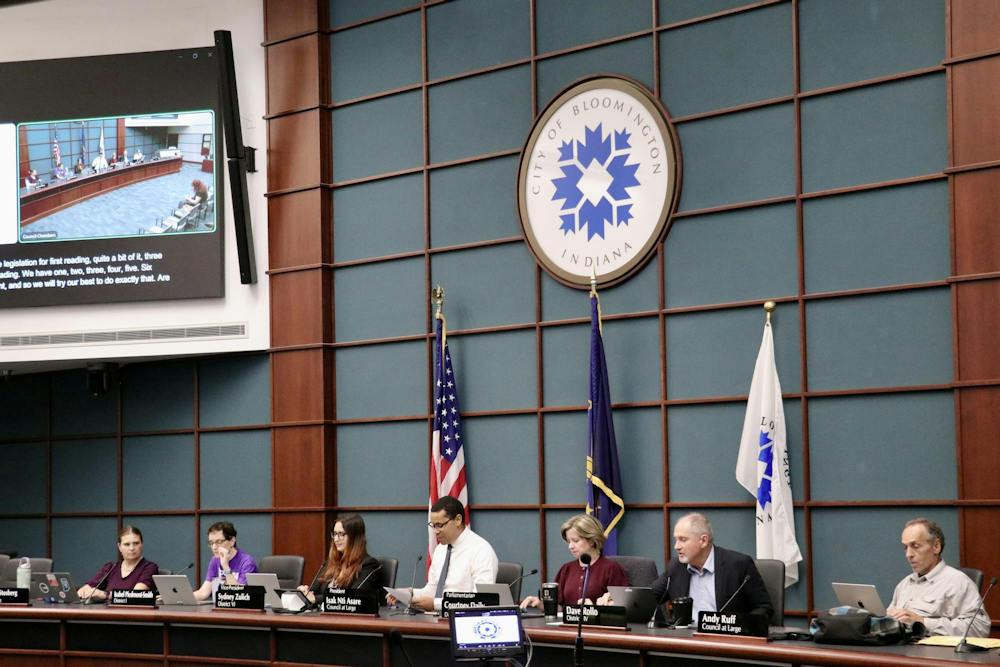
The Bloomington City Council banned city agencies from using or accessing automated license plate reader technology and approved the 2027 city budget at its Wednesday meeting.
The council voted unanimously 7-0 to pass the ALPR ban, which drew more than 75 Bloomington residents and Indiana University students, many of whom spoke in its favor. Councilmembers Matt Flaherty and Kate Rosenbarger were absent.
City agencies will be banned from owning, operating or using any ALPR cameras or records systems. Additionally, the city is banned from accessing ALPR data obtained by other agencies, meaning that even if another agency collects ALPR data, Bloomington agencies are prohibited from accessing that data.
The ordinance also bans the use of any surveillance cameras whose data is shared with or searchable by any third party.
In an Oct. 7 memorandum to the council authored by Deputy Mayor Gretchen Knapp, Bloomington Police Chief Mike Diekhoff and Corporation Counsel Margie Rice, city administration asked the council to remove portions of the legislation that broadly applied to surveillance cameras, proposing council and administration work together to develop city policies about surveillance cameras instead.
The reasoning behind the request was concern that broadly applicable bans on surveillance technology could include unintended technology like cameras worn by police during undercover drug investigations, or police interview room cameras.
“Given the variety of tools potentially impacted, we suggest forming a small working group to examine the existing uses and policies, and refine as needed to distinguish between invasive technology that puts residents or the City at risk,” the memorandum stated.
Flock has faced local and national criticism over allegations of the company sharing data with federal agencies, including U.S. Immigration and Customs Enforcement. Around 400 people showed up to a January protest outside City Hall against the use of Flock in Bloomington.
Multiple cities and local governments across the country have also alleged that Flock data is still accessible to other law enforcement agencies even after they opt out of data sharing or cancel contracts.
Despite a growing national trend of cities and localities cancelling their contracts with Flock, Bloomington is now one of just a handful known to officially ban the use of Flock or ALPR cameras entirely. The town of Ypsilanti, Michigan formally banned ALPR cameras in 2022. The mayor of Athens, Ohio also announced a ban on Flock cameras in early October.
A March resolution from the council called on the city and BPD to review its Flock contract, and Bloomington Mayor Kerry Thomson announced the city would not renew its Flock contract in April. The March resolution stated that the council intended to create future legislation governing the city’s use of ALPR technology.
The city administration endorsed the ban on ALPRs in its Oct. 7 memorandum, but proposed a discussion at a later date on whether the city should use ALPRs for parking technology if recommended by a city parking study. It also stated that the city had four Flock fixed security cameras in use, but that those cameras “are not connected to Flock’s network.”
Councilmember Isabel Piedmont-Smith, who co-sponsored the legislation with Council President Isak Nti Asare and Council Vice President Sydney Zulich, said the council had “ample evidence" to distrust Flock, other corporate vendors and federal authorities that may have accessed wrongfully obtained license plate reader data.
An amendment to the ordinance clarifying that no person or entity is entitled to withhold surveillance evidence from the city in a criminal investigation passed 6-1, with only Asare voting against it. Asare said he didn’t think the amendment “accomplishes anything,” as agencies can already obtain warrants for evidence in a criminal investigation.
The amendment also specified that BPD’s body cameras do not fall under the ban on surveillance camera systems that automatically share video data with third parties. Diekhoff told the council that BPD policy is that body cameras cannot be turned on or used when off an officer’s body.
“I think that it’s really important that our police are able to maintain their body-worn cameras,” Councilmember Hopi Stosberg said. “It was not that many years ago where a similar sort of crowd would have emerged to require our police force to wear body-worn cameras to hold officers accountable for how they’re treating the public.”
Over 20 Bloomington residents and IU students spoke at the meeting, most calling on the council to ban Flock cameras. One Bloomington resident, Seaforth Breeze, spoke to the council earlier this year about a Flock camera facing their home. Breeze said Wednesday the camera is no longer there.
“It has been a huge relief in my life, a weight off my shoulders,” Breeze said. “But I, one, know that that is not the case for everybody in this community, especially at IU for example.”
The council also briefly discussed another ordinance about surveillance technology sponsored by Councilmember Dave Rollo aiming to ban artificial “superintelligence” technology, which the ordinance defines as “a system or entity that can significantly outperform all humans on essentially all cognitive tasks.” It will be read for a second time at the council’s Nov. 4 meeting.
After around three hours spent discussing Flock and surveillance technology, the council voted to pass the city budget for 2027. The council held a special session Oct. 7 to amend and discuss the final city budget voted on Wednesday, approving millions in budget cuts and withholding $3 million in unspecified housing development funds. Asare was the sole vote against the first appropriations ordinance, and the second passed unanimously.
The council also introduced a proposed ordinance to remove certain compliance requirements when a property is being evaluated for development or renovations, which would change the Unified Development Ordinance, the city’s land use and development code.
Local business owners spoke at the meeting about how compliance requirements caused long and expensive delays to their business operations. Doug Hazen, owner of Hazen Insurance Agency, told the council that after purchasing his own building for his company, the city told him it couldn’t be occupied until he updated the parking lot and met other compliance standards related to building occupancy.
“I bought the building, I make the payments on the building, and I’m told I can’t occupy the building unless I go ahead and pave this whole back entire parking lot,” Hazen said.
Christopher Emge, the senior director of government and community relations for the Greater Bloomington Chamber of Commerce, said the chamber supported the proposed UDO changes. The ordinance will be read a second time Nov. 4.
The council’s next regular session is Nov. 4 at 6:30 p.m. in City Hall.