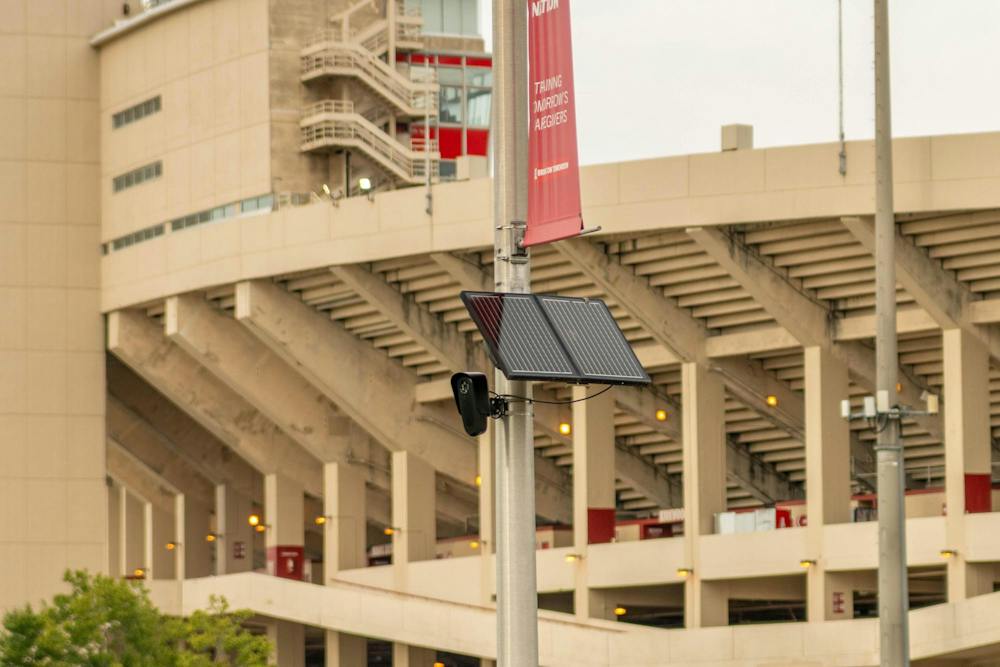
Amid growing backlash to the use of Flock license plate reader cameras by law enforcement, student groups at Indiana University Bloomington are questioning the IU Police Department’s use of the technology on campus.
IUPD wouldn’t say how many Flock cameras they use in response to inquiries from the Indiana Daily Student.
However, documents released from a public records request and posted to BloomDocs — a records repository run by B Square Bulletin editor and publisher Dave Askins — in July appear to confirm IUPD purchased at least five cameras from February 2023 to May 2025.
DeFlock, an open-source website where users can report Flock cameras to a nationwide map, counts six cameras on the Bloomington campus, with five of those in the parking lots and roadways of the IU Health Bloomington Hospital. The other camera is along 17th Street, near a Memorial Stadium lot.
The IU chapter of Young Democratic Socialists of America and some IU Student Government officials are working to challenge the surveillance system’s presence on campus, aiming for their eventual cancellation and refusal of future surveillance contracting.
IU’s video and surveillance policy, last updated in October 2023, allows the “use of any device or system” in the investigation or prevention of crime.
“The Indiana University Police Department uses a variety of investigative tools to support public safety,” IUPD Public Information Officer Julia Nowak wrote in an email to the IDS. “Access to license plate reading technology is limited to authorized personnel for investigative purposes only, and IUPD adheres to data stewardship standards as required by Indiana and federal law.”
IUPD’s General Orders, a set of procedures and policies that guide the official conduct of the police department, say data captured on cameras may be stored by the camera vendor or in a “secure location” for no longer than 30 days unless pursuant to a written preservation request. IUPD will only access data from the plate readers’ servers for an active incident or investigation, according to the policy.
Young Democratic Socialists’ petition
IU’s YDSA chapter voted 29 to two at its Oct. 8 meeting to “establish” the “De-Flock” campaign. For its first action, it plans to table by the 17th Street Flock camera near Memorial Stadium during tailgates for the Oct. 17 Indiana football game against Ohio State, said IU YDSA Communications Officer and senior Jack Buinicki.
The organization has held multiple general body and committee meetings this semester to plan a campaign against the use of Flock cameras on campus. At its Sept. 24 meeting, the group discussed ideas to pressure university administration, raise awareness of the use of the cameras around campus and involve other campus organizations in the campaign.
The campaign proposal, shared in the group’s messaging channel, demands full transparency on the parties and administrators involved with IUPD’s Flock contract, privacy measures and data use. It also requests IU administration to immediately move to cancel any contracts with Flock and avoid contracts with similar technology companies.
IU YDSA aims to educate the campus and Bloomington on its concerns over Flock misuse, particularly the potential for misuse directed toward minority groups.
Half of the 177 criminal citations issued by the Louisville Metro Police Department last year involving the use of license plate reader technology were Black residents, according to Louisville Public Media. The outlet reported that Black residents make up almost a quarter of the city.
In September 2026, five Indianapolis officers were criminally charged after alleged Flock misuse, including the surveillance of ex-spouses.
IU YDSA launched a petition on social media Oct. 4 titled “Get the FLOCK off Campus!” The petition has 80 online signatures and 223 in-person signatures, according to YDSA co-chair and IU senior Diego Barron.
Barron said he thinks the recent increase in anti-Flock sentiment felt around the state and country has helped part of the spike in attendance. The average attendance at IU YDSA meetings surged from around 20 last semester to between 60 and 80, Barron said.
At the Sept. 24 meeting, multiple members said the hate against Flock cameras is a bipartisan issue and invited others to think of how they could reach people with different political beliefs than them.
Further Flock discussions
College Democrats at IU held a discussion about Flock Sept. 17. Around 15 members participated in an “ethical dilemma game" created by the group organizers to promote discussion and critical thinking about the use of Flock cameras.
Isaac Chapman-Whitehead, senior and president of IU College Democrats, told the IDS that while the group focuses more on local elections than campus activism, it is opposed to the use of Flock on campus. Chapman-Whitehead is also a representative in IUSG Congress.
He said these are issues that potential candidates wanting to work with College Democrats at IU will have to be prepared for.
"If they're not talking about Flock, then that's just shortsighted,” Chapman-Whitehead said.
IUSG Congress passed a joint resolution Sept. 28 in opposition to the use of Flock cameras on campus and asked the administration not to renew any contracts with Flock. Student Body President Alexa Avellaneda-Yonamine signed the resolution.
Sophomore Austin Perny, an IUSG congress member who authored the bill, told the IDS he believes the rapid expansion of surveillance like Flock represents a threat to public privacy.
“We don't just wake up one day and saying, ‘Hey, I would love, you know, Big Brother to have a camera in my house.’ Like, no one, no one's going to say that, right?” Perny said.
Perny said the bill asks IUPD and IU administration for a public notification of any future surveillance company contracts. The bill also asks for full disclosure of the capabilities of IUPD’s Flock cameras.
IUSG operates in an advisory role and does not have a position in the university’s official policy-making process.
Perny also brought up the City of Bloomington and Monroe County Sheriff’s Office’s ultimate cancellations of Flock contracts after public concern and protest.
The City of Bloomington announced it would not renew its contract with Flock in April 2026, following a protest in January.
The Monroe County Board of Commissioners voted in July 2026 to cancel its contract with Flock a year before it ended.
Perny said he is asking for similar transparency and action from IUPD and IU administration.
“I think we are a voice for the students, but they can see, ‘Hey, we have a good percentage of the student body that doesn't feel comfortable with the technology on campus, and this is something that a lot of people are passionate about,’” Perny said.