The 2026 midterm elections are less than three weeks away, and the secretary of state race has become the one of the most competitive and publicized in Indiana.
As the future chief election officer of the state, candidates have discussed election integrity and perceived problems and solutions with Indiana ballots across the campaign trail. The office also manages business and commercial filings, registrations and regulations.
All four candidates have met for two public forums in October, following their first moderated conversation in late August.
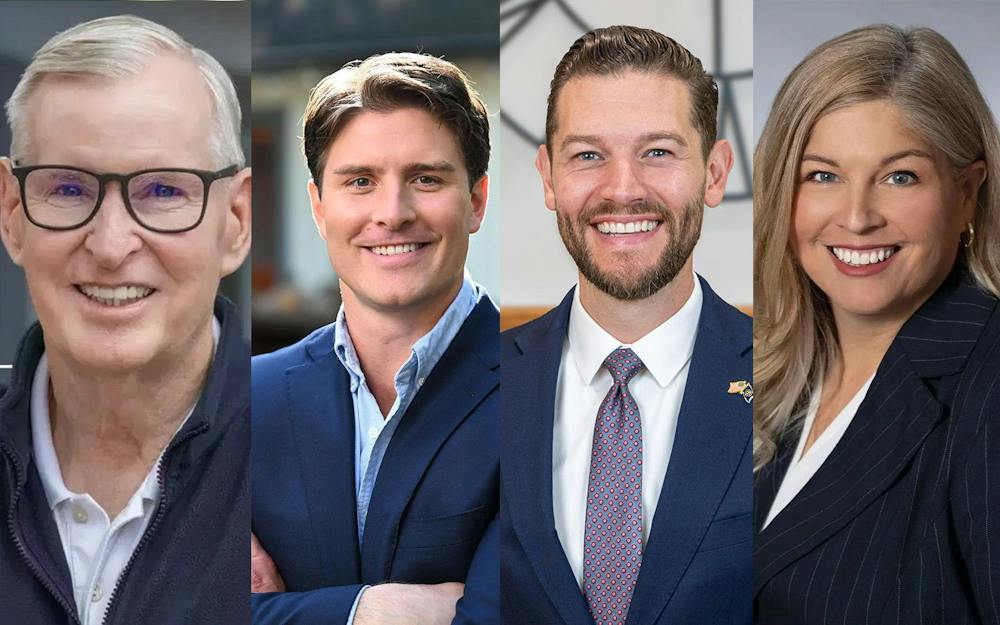
Democrat Beau Bayh, Republican Max Engling, Lincoln Party candidate Greg Ballard and Libertarian Lauri Shillings are the candidates on the ballot.
Three candidates did not respond for multiple requests for interviews, with Ballard unavailable by publication.
The secretary of state, a Republican-controlled office since 1994, received heightened attention after Indiana’s June 20 Republican convention, where Engling defeated incumbent Diego Morales, who finished third.
Morales lost the endorsement of U.S. Sen. Jim Banks and Attorney General Todd Rokita in May after his office generated multiple controversies, including contract decisions and international travel.
Engling, a former regional director and advisor to Banks and Indiana University-Purdue University Indianapolis graduate, said at the Oct. 7 debate he is the candidate most equipped to handle problems with the office because of his role in ousting Morales.
Bayh, son of former U.S. Sen. and Indiana Gov. Evan Bayh and grandson of late Sen. Birch Bayh, is a Harvard University graduate, former U.S. Marine and current attorney. He has called for a full independent audit of the office as his top priority, citing the years of controversy and purported financial misuse by Morales.
The Republican Indianapolis mayor from 2008-2016, Ballard adopted the Lincoln Party in March as an effort to open ballot access to other independents, he told the Indiana Capital Chronicle. If he receives more than 2% of the vote, the party’s candidates will get their names on official general election ballots for the next four years.
If he earns 10%, the party would be able to hold primary elections, according to Indiana law. Ballard served 23 years in the Marines and graduated from Indiana University with a bachelor's degree in economics.
Ballard filed a lawsuit Thursday to force the Indiana Election Commission to meet and rule on four pending campaign finance complaints, two against Engling and two against Bayh, before the election. In an accompanying letter to commission chair Beth Boyce, Ballard said that the commission typically meets in September but hasn’t this year.
Shillings, a creative director at and alumna of the University of Indianapolis, said at a policy forum that her main priority is to fix and update the office’s website, after she had negative experiences with broken links and forms.
All four candidates agreed at the Oct. 13 forum the decision to use voting centers or precincts should be left up to the county level government, WTHR reported. Vote centers allow voters to cast their vote at any polling location in their county, compared to the traditional assignment of nearby neighborhood polling locations.
Monroe County does not have voting centers, with residents instead assigned a location polling location. Marion County has used the voting center system since 2019, and Indianapolis residents are now permitted to vote at any center they choose.
Election priorities
Bayh has focused on “cleaning up the corruption” of the office, he told the Indiana Capital Chronicle. He said he wants to be a “good faith partner” to businesses across the state. He also mentioned improving efforts to increase voter turnout, including protecting early voting and working to eliminate straight-ticket voting, where people vote exclusively for one party down every race on the ballot.
Engling has advocated for closed primaries, which only allows registered party voters to vote in their respective party’s primary election. Indiana currently has a semi-open system, meaning voters can only vote in a party’s primary if they voted for a majority of the party’s candidates in the last general election or plan to in the upcoming election.
Engling has also campaigned for different color identification cards for “legal but non-citizen" individuals to ensure that only U.S. citizens vote in Indiana elections, according to WFYI’s Voter Guide.
He also expressed interest in an election transparency portal for citizens to directly report any perceived corruption, fraud or any similar issues they experienced in the election.
Shillings emphasized modernizing services to improve user experience on the secretary of state website and political financial transparency. She told the Indiana Capital Chronicle she wants “to make it so you can see who is paying for your politicians at every level.” She said she will run the office in an impartial way that serves the people instead of a political party.
Ballard's main election priority is creating a comprehensive voter guide to explain each office’s role and provide neutral information for voters. Ballard said the office should be non-partisan, and that he would not fundraise for or endorse any other parties if elected, to ensure election fairness.
Election Day is Nov. 3, and you can find your polling place in Monroe County here.