
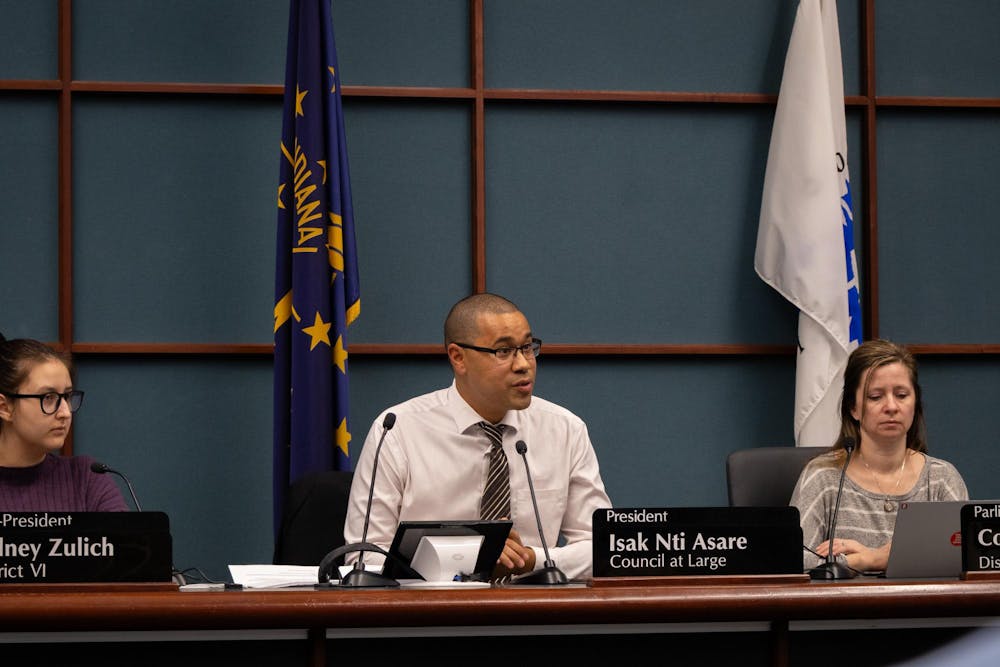
The Bloomington City Council discussed the city’s contract with Flock Safety, delayed rezoning portions of the city-led Hopewell housing development and considered multiple procedural ordinances at its meeting Wednesday.
City Council President Isak Nti Asare introduced a draft resolution at the meeting to review the city’s use of automated license plate readers. The city signed a contract with Flock Safety for surveillance cameras in December 2024.
About 400 demonstrators protested the contract Jan. 30, citing allegations that Flock systems allow other law enforcement agencies like U.S. Immigration and Customs Enforcement to access information.
The resolution, which Asare said was included in the meeting’s legislative packet to garner feedback from councilmembers and the public, focuses not only on the city’s contract with Flock, but on automated license plate readers as a whole.
“While there are specific concerns that have been raised about Flock as a provider, this conversation should not be reduced to a single company,” Asare wrote in a memo in the packet. “The deeper issue is whether Bloomington has the institutional capacity to govern technologies that are increasingly common and will continue to be so.”
The resolution would request a report from the Bloomington Police Department on details about the contract, such as who has access to the surveillance camera data and the program’s current rules around auditing and data sharing.
It would also state the council’s intent to develop an ordinance setting out rules for city use of automated license plate readers and other forms of surveillance technology.
“I'm taking this very seriously, and it is our intention to ensure that law enforcement, including ICE, cannot access our data under any circumstances,” Mayor Kerry Thomson said at a Jan. 27 town hall.
Four community members spoke during public comment Wednesday about the city’s contract with Flock, urging city leadership and city council to end the use of the surveillance cameras and dissolve the contract over privacy concerns.
One of the commenters, Bloomington resident Seaforth Breeze, said their current residence is located down the street from one of the Flock surveillance cameras, and they don't see the technology as a solution to any systemic issues.
“Every single day when I cycle to work, when I get in my car, all hours, even when I’m on my patio, the camera is staring right down at me,” Breeze said.
The council voted against hearing zoning changes for Hopewell, a city-led development effort expected to break ground on its first project in June 2026.
The city wants to create more flexible zoning that will allow for mixed-use developments at Hopewell. Without a PUD, or planned unit development, the project could have fewer homes and higher housing costs, according to project consultants at an October 2025 event.
Councilmember Hopi Stosberg is a member of the city’s Plan Commission, which voted unanimously Feb. 9 to recommend the ordinance to City Council. During Wednesday’s meeting, Stosberg said the ordinance should not be read because it was put on the council agenda late, after the Feb. 9 deadline.
“At the time, I did vote in the affirmative, though I regret that now,” Stosberg said. “The PUD document itself had a number of problems with basic clarity and correctness.”
Councilmembers Matt Flaherty, Dave Rollo, Kate Rosenbarger and Isabel Piedmont-Smith also expressed concern that the process of sending the PUD to City Council was rushed.
“I just, I resent that this came through to the Plan Commission in a state that was really not fully baked,” Piedmont-Smith said. “Like councilmember Stosberg, I think it’s a good project, but I think we are not doing anybody a favor by rushing it.”
The motion to hear the PUD ordinance failed 7-2, with only Asare and City Council Vice President Sydney Zulich voting in favor.
In a statement Thursday, Mayor Kerry Thomson criticized the procedural delays, stating that delays increase cost.
“We are in a housing crisis, and the community should demand that its elected officials respond with urgency,” Thomson said in her Thursday statement. “My administration remains committed to getting this right and getting it built.”
She said the ordinance will return to the city council on March 4 and encouraged community members to make their voices heard.
Flaherty suggested introducing legislation that would require a councilmember to sponsor legislation before it is brought to the council.
The council also discussed an amendment to Ordinance 2026-05, which would allow the council to debate and amend ordinances at their first reading. Currently, ordinances must undergo two readings before a vote and cannot be passed on the same day they are introduced, except by unanimous vote.
Public commenters raised concern that allowing the council to pass ordinances on first hearing would decrease public transparency. Stosberg said the amendment could make council meetings tedious due to repetitive public comments.
“Do I have a problem having public comment at first reading? No,” Stosberg said. “But I have a concern about having too much duplicative public comment that isn’t a good use of anybody’s time, including the person who’s coming to comment.”
The council initially passed the amendment in a 5-4 vote, but after further discussion, voted 6-3 to reconsider the vote, so the amendment did not pass.


