
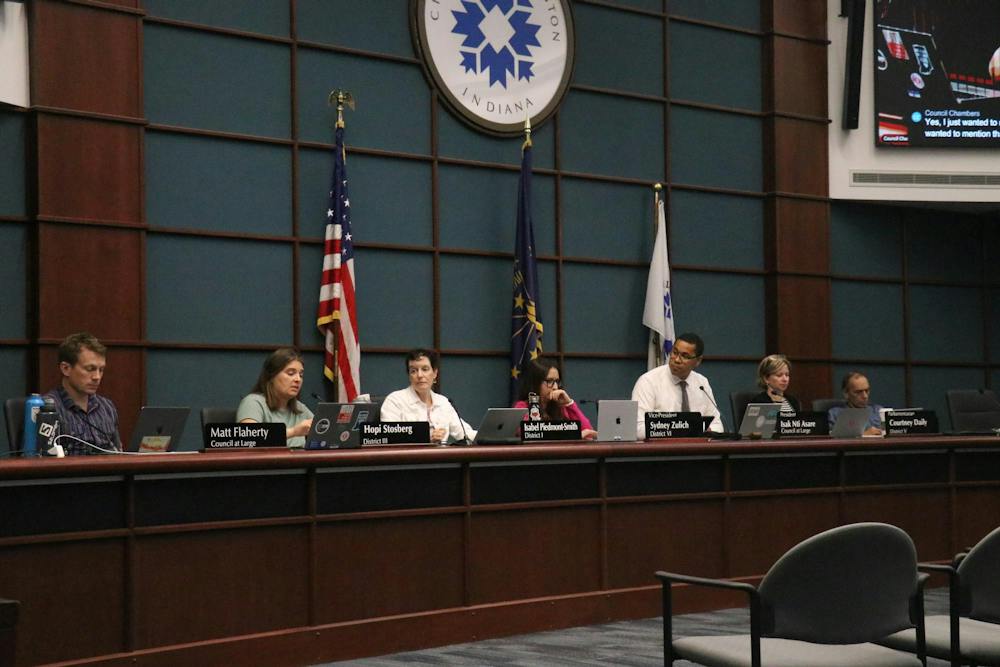
The Bloomington City Council amended the city’s proposed 2027 budget Wednesday, unanimously postponing a final vote on the $171.4 million budget to Oct. 14 after a night of spending cuts and a sharp exchange between Mayor Kerry Thomson and councilmember Hopi Stosberg.
Of that total budget, $113.1 million is subject to approval from the Indiana Department of Local Government Finance. Indiana law requires local governments to submit their budgets to the DLGF within five days of adoption so it can certified.
According to a memorandum from Bloomington Controller Geoff McKim, the state has set the maximum amount the city can raise property tax levies at $43.8 million, a 6% increase from 2026.
Councilmembers introduced 17 amendments to the ordinance to lower spending.
They voted 6-1 to hold $3 million in Housing Development Fund appropriations due to no specified plan for the money’s use. Councilmember Courtney Daily voted against holding the money, and councilmembers Dave Rollo and Kate Rosenbarger were absent.
During the time for comments from city officials, Thomson said holding housing development funds until the council approved a specific use for them would add “layers and layers of red tape.”
Stosberg, who supported the amendment, called that language disrespectful to the council and to residents, noting that several projects in the mayor’s memo requested more than $1 million in city assistance, according to Stosberg.
“We are the fiscal body of this city, and you considered us, with projects that might be over a million dollars in city assistance, to just be ‘layers and layers of red tape,’” Stosberg said.
Stosberg said that as the city’s fiscal body, the council should publicly review spending of that size.
“It’s not that you’re just disrespecting the nine of us up here as individuals, as elected officials, as a body, but it also feels like blatant disrespect to the residents of this city,” Stosberg said.
During Stosberg’s remarks, Thomson left the room outside council chambers, where she was seen texting.
Thomson addressed the exchange later in the meeting while responding to a proposed $2.5 million cut to a temporary appropriation in the Parking Department’s Parking Meter Fund, sponsored by councilmembers Isak Nti Asare, Isabel Piedmont-Smith and Stosberg. Future appropriations can be considered by the council alongside a project proposal.
Thomson confirmed she left the room during Stosberg’s comments, saying the council has gotten to the point where cabinet members, staff and the public “expect to be demeaned” when they speak at the podium, and that she heard from her and the council’s staff that the work environment can feel hostile.
“There’s not a structure that people can respond,” Thomson said. “I told myself that I was going to let our cabinet know that when they're called names or when somebody is speaking down to them in a demeaning way, anywhere, if they're not in a position to say something, they can leave. And I was reminded that if we leave, we don't get the city's work done.”
In her closing remarks, Stosberg defended expressing frustration. She said most of her votes were about improving transparency and apologized to any city staff for any discomfort. The $2.5 million amendment passed unanimously.
The councilmembers unanimously voted to adopt an appropriation ordinance that sets the Bloomington Transit Corporation’s 2027 budget and property tax levy at $37.6 million, nearly double last year's $19.4 million budget.
That increase is driven mainly by proposed capital projects, including $22.5 million towards the first phase of construction of a new Bloomington transit administration, operations and maintenance building on Curry Pike and Profile Parkway. The current facility on Grimes Lane reached operational capacity, requiring a larger space, according to the Bloomington Transit 10-year strategic plan.
The council also unanimously voted in favor of an appropriation ordinance that sets the 2027 budget for the City of Bloomington Utilities’ water and wastewater departments.
If passed, the department would receive $65.3 million, an approximate increase of $7.5 million over the previously proposed 2026 budget. The changes are due to increased water rates resulting in more revenue, McKim said, with water utilities receiving $28.9 million and wastewater utilities receiving $36.4 million.
The ordinance was unanimously approved by the Utilities Service Board in July 2026 before the council began its budget review.
The council’s next meeting, where it plans to vote on the city budget, will be at 6:30 p.m. Oct. 14 at City Hall.


