
All opinions, columns and letters reflect the views of the individual writer and not necessarily those of the IDS or its staffers.
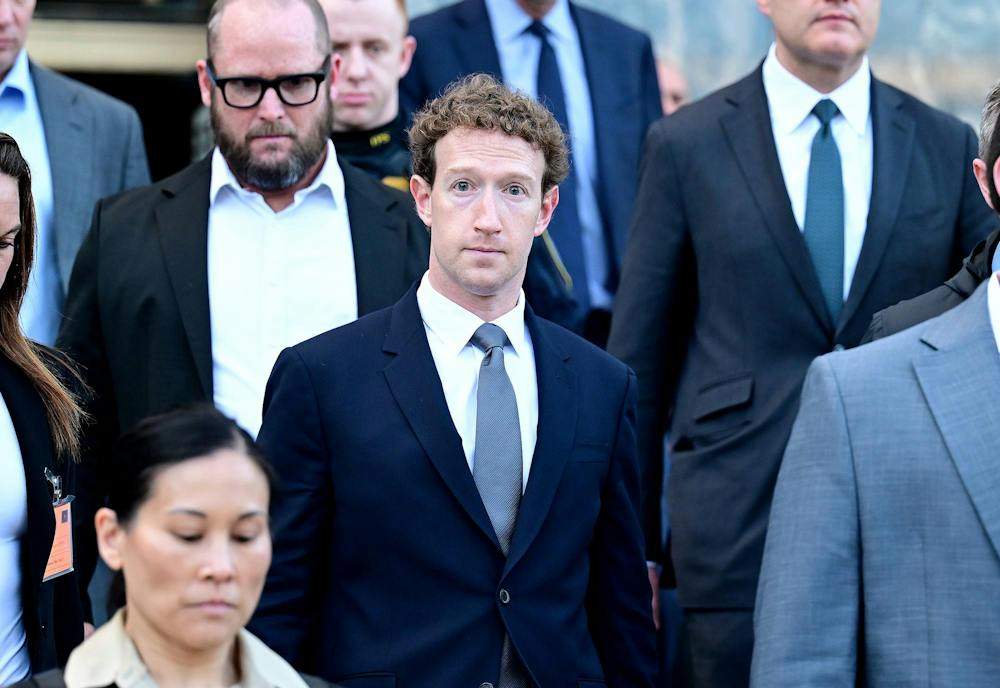
Mark Zuckerberg is sorry again.
No, he didn’t apologize to victims’ families at a Senate hearing. That happened two years ago, when his social media platforms made headlines for contributing to children’s poor mental health and exploitation.
This time, 29 states alleged they were intentionally designed to addict their youngest users — teens and, despite their inability to create accounts, “tweens.” As part of a $17 billion settlement, Zuckerberg must now contain the effects of his Frankenstein’s monster.
Thus, United States Meta users under 18 will be limited to using the company’s platforms for a maximum of two hours a day — which is for the best.
Social media has its benefits, but these come when it’s perused in moderation, a virtue that children, notably, lack. It’s also one that adults must also struggle for. In a recent column in the Indianapolis Star, Jacob Stewart recounted his journey of throttling his social media use by turning his phone into a time-limited, scroll-less, colorless, boring old rectangle.
I, too, undertook a doomscroll detox this summer by downloading an app to lock other apps — and setting the count-down clock to change settings at absurd amounts of hours. And earlier this month, Emma Howard, my colleague at the Indiana Daily Student, also wrote on cutting down how much time we spend online. Escaping social media isn’t an uncommon idea these days: 82% of Generation Z associated the word “addicting” with social media use in a 2024 poll.
Despite its problems, however, social media has its pros.
Among the greatest is the algorithm. For a thought experiment, imagine your TikTok or Instagram feed without an algorithm. Absent a “For You” page, the content you see would be based on the accounts you already follow. And that creates a knowledge problem: how do you come to find accounts you enjoy without being suggested them?
That’s a problem the algorithm fixes. As Howard wrote, the longer we scroll and the more content we like, the better social media platforms “can piece together profiles” on us. While Howard presented this fact as dangerous — it’s how social media companies hook us — it’s also what has allowed social media to spread culture in an era when magazines have disappeared.
Because the algorithm favors content that will earn our attention, it incentivizes intentional production and has contributed to the rise of influencers. So occasionally, one hears the lamentation that social media has moved away from being a place of authentic, unedited expression. But this was necessary for social media to become a curator of taste.
And it can do this for cheaper, with more range and more frequency than magazines could.
At the same time, Meta and other companies glean massive amounts of data from you, in a way that paperback magazines never could — data they’ll then sell to advertisers to personalize the ads you see, besides the content. Far from insidious — this is something agreed to when you sign up — it builds on the magazine model even better.
Look inside the cover of a Vanity Fair or a National Geographic, and you’ll find ads, like wide nets, aimed at broadly interesting the people advertisers think might pick them up. Since the advent of data commercialization, however, advertising has become more personalized, which, in turn, is more useful to both sellers and shoppers.
I grant there is a certain charm to the slowness and expert curation of the traditional magazine. That model may be even better, precisely because it avoids the mass culture pitfalls of social media, the loss of individuality and cultural texture that comes with everyone in the same demographic witnessing the same media — local musicians being lost because of the music industrial complex. However, social media can also fight against this through hyper-personalized algorithms, the ones that are often said to put us into our own bubbles.
Social media has democratized the construction of taste, even bad taste, which is a reason to keep it away from kids, lest we end up with worse mutants of 6-7.
As we move into the deep time of AI, when I expect humans will have more leisure time than we’ll know what to do with, the demand for influencers will only increase. It’ll be important to have such mass access to a culture-making platform.
So, maybe, just maybe, we have a little reason to thank Mark Zuckerberg.
Eric Cannon (he/him) is a junior studying philosophy and political science and currently serves as a member of IU Student Government. His column normally appears Sundays and Wednesdays. Never miss them or his other opinionated musings on X.



