Editor’s Note: All opinions, columns and letters reflect the views of the individual writer and not necessarily those of the IDS or its staffers.
For every book that mentioned “late-stage capitalism” in 2010, 14 mention the phrase today. When a third of Democrats identify as democratic socialists, and even Republican presidential hopefuls abjure free markets in favor of a government-commanded economy, this should not come as a surprise. Capitalism, it is fair to say, is no longer in vogue on either the left or right.
Most adopters of the phrase understand it to describe a civilization that has been driven to the point of over-commodification by unscrupulous shareholders’ love of profit, a society where nothing is held to be too sacred to be protected from big business. What qualifies a society as extremely rather than relatively commodified is fuzzy; capitalism, it seems, is always entering its latest stage while it simultaneously progresses toward a yet later stage.
Nonetheless, by applying this descriptor to present economic conditions, those dissatisfied with some aspect or other — private equity purchasing and building family homes to rent, social media platforms scraping users’ personal data to sell or men and women trading their gametes for money — can come unleash a catch-all grievance upon the powers-that-be.
I propose that Vice President JD Vance has more precisely defined a late-stage capitalistic society. In an interview with conservative commentator Michael Knowles, he said the free-market dogmas these societies are based on “elevate economic development above human dignity.” Vance and Sen. Bernie Sanders of Vermont hold vastly different views as to how we arrived at this late stage, but both are post-liberals and believe that economic freedom must be curtailed to secure a more important value, quite abstrusely called the “common good.”
Anything can contribute to the common good. Sanders has pointed to sports fandom, a humanistic pursuit thwarted by the business class’s unforgiving pursuit of profit. In Sanders’ childhood, his beloved baseball team, the Brooklyn Dodgers, hit the road to draw more money from an open market in Los Angeles than they could have in three-team New York City. Sanders sought to stop the Chicago Bears from repeating this commercial-minded backstabbing.
To Sanders’ credit, such ruptures do end worlds. New ones begin. The present world belongs firmly to the LA, not the Brooklyn, Dodgers. Anything that transforms the status quo in the name of saving money or being more efficient can signal a later stage of capitalism.
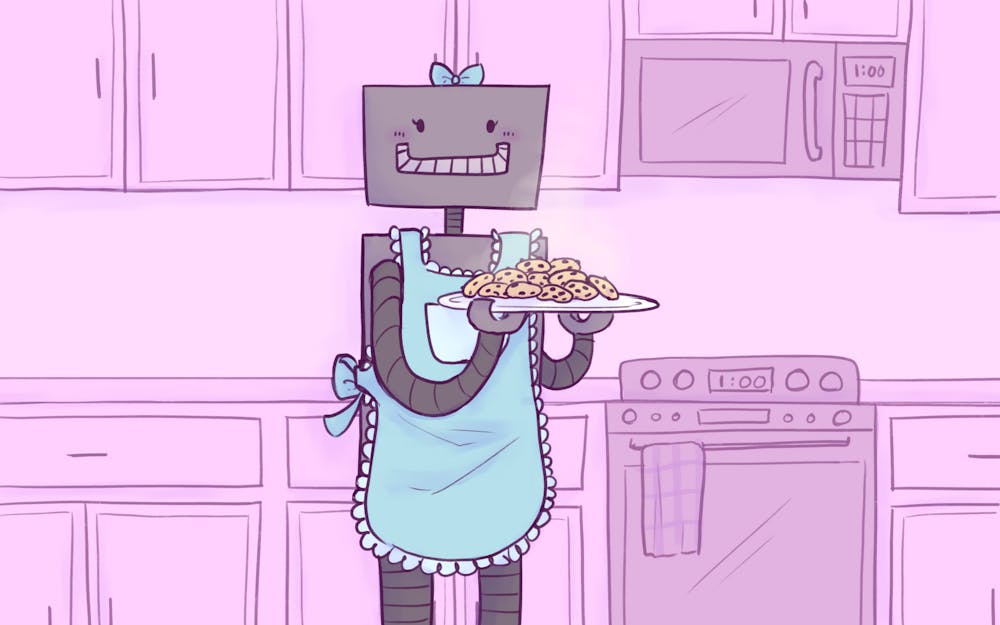
Which brings us to robots: in short, post-liberals don’t like them. Robots usher in capitalism’s latest stage: the replacement of human labor to cut costs. If that’s right, Indiana University has joined Purdue University in a final leap into capitalist deep time. Last year, GrubHub’s robots mapped our campus’s streets, and now they roll among us. Politely, they stop at crosswalks.
It’s clearly too late to have a future where we don’t share our streets with our new metal friends — at least, I find their demeanor to be quite friendly, and I treasure every encounter I have with one of these cute, four-wheeled creatures. Over time, Bloomington restaurants and other stores will mostly prefer to outsource their deliveries to third-party businesses like GrubHub, with their drivers — and increasingly, their robots and soon, I suspect, their robotic self-driving cars.
The arrival of this stage spells the end of jobs that high school and college students used to work. While harmful to those displaced, letting the robots work these jobs will, on the whole, bring about greater prosperity and comfort.
The savings and efficiency that automation has wrought time and again in human history is the reason why children can complete high school rather than work on the family farm and can, more than ever, spend even summertime in total leisure. This past summer was the lowest on record for high school employment since the government started tracking that statistic in 1948.
Alas, an abundance of leisure time is questionably spent on high-school and college students, heathens that we are. The middle-aged, with an accrual of practical wisdom, would doubtlessly devise better users for these hours, just as they would derive more from college coursework. Some sick twist of fate has granted the most unformed segment of the population the largest allotment of free time.
As we no longer wake before sunrise to detassel corn, as did former Sen. Ben Sasse of Nebraska, we must find teachers of discipline and character outside of traditional work. To the boys of this country, Sasse recommended football in a column for the Wall Street Journal on Thursday. The sport encourages perseverance, creates community, forms brotherhood and privileges action.
It is significant that the decline of manual labor in this country coincided with the rise of recreational exercise. While delivery robots bring an end to interpersonal labor, like food delivery, and intellectual labor, young adults most affected by this change must consider how they’ll hit the social and mental gyms of the future — every delivery via robot means one less human-to-human interaction, after all. And some suggest that Anthropic's artificial intelligence model Claude just solved the Navier–Stokes existence and smoothness problem, a longstanding mathematical quandary. At any rate, Claude has made progress on other hard problems.
The benefits that late-stage capitalism will give are numerous, but the positive side-effects of hard work that were once gained organically through human toil, more than ever, need to be intentionally pursued.
Eric Cannon (he/him) is a junior studying philosophy and political science and currently serves as a member of IU Student Government. His column appears Sundays and Wednesdays. Never miss them or his other opinionated musings on X.