
Editor's note: All opinions, columns and letters reflect the views of the individual writer and not necessarily those of the IDS or its staffers.
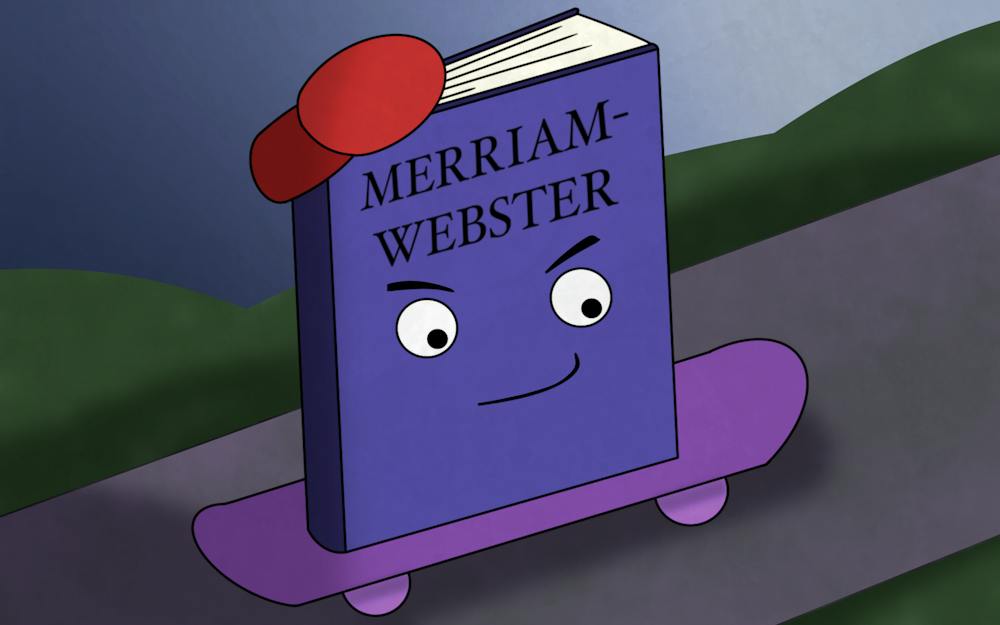
Merriam-Webster defines “copium” as “avoidance, denial, or minimization (as of a bad situation, problem, outcome, etc.) imagined as a narcotic.” That certainly seems to be what its 1,400-word update has been.
Last Tuesday, the dictionary publisher announced 1,400 new terms and their definitions would be added to its online dictionary, Merriam-Webster.com. The print edition will be “looksmaxxing,” too, as many of the definitions will also appear in hard copies. While company president Gregory Barlow declined to release a full list of the terms, it’s apparent the new “glow-up” has an overarching theme: slang.
Granted, language always has and always will evolve. There’s a reason that Victoria’s Secret doesn’t have a “pantaloons” section. And if a quick Google search could provide Meemaw with a clear answer on what “cuffing season” is, we might just bridge a couple of generational gaps. While this reasoning alone might have Merriam-Webster firing up the printing presses, attempting to define slang forgets the secret sauce that makes it such a cultural phenomenon.
To understand why defining slang doesn’t exactly work to the user’s advantage, we ought to set the time machine to 1699, when one of the first English slang dictionaries was published. “A New Dictionary of the Terms Ancient and Modern of the Canting Crew,” sought to expose the seedy underbelly of London’s streets by providing a guide to slang terms used by beggars and thieves — a secret language known as “cant,” hence the book’s title.
Unsurprisingly, after being exposed by anonymous writer “B. E. Gent” — subtle, no? — London’s “riffraff” started to abandon phrases like “dulpickle” and “jobbernoll.” And it’s a crying shame that they did. I’d really like to call someone a “bully-fop” one of these days.
What this tale reveals about slang is that it has an in-crowd. It’s agreed among many linguists that one of slang’s core functions is to signal belonging to a particular group. Breaching that barrier, throughout history, has frequently dulled the usage of certain phrases, if not rendered them completely obsolete. So, when in-group language trickles into the mainstream, it doesn’t go without some resistance.
For example, African American Vernacular English is a dialect used among Black Americans for hundreds of years. While AAVE has structured linguistic rules and is not merely a compilation of slang terms, many of its phrases have been taken up within internet culture as slang. Many linguists and community members argue that the appropriation of these terms has diluted their cultural meaning into simplistic trends.
Expanding the audience of some language isn’t always as culturally significant as the appropriation of AAVE or other dialects, but it still has its pitfalls regardless. According to the American Psychological Association, slang is a critical part of youth development — a key factor being the sense of belonging that it invokes.
Cognitive scientist and assistant professor of linguistics at Stanford University, Robert Hawkins, has found that individuals prefer to use concise language when signaling membership within a particular group, despite causing confusion for outsiders.
“Slang is doing two things at once,” Hawkins said. “When you say something your friends understand and your parents don’t, you’re communicating content—like whether something’s cool or not—but you’re also communicating who you are.”
When the elderly inevitably catch on to what a certain phrase means, it goes out of fashion as swiftly as it came. Of course, this process is now quickened by internet algorithms. That might explain why a few memes died off when professors started adding them to slideshows. There’s nothing less amusing than the “Success Kid” staring back at you on a Monday morning lecture.
With this core function of slang in mind, Merriam-Webster’s decision to honor Generation Z’s antics doesn’t quite do them justice. Putting slang in the dictionary defeats its purpose.
And if exposing slang terminology drives down its usage quicker, the publisher is going to lose some “aura.” If it plans on adding new slang to the Collegiate, as it did last year in an extensive 5,000-word update, those terms are going to be outdated sooner than new editions can be printed.
To my knowledge, many of those previously added slang terms are currently out of style. “Adulting” has been deemed childish, “side-eye” will get you side-eyed and “rizz” has lost its, well, rizz. It’s a “hard pass” for me.
I am no oracle, but I surmise that the same will happen this year. “Neckbeard” will be out before you can grow one. “Trash panda” is probably already in the trash.
But don’t “crashout,” Merriam-Webster. Just keep it formal.
Emma Howard (she/her) is a junior studying journalism.



