
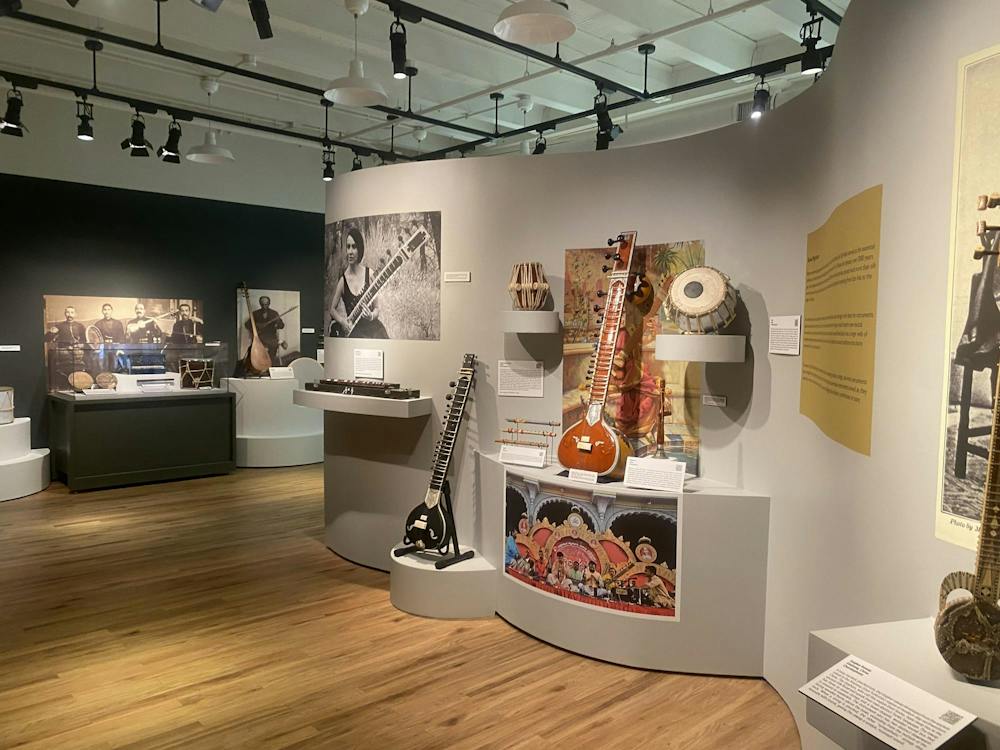
More than 70 musical instruments from across Asia, the Middle East and North Africa reside in the McCalla Center in preparation for its latest exhibition, “Treasures of the Silk Road.” The free exhibition will open from 4-6 p.m. Sept. 25 and will run through September 2027.
The instruments are from the Pastel-Daneshgar collection, which consists mainly of strings, percussion and flutes, featuring instruments like the sitar and bansuri.
The collection owner, musician and scholar Shayar Daneshgar, has been acquiring these instruments for more than 30 years. The goal of showcasing the collection in the McCalla Center is to portray the East-West connection through the similarities in instrumentation, he said.
“Some of these instruments that we see in that room, they are really ancestors of instruments that we have here (in the collection),” Daneshgar said. “So, we just want to talk about the cultural contact between East and West. That people, artists, cultures — they met and bought ideas, cultural objects, musical instruments, navigation items.”
Daneshgar is a retired faculty member at IU’s School of Global and International Studies in the Department of Central Eurasian Studies. He retired from teaching Persian and other Turkic languages two years ago. Daneshgar's first encounter with music was when he was six years old, watching his brothers perform onstage. Coming from a musical family, he began as a singer, cultivating a deep appreciation for music and instruments as he grew older.
His love for performance continued throughout his life as instruments fell into his hands throughout the years.
Within the collection, some instruments he purchased himself, some were found by colleagues and a small fraction were donated. While only two-thirds of the collection is being shown at the McCalla Center due to space, Daneshgar said the instrumental collection is one of the largest in North America. He keeps doubles of some of the instruments shown at his home.
Shaping the large collection of instruments into a cohesive exhibit is a task that falls onto Brian Woodman, the McCalla Center’s director. Woodman quickly began preparations to organize the space, staffing and time for the exhibit. Woodman said he and Daneshgar began planning for the exhibit in April, with a turnaround time of only five months, compared to the years often spent planning exhibitions at other museums.
The McCalla Center holds seven gallery spaces housing temporary and semi-permanent exhibits, often rotating throughout many different types of collections from different forms of art, with the McCalla Center staff learning as they go about each niche topic they encounter. Woodman said this proves to be a learning curve for his team, relying on experts to come and verify their information.
“We’re always in an unusual situation where, since we don’t hold the collections, we always have to learn a lot about the collections when they come in,” Woodman said. “But we always need someone who’s an expert to then come in and be like ‘That was close, but actually, this is exactly right.’”
In this instance, Daneshgar is to come in and make sure all of the plaques, informational blurbs and descriptions for each instrument are accurate.
In charge of installing and designing the exhibit itself, Jacob Goode serves as the lead preparator for the McCalla Center.
Goode’s process for designing the room includes making a model of the room, playing around with the items and making sure everything is to scale. He credits accessibility as one of the most important parts of crafting a room, needing the language on the plaques and informational blurbs to be understood by varying levels of understanding.
“All that good stuff that would go into, you know, putting a show together that works for everybody who comes to see it because the idea is accessibility, right?” Goode said. “To make sure everybody can enjoy it, everybody can learn from it, everyone can read it.”
The “Treasures of the Silk Road” exhibition will open Sept. 25, intentionally occurring at the same time as the Lotus Festival that runs Oct. 1-4, which Daneshgar co-founded. The exhibition is free and will be featured in the McCalla Center until September 2027.


