Indiana University is the sixth-worst university in the country for free speech, according to a list released Wednesday by the Foundation for Individual Rights and Expression.
Out of 261 schools in the annual College Free Speech Rankings, IU ranked 256, with a score of 51 and an F speech climate grade. According to the report, the university improved six points from last year.
In last year’s report, IU was ranked third-worst out of the 257 higher education schools included in the report, the lowest ranked public university in the country.
An IU spokesperson said they don’t have a statement to provide.
Why is IU ranked so low?
The new report cited six “speech controversies,” or incidents where free speech was tested on campus in 2024 and 2025, that contributed to IU’s low ranking.
FIRE referenced three instances of “deplatforming,” or situations when IU canceled or postponed a guest event. All three of these situations were also mentioned in last year’s report.
The first was IU’s cancellation of an art exhibition by Palestinian-American artist Samia Halaby that was scheduled to run from February to June 2024.
The artist’s grandniece previously told the IDS that the director of the Sidney and Lois Eskenazi Museum of Art cited two reasons for the exhibit’s cancellation. One was for security and safety concerns. The other was Halaby’s Instagram, where she advocated for ceasefire in the Israel-Hamas war and Palestinian freedom.
In March 2024, IU urged IU Hillel to postpone a speaker event with former Hamas member and Israeli spy Mosab Hassan Yousef. The event received criticism from the Middle Eastern Student Association and the Palestine Solidarity Committee due to Yousef’s derogatory comments about Islam and its followers.
Protesters that were unaffiliated with the organizations planned a counter-demonstration, but the IU Hillel event did not take place after security threats “involving the Muslim community and several white supremacist groups.” IU Hillel stated it planned to reschedule the event for the fall but never did.
The last incident of “deplatforming” in the report was the IU School of Medicine’s cancellation of its annual LGBTQ+ Health Care Conference in January 2025, where journalist Chris Geidner was scheduled to be a keynote speaker. Executive Associate Dean Mary Dankoski said that the decision to cancel came because of “challenging” timing amid state legislation targeting diversity, equity and inclusion.
The report also mentioned Media School Dean David Tolchinsky’s firing of Student Media Director Jim Rodenbush in October 2025 after he refused an order to direct Indiana Daily Student editors to omit news stories from its Homecoming edition. The termination letter stated he was not eligible for rehire at IU.
Rodenbush has since filed a lawsuit against the university, alleging it university violated his First and 14th Amendment rights.
Lastly, the report mentions two instances of groups being suspended on campus as a form of “students under fire.”
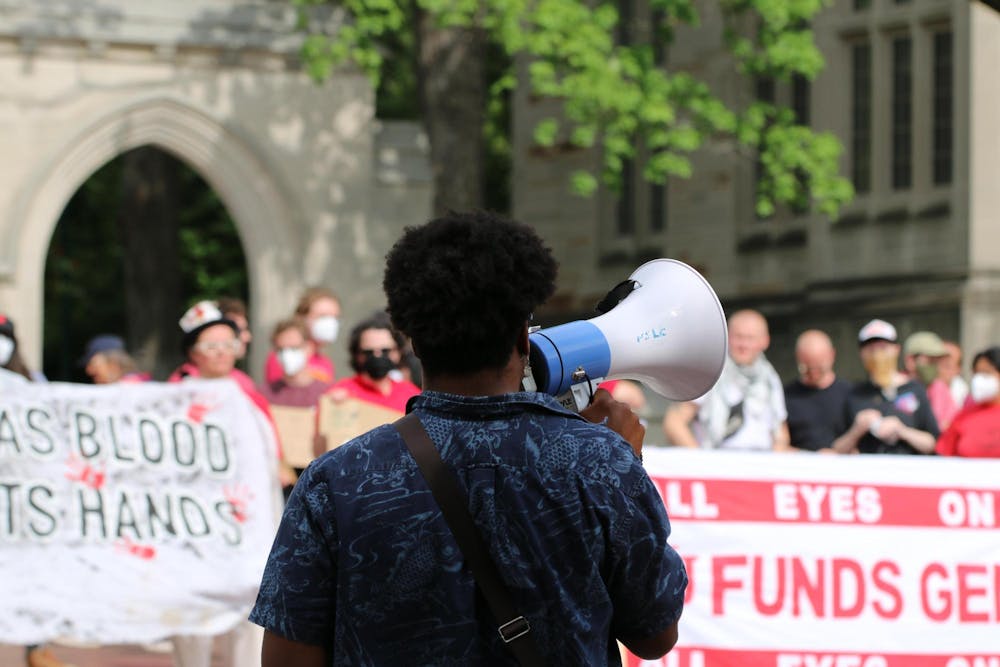
In August 2025, IU suspended operations conducted by the Palestine Solidarity Committee of IU and placed the organization on cease and desist. The IU Office of Student Life sent a letter to the PSC, alleging code of conduct violations and claimed the group presented “an ongoing threat of harm and disruption to the university community,” but did not explicitly state what policies were violated.
The report also mentions when the IU Office of Student Life prevented 27 of its fraternities from hosting social events in November 2025 following multiple alleged hazing incidents.
While the ban was lifted in December for fraternities “in good standing,” FIRE stated the initial mass suspension “raised concerns about guilt-by-association and infringements upon students’ association rights and due process protections.”
What do the rankings mean?
IU received an overall score of 50.6%, up 5.6% from 2025. The survey’s average overall score this year is 61.36%, the highest recorded in seven years, according to FIRE.
FIRE surveyed 341 IU students and asked an array of free speech-related questions. Of those surveyed, 54% said they have self-censored on campus at least once or twice a month, and 68% said “shouting down” a speaker to prevent them from speaking on campus is acceptable, at least in rare cases. Additionally, 31% of students said using violence to stop someone from speaking on campus is acceptable, also at least in rare cases.
The university also continues to hold a “yellow light” spotlight rating, meaning it has at least one ambiguous policy that “too easily encourages administrative abuse and arbitrary application.”
In the report, FIRE said IU’s adoption of the Chicago Principles, a set of free-speech guidelines, was a step toward improving its free speech ranking. To earn a “green light,” FIRE said IU should revise its student policies and adopt an official commitment to institutional neutrality.
In this year’s report, Purdue University ranks seventh overall and is the top-ranked school in the state of Indiana. DePauw University ranked No. 25 nationwide, and the University of Notre Dame ranked No. 232.