
Editor's note: All opinions, columns and letters reflect the views of the individual writer and not necessarily those of the IDS or its staffers.
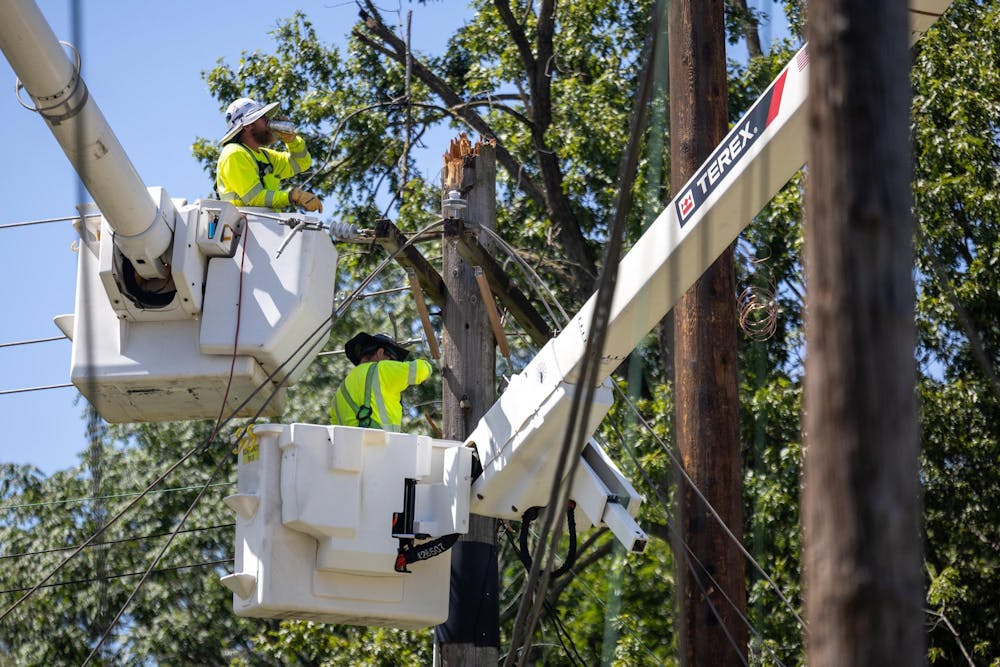
When the Aug. 11 derecho — which brought hurricane force winds to Northwest Indiana and Illinois — knocked out power to 370,000 Northern Indiana Public Service Company customers, residents had little indication that they would have to wait two weeks for their power to be restored. NIPSCO continuously delayed the deadline for power restoration, from Aug. 18 to a final deadline of Aug. 25, leaving residents unsure of when they could expect relief. Gary, which has a predominantly Black population, waited longest to have their power restored.
“It really feels like the end times” said Latasha Montgomery, a Gary resident interviewed by the Indianapolis Star on Aug. 24, 12 days into living without electricity with her three kids.
For Gov. Mike Braun, the weekend of Aug. 22—23 was spent in D.C., three blocks from the White House, in a $200,000 taxpayer-funded suite the Indiana Economic Development Corporation rented so he and other state officials could watch the Freedom 250 Grand Prix circle the National Mall. While Gary families were washing laundry by hand and salvaging what they could from dead refrigerators, the governor of Indiana was wining and dining with the rich and powerful.
To be fair, Braun didn’t sit entirely idle in the storm’s immediate aftermath: he declared a statewide disaster emergency and mobilized the Indiana National Guard on Aug. 13, two days after the storm hit. But over the following two weeks, on-the-ground reporting consistently described a NIPSCO response that was disorganized and unprepared next to its Illinois counterpart, which had already finished the job while Gary was still waiting.
It wasn’t until Aug. 24 — the day after his race weekend ended — that Braun’s office finally called NIPSCO “a monopoly utility” that had “failed to keep its end of the bargain,” directing the Office of Utility Consumer Counselor to petition the Indiana Utility Regulatory Commission for an investigation.
If Braun’s attacks against NIPSCO are an attempt to escape his share of the blame, he’ll have to pick a new target — NIPSCO’s failures happened under Braun’s watch. Nearly every commissioner on the IURC is his appointee. In December, he installed three at once, including then-Indiana Sen. Andy Zay as chair, promising a crackdown on “excessive and unnecessary” rate hikes.
Six months later, Zay was part of a majority that approved a $71 million rate increase for AES Indiana. Braun demoted him within days, then fired him outright in August. Zay sued for unlawful retaliation, and the state settled for $625,000. Braun reshuffles the commission the moment it embarrasses him politically and invokes it as a shield the moment rising utility prices threaten his “affordability” agenda.
That same commission approved NIPSCO’s biggest bet in company history. In September 2025, the IURC signed off on GenCo, an unregulated NIPSCO affiliate building three gigawatts of gas-fired generation, a near-doubling of the utility’s capacity, at a cost of nearly $7 billion. This was done, of course, to feed Amazon’s data centers. NIPSCO says it will ring-fence those costs from ratepayers and even pass back roughly $1 billion in credits over 15 years, or about $7 a month per person.
Compare that to NIPSCO’s actual track record: in the last decade, NIPSCO’s residential rates have jumped 91%, the steepest increase of any utility in Indiana, leaving it with the highest electric bills in the state. And rather than pause during the crisis, NIPSCO filed for three separate rate increases on Aug. 11, Aug. 14 and Aug. 20, worth a combined increase of $7.33 a month. Meanwhile, hundreds of thousands of its customers still had no power.
This is not a company struggling to make ends meet. NiSource, NIPSCO’s parent company, posted $929.5 million in net income in 2025, up from $739.7 million the year before a record. In 2024, the private equity giant Blackstone bought a 19.9% stake in NIPSCO for $2.16 billion. Wall Street wants to invest in Indiana’s power grid, because Indiana’s regulatory system guarantees a consistent return-on-equity, and that return ultimately comes in the form of ever higher utility payments.
So, when Braun calls NIPSCO a monopoly, he’s not wrong. He’s just describing a monopoly his administration has spent two years empowering: rubber-stamping a multibillion-dollar data center buildout, firing a IURC chairman who crossed him and settling that firing with $625,000 of public money. All the while, NIPSCO kept raising rates through a derecho recovery and posting record profits for shareholders like Blackstone.
Freelance journalist Eivin Sandstrom has gone as far as to argue NIPSCO should simply be taken out of private hands and run as a public utility. That’s a broader conversation than this column has room for. However, it’s the kind of idea that starts to sound reasonable when the alternative is two weeks without power.
Gary got its lights back this week. Braun got a race weekend, a hospitality suite and a headline blaming somebody else. Hoosiers deserve better than a governor who only shows up for the parts of the job with a green flag.
If you are interested in supporting Gary’s recovery, you can donate to the Lake County Disaster Relief Fund or the Greater Gary Storm Recovery and Relief Fund. The American Red Cross and Gary Muslim Center are also providing aid to affected families.
Spencer Robinson (he/him) is a junior studying public policy analysis and law and public policy. His commentary can also be found on his Substack.
Editor's note: Eivin Sandstrom previously worked at the IDS as an opinion writer.



