
Editor's note: All opinions, columns and letters reflect the views of the individual writer and not necessarily those of the IDS or its staffers.
Is there anything more American than complaining about taxes?
When students left Bloomington over Easter weekend, they met sticker shock at the pump. Bloomington gas stations peaked near $4.199 per gallon as a direct result of the war in Iran. The cost of a barrel of oil has soared from $60 before the war to a peak of about $113 on April 7.
Indiana gas prices, which were an average of $2.798 on March 2, have gone up to $3.912 as of April 14. Recent days have seen a relative cooling in the price of gas, owing partially to Indiana Gov. Mike Braun’s 30-day suspension of the gas excise tax. This tax is fixed at 36 cents for every gallon of gas purchased in the state.
The governor has been open with his rationale for suspending the gas excise tax.
“Affordability is my top priority,” Braun said in an X post on April 8.
Affordability is top of mind for both parties going into the midterms. Republicans have been eager to minimize spiking gas prices as a temporary effect of the war. The move to suspend the gas tax, however, worsens a looming fiscal crisis within the Indiana Department of Transportation and will cost Hoosiers more in the long run. Raising the gas tax — not lowering it — is necessary to move beyond oil and ensure affordability.
Indiana desperately needs more road funding. INDOT is facing a looming “fiscal cliff” as more Hoosiers transition to EVs and, even in gas-powered vehicles, fuel economy increases. Inflation, especially in the cost of construction materials, has also chipped away at the purchasing power of infrastructure spending. Total real annual INDOT revenue is expected to decrease from $3.4 billion in fiscal year 2024 to $2.6 billion in fiscal year 2030 as a result.
INDOT has already felt this effect, with 300 of the department’s projects delayed due to funding issues in January. These delays will cost taxpayers far more in the long run. Roads in “poor” condition require $150,000 to $1.5 million every mile to renovate, while good condition roads only require $1,000 to $7,500 per mile to maintain.
“It's major projects, like a full improvement of the northwest quadrant, 465 and 65 up there,” INDOT legislative director Aaron Wainscott told state representatives during a Jan. 5 committee meeting.
Construction delays can increase the traffic fatality rate, especially in work zones. In 2023, 33 people were killed — and more than 1,750 were injured — in INDOT work zones. INDOT funding has a direct effect on the safety of Indiana roads.
The simplest way to make up the gap is to increase the gas tax. Indiana is projected to consume around 3.044 billion gallons of gasoline in 2026. To fund INDOT at 2024 levels today, the gas tax would have to increase by around 13 cents per gallon. By 2030, with rising EV adoption and fuel economy, that number would be north of 27 cents per gallon.
A better tax — considering our already decreasing reliance on gasoline — would charge based on the total mileage driven on Indiana roads. This concept is called a vehicle miles traveled tax. Pilot programs have rolled out across the country, and Oregon, Utah and Virginia have fully implemented opt-in programs. Drivers are charged a flat rate, usually around one cent per mile traveled. In exchange, their vehicle registration fees are waived. For people who drive very little, it can save hundreds of dollars in fees.
Indiana drivers travel 18,052 miles per year on average, and there are approximately 4.720 million total licensed drivers in Indiana. Using these numbers, a one cent VMT tax would result in $852 million in additional revenue per year, more than enough to cover INDOT’s current funding gap. A two-and-a-half cent VMT tax would be able to replace all other state-level INDOT revenue sources, and a four cent VMT tax would be able to replace both state and federal funding.
This rate covers the taxes necessary to fully fund Indiana’s roads, but our taxes shouldn’t stop there. Roads carve through native habitats, accelerate climate change and deteriorate human health; effects not currently included within the gas tax. After factoring in negative externalities, cars cost society 16 cents to 20 cents per passenger mile — $4.515 per gallon. This cost affects everyone in Indiana, not just drivers, to the tune of $16.581 billion annually. annually.
Sixteen billion dollars isn’t a cost in the traditional sense; it doesn’t show up as a liability on INDOT’s budget, and it’s not sitting inside a bank account. The social cost of driving is best understood as the cost of reversing the damage caused by driving.
Take climate as an example, which accounts for around 40% of the social costs of car use. To reverse the climate impact of burning a gallon of gasoline in a car, it costs $1.71 per gallon — 7 cents per mile — on average. Raising the per gallon tax by this amount would also have the knock-on effect of reducing the total gallons consumed in the first place, as some people would start driving less. In this sense, the $16.581 billion social cost of driving is not realizable; minimizing social cost is a goal, not an untapped source of revenue.
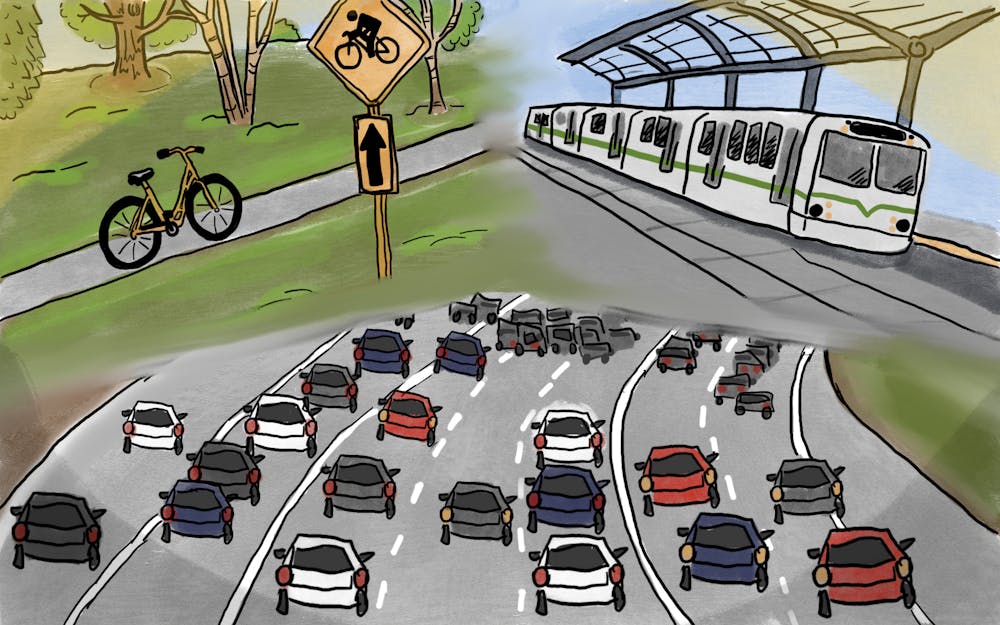
Unlike driving, biking and walking have positive externalities. Every mile benefits society 32 cents and 67 cents respectively. For public transit, every dollar invested returns an average of $5 in economic activity. The difficulty is that the Indiana government has consistently blocked car alternatives. In 2014, several Indiana counties banned light rail systems. including in Indianapolis.
A lack of alternatives to driving ultimately poses significant costs in the long run. On average, Hoosiers spend 24 hours in traffic and $11,500 on car ownership annually. The states that spend the most on public transit — Massachusetts and New York — spend far less per capita, both under $1,000 annually. The difference is over $10,000 a year, but those cost savings require owning a car to be optional, a difficult proposition in Indiana.
It’s possible for Hoosiers to live without car dependency. Indiana had a system of electric interurban rail as recently as the 1920s. Former IU President and Chancellor Herman B Wells, who was an undergraduate in the 1920s, claimed he could get from Bloomington to Chicago in five hours using this system.
Today, the trip is four hours by car.
The flow of oil will inevitably stop. Whether as the result of conflict, resource exhaustion or from other, currently unforeseen causes, oil is not the future. The painfulness of this transition rests on how well the state government plans for it. Braun’s suspension of the gas tax goes against this, bringing short-term relief while halting progress on real solutions. Braun is unwilling to fund public transit and reform our tax system, two necessary steps to ensure long-term affordability and quality of life gains for Hoosiers.
It is time to accept the necessary costs of the clean energy transition.
Spencer Robinson (he/him) is a sophomore studying public policy analysis and law and public policy. His commentary can also be found on his Substack.



