Editor's note: All opinions, columns and letters reflect the views of the individual writer and not necessarily those of the IDS or its staffers.
When Charles Darwin published “On the Origin of Species” in 1859, he had a problem.
His new theory of evolution was groundbreaking and well-supported, but it was missing something. If organisms really evolved, fossilized evidence of gradual changes in their structures over millions of years should exist — something that, at the time, did not appear to. There was a gap in the fossil record, which Darwin called “the most obvious and serious objection” against his theory.
Today, we understand fossilization is an extremely rare occurrence. To become a fossil, an organism must be buried under a layer of sediment almost immediately after it dies. Even if the conditions are perfect, nothing guarantees a fossil will form — and even if one does, there’s no safeguard Earth’s natural geologic processes won’t weather it away before it can be discovered.
When you consider all the random chance this process involves, it should come as no surprise the fossil record remains incomplete. Some organisms are lucky enough to be preserved while others decompose into obscurity.
But sometimes, it’s not all about luck. Gaps in the fossil record form naturally, of course — but they can also form politically.
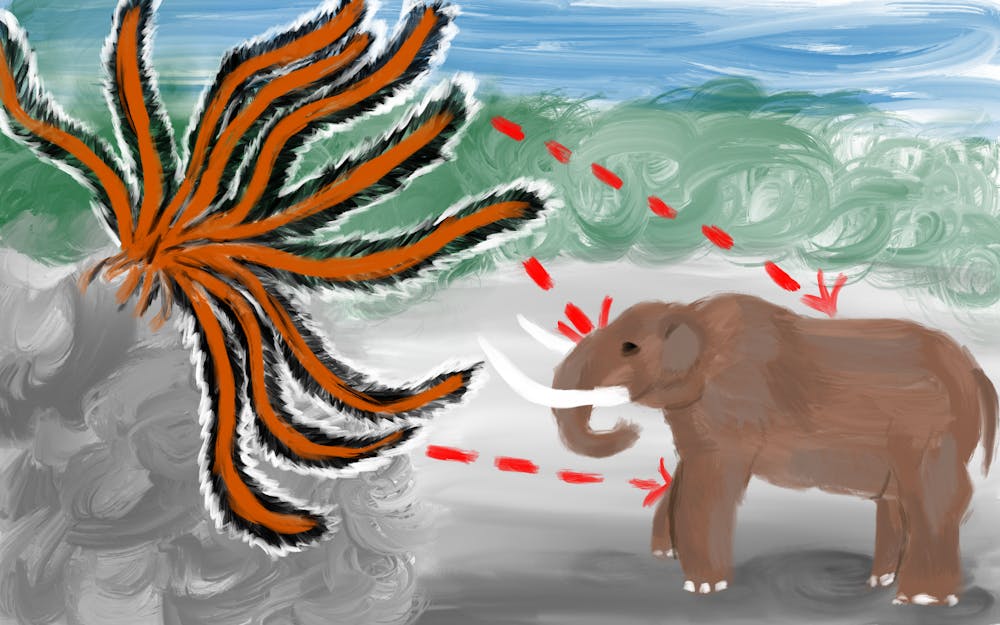
Within the last decade, a magnificent species that looked set to be unearthed and elevated to statewide fame was tragically reburied by legislation. Indiana’s state fossil is, legally, the American Mastodon. It was made official in 2022 when then-Indiana Gov. Eric Holcomb signed House Bill 1013 into effect.
But there was once another: a true champion of the Cambrian positioned to become a symbol of Hoosier pride before being reduced to a mere footnote in Indiana’s state history. Such is the tragic tale of the crinoid, the greatest state fossil that never was.
Crinoids are marine invertebrates related to starfish and sea cucumbers. Over 300 million years ago, they were a dominant presence amid the teeming fauna of Indiana’s warm, inland sea.
You can recognize them for their feathery, technicolor arms, which they use to filter out plankton and other tasty debris from their environment. Their water vascular system allows them to pump water through their tube feet to move about on the ocean floor, and they can even regenerate lost body parts. And unlike the lily-livered mastodon, they’re still around today, having survived all five major extinction events in Earth’s history.
They’re pretty cool, to say the least, but not everyone is on the same page. In 2015, seven years before the mastodon usurped its throne, a bill to make the crinoid the official state fossil fell flat in committee before it could ever make it to the floor.
So, we’re left with the mastodon — whose name translates to “nipple-tooth,” but that’s hardly the worst part about it — as our state fossil instead. The most glaringly obvious problem with this selection is that the American Mastodon is one of the most ubiquitous fossils in existence. Specimens have been found as far north as Alaska, as far south as Mexico, and practically everywhere in between.
I could live with selecting the massive, tusked proboscidean, albeit a bit basic and cliché, if it was somehow connected to Indiana’s history. But the American Mastodon is no more unique to Indiana than it is to any other state. In fact, then-Sen. Mike Braun was vying to make it the national fossil as recently as 2024.
A fossil to all is a fossil to none, and the mastodon definitely lacks any hometown-hero quality. You know what doesn’t? Ask the folks in Crawfordsville — home of the world-renowned Crawfordsville crinoids.
They’re not some bizarre high school mascot. The crinoids buried in the sediment of Crawfordsville are some of the best-preserved ever discovered, attributed to a near-perfect combination of shallow water and an inflow of silt from an ancient river. Thanks in large part to their great condition, the fossilized remains uncovered in Crawfordsville have jumpstarted the discovery of a variety of new crinoid species.
When it comes to species discovery, Bloomington too has a major crinoid connection. The late Norman Gary Lane, a professor of paleontology at IU, dedicated a huge portion of his life to the study of crinoids. He taught for 20 years, retired as a professor emeritus, and had become internationally recognized as an expert on crinoid fossils.
The crinoid’s relevance to the Hoosier State manages to extend even further. Established Indiana Daily Student readers may recall the significance of Indiana limestone from a previous opinion column — the state stone of Indiana and the building block of much of IU’s campus. But there would be no limestone without the crinoid! It was their calcium-rich remains, along with other marine life, which were compacted over eons to form that grainy, gray gold we know and love.
I’m with Darwin — there is a serious and obvious objection to be urged here. Why should the title of state fossil belong to the creature with no unique connection to Indiana, especially while our feathered, tentacled superstar waits filter-feeding in the wings?
The fossil record is indeed incomplete. One, in particular, is missing from the hearts of Hoosiers everywhere. But unlike real fossils, we don’t need to rely on perfect geological conditions to cement the crinoid into Indiana’s history. And until our crinoid king finally takes its rightful place, Indiana’s state fossil will remain a relic of poor judgment.
Spencer Schaberg (he/him) is a sophomore studying microbiology.