Editor's note: All opinions, columns and letters reflect the views of the individual writer and not necessarily those of the IDS or its staffers.
Imagine watching the Empire State Building being constructed in reverse. From high above, you see masons, plumbers and electricians work like ants to dismantle floor after floor and load the materials onto enormous truck beds. They drive backward to the nearby railyard, where steel beams and stone slabs are separated onto train cars and pulled across the country to their origin point.
You notice something unusual: The trains carrying the stone have all arrived at a single, familiar location. If you had the mystical powers to witness the Pentagon deconstructing itself against the flow of time in a similar way, you would eventually reach the same starting point. You could watch the assemblages of 35 state capitol buildings in retrograde, and in every case, their stony exteriors would come to rest in the quarries of southern Indiana. The same is true for many of the buildings on Indiana University’s campus.
But what could the Empire State Building, the Pentagon and most state capitol buildings have in common with Wylie Hall?
You walk past the answer every day on your way to class, whether you know it or not. That cream-colored, grainy stone everywhere isn't just any cream-colored, grainy stone. That’s Indiana limestone, baby.
The material is vital for American architecture — it’s even been nicknamed the “nation’s building stone” — and it comes from right here in Monroe County. To understand how limestone got here, we have to look back a few hundred million years.
The continents were once united in a supercontinent called Pangaea, which centered roughly on the equator. During this period, the land that would eventually become Indiana was covered in a warm sea filled with invertebrate creatures of all shapes and sizes. As generations of gastropods and the like came and went, their shells and exoskeletons piled up on the seafloor.
Over time, these calcium-rich remains were pulverized into a fine sand and solidified into a thick layer of rock known today as Indiana limestone. If you’re lucky, you can see marine fossils hardened into the limestone around campus, visible evidence of its aquatic origins.
Composed almost entirely of calcium carbonate, Indiana limestone is incredibly pure. This purity lends the stone a special property: It’s what stonemasons call a “freestone,” which means it can be cut from any direction without cracking. Freestones are particularly useful if you’re looking to carve intricate designs into your structures. The giant brain sculpture outside the Psychological and Brain Sciences building is a great example.
The first Indiana limestone quarry emerged in 1827 in Stinesville, about a 20-minute drive from modern Bloomington. But Limestone didn’t rise to fame until the 1870s after the Great Chicago Fire. Rebuilders looking for a fireproof, high-quality and workable material found the ideal candidate below southern Indiana’s surface, and limestone hasn’t left the spotlight since.
The birth of the skyscraper in the late 19th century took limestone to new heights. Along with the Empire State Building, the Department of Commerce, the National Cathedral and the original Rockefeller Center Buildings are full of the stuff. Limestone quickly became a go-to for architects of an ever-expanding America. Sea to shining sea was bridged not by amber waves of grain, but grainy blocks of lime.
The limestone boom certainly left its mark on our land. There are over 1,200 abandoned quarries throughout Indiana, including a multitude in Monroe County. Some have been repurposed as swimming pools, parks and chill spots for college students to hang, yo. If you have the chance, you should definitely check out an old quarry (safely, and without trespassing).
Limestone is still used today, though not as commonly as it once was. Synthetic alternatives have reduced demand somewhat owing to their ability to resist corrosion due to acid rain. Nevertheless, several limestone quarries are still active in Indiana and it remains a popular architectural design option.
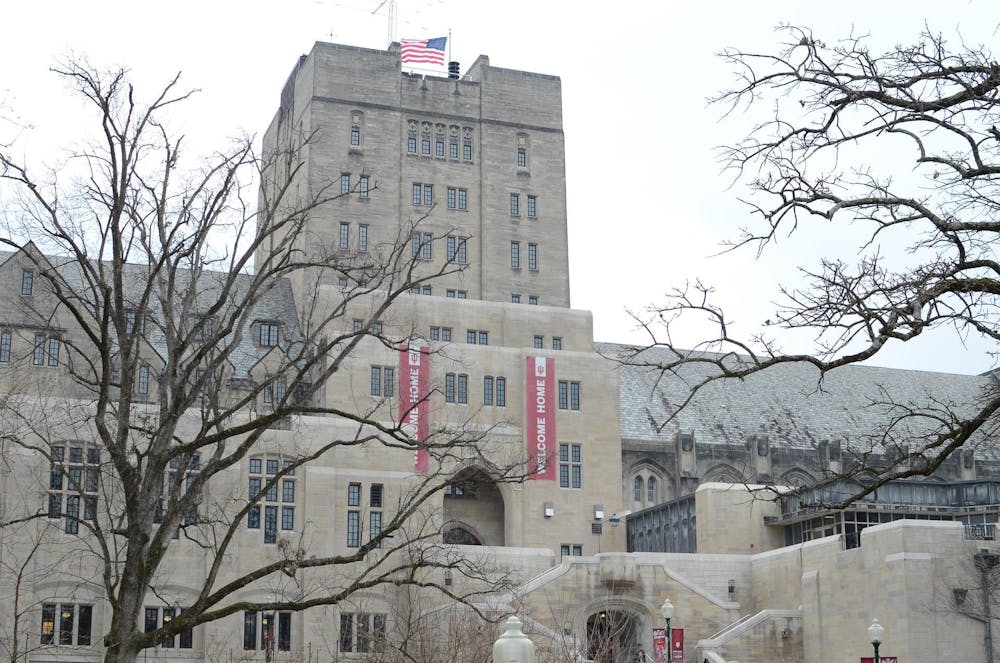
Buildings on campus that look like they could be limestone probably are. The same goes for any kind of carving on campus — it’s a pretty safe bet. Indiana limestone is integrated into nearly every building at IU, providing campus its coherent architectural scheme. From Sample Gates to Ballantine Hall to the Indiana Memorial Union, each IU landmark fits like an element of a larger whole.
Limestone is ingrained in more than just our surroundings, though. The Little 500 men’s champions in 2023, the Cutters, got their name from — you guessed it — cutting limestone.
The Cutters first appeared as the protagonists of the 1979 film “Breaking Away,” which tells the story of a group of underdog Bloomington locals who go on to win the Little 500. “Cutters” is meant to be a slight on the locals, many of whom have personal ties to the limestone industry, coined by a group of wealthy IU students. The name is still used today, although the Cutters are no longer underdogs. The limestone-born bikers hold a record 15 Little 500 championships.
I’d like to think limestone is also ingrained in our spirits as a source of Hoosier pride. Indiana limestone built this country, and Monroe County is one of only a few sources of the pure material in the world. If we didn’t already have Hoosier the Bison as our mascot, maybe we could’ve had Limey, the friendly limestone slab. Though decidedly less warm and fuzzy, Limey would have made a much more relevant representative of IU’s contemporary history.
There’s a life lesson in the history of Indiana limestone, though it might be buried deep below the surface. If you can be both strong and shapeable — solid enough to weather the elements, but yielding enough to be carved into something intricate — don’t worry. You might be stuck in your quarry right now, but you can go anywhere in the world, my sedimentary friend. Wherever you end up, just don’t forget where your Paleozoic precursors deposited you.
Spencer Schaberg (he/him) is a sophomore studying microbiology.