Editor's note: All opinions, columns and letters reflect the views of the individual writer and not necessarily those of the IDS or its staffers.
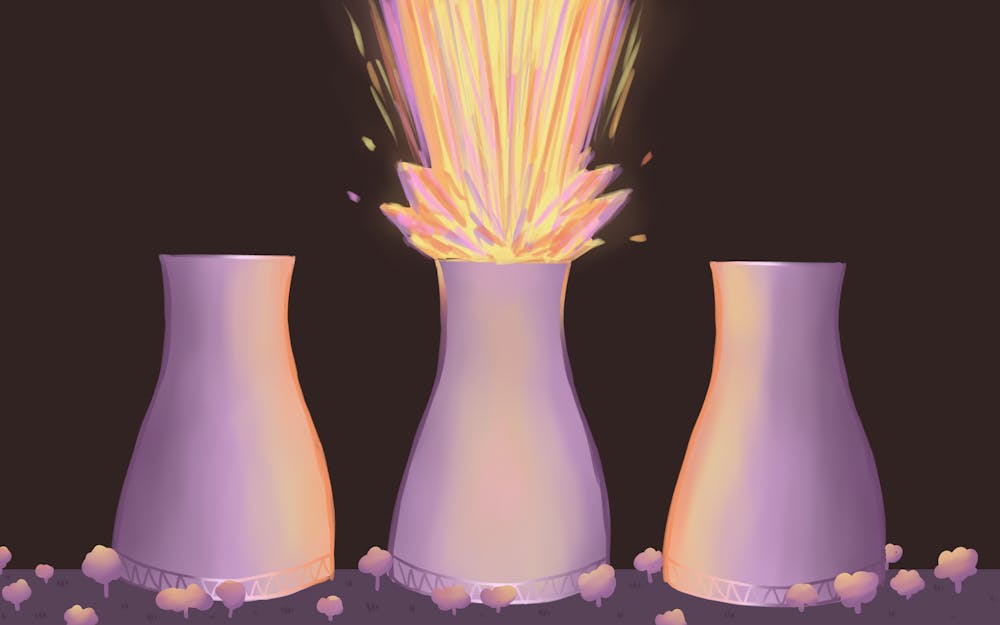
On April 26, 1986, Reactor No. 4 of the Chernobyl nuclear power plant exploded during a test of its emergency water cooling system. The resulting fallout released 400 times more radioactive material into the atmosphere than the atomic bombing of Hiroshima, contaminating an area of about 58,000 square miles. At least 30 people died, and thousands more from around the area have since been diagnosed with illnesses linked to radiation exposure.
But the tragedy at Chernobyl was even more devastating than its human toll.
In 1986, the world was in the midst of a nuclear renaissance: in the early 1980s, global nuclear power generation had been increasing by an average of 15% per year. Then the disaster struck, shattering public trust in the most powerful green energy source on the planet.
This Sunday will mark the 40th anniversary of the Chernobyl disaster. Even four decades on, though, nuclear energy remains shrouded in suspicion. Whether shaken by similar incidents at Three Mile Island in 1979 and Fukushima Daiichi in 2011, or simply unaware of the safety and efficiency of modern reactors, the masses remain divided on nuclear power — at least in the West.
In Asia, 55 nuclear reactors are in construction, and about 60 more will be built in the near future. Nuclear output in Europe and North America, by contrast, is stagnating. Other countries are seeing what we’re not: that nuclear power is not the unstable, waste-dumping villain we make it out to be.
Most nuclear energy comes from nuclear fission, where atoms of unstable elements like uranium or polonium split apart to release neutrons, other elements like cesium and iodine and a burst of energy. The neutrons from these fissions slam into other atoms, causing a power-generating chain reaction. The key to avoiding a meltdown is to keep this chain reaction at a constant, stable rate — something the Chernobyl reactor failed to do as a result of operator error and deficient protocols.
To maintain that stability, nuclear reactors rely on control rods. These long bars, forged from neutron-absorbing material, can be lowered into the reactor core to slow the reaction down. Nuclear plants automatically lower these rods in the case of any emergency, including a complete power outage.
In the absolute worst-case scenario of a nuclear meltdown, reactors are designed to fail without releasing their radioactive contents. The Three Mile Island reactor did just that when its core melted in 1979 without releasing any harmful level of radiation.
Thousands of sensors monitor reactors at all times, technicians carry out tests on a regular basis and reactors are routinely inspected by regulatory bodies like the International Atomic Energy Agency and the U.S. Nuclear Regulatory Commission. If you’re still not convinced of their safety, consider that over the course of 70 years of nuclear reactor operations — across 665 reactors, past and present — only three major incidents at power plants have ever occurred. And only one of those incidents took place after 1990.
But operational safety isn’t the only aspect of nuclear power underestimated in the public eye. Contrary to what “The Simpsons” — and particularly Blinky, the three-eyed mutant fish — might have you believe, nuclear waste is handled with a great deal of care and planning in the real world.
First, spent fuel rods are removed from their reactors and transported to a specialized pool to cool off over a five-year period. From there, technicians seal the spent fuel into leak-proof steel containers. They then store the containers in enormous concrete vaults filled with non-reactive gas. The entire process is meticulously designed to ensure no radioactive waste escapes into the environment.
The best thing about nuclear waste disposal, though, is that there isn’t much to dispose of. Thanks to nuclear fuel’s high energy density, reactors require small quantities of fuel, which produce proportionally small quantities of waste. As of 2019, all the nuclear fuel ever consumed by the U.S. nuclear energy industry could fit into a 30-foot-high stack across the area of a football field.
Nuclear fuel is so energy-dense, in fact, that just a hockey puck-sized piece is enough to supply all the energy a person needs for their entire lifetime. Did I mention nuclear energy produces near-zero carbon emissions?
Nuclear dominates other green energy sources, like wind, hydroelectric or solar, in terms of reliability and efficiency. Nuclear reactors can produce power regardless of the weather, require only a small area of land and operate at maximum capacity for more than 92% of the year. For context, even oil and natural gas plants are only producing maximum power about 55% of the time.
The safety, efficiency and sheer power of nuclear energy make it the ideal green energy candidate to transition our civilization away from noxious fossil fuels. According to one study, global nuclear power has already prevented an estimated 1.8 million deaths due to air pollution.
That number could have been even higher. Based on estimates linking air quality to life expectancy, post-Chernobyl nuclear energy stagnation allowed fossil fuel emissions to claim an estimated 318 million years of human life globally. Assuming a 75-year average life expectancy, that’s the equivalent of more than four million lives lost — purely from the blow to nuclear power’s reputation.
If we want a chance at saving our planet from a suffocating haze of oil and gas emissions, it's time to embrace a long-neglected ally. Nuclear energy is our path forward: It’s the most reliable, most powerful and most fuel-efficient green power source around.
Of course, nuclear carries some risk — as every energy source does. But there’s a difference between exercising reasonable caution and letting decades-old ghosts haunt green energy’s top producer. If we’re looking for clean energy on a global scale, we’ll need to seriously reexamine nuclear energy’s reputation.
Spencer Schaberg (he/him) is a sophomore studying microbiology.