Editor's note: All opinions, columns and letters reflect the views of the individual writer and not necessarily those of the IDS or its staffers.
There is an app on my phone that I check, occasionally.
It is called Snapchat. Its most frequent users are members of Generation Z, and its most relevant feature is that posts vanish after 24 hours, a design choice that selects for the ephemeral and, therefore, for the uninhibited.
At Indiana University, this ephemerality accumulates in a loose constellation of class-based groups that people can post stories to: IU 2026, ’27, ’28, ’29 and so on. What you find in these groups is mostly ordinary. There are advertisements for sublets, free futons and last-minute ticket sales to football and basketball games.
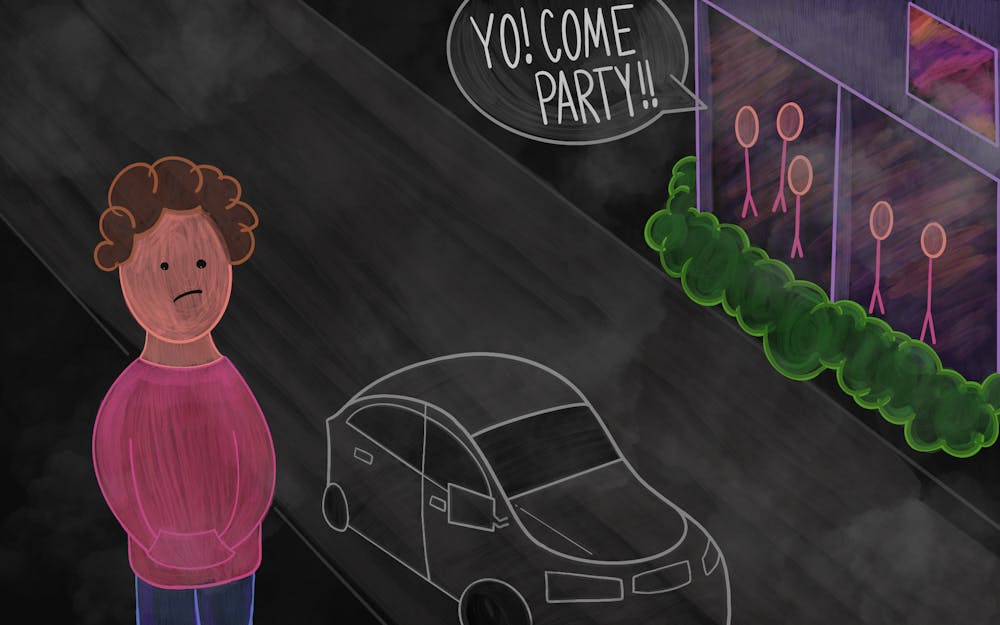
But after hours, the mundane commerce of student life retreats before advertisements for fee-seeking parties — unless you’re a woman, in which case entry will be free of charge. It also retreats before early morning Little 500 ride-home offers, used toothbrushes for sale and heat-of-the-moment attempts at publicly shaming line cutters terrorizing the Cream and Crimson Carnival.
The range of topics is broader and, for the most part, more wholesome than those on Fizz, Yale University's student-exclusive social media app that skips the ordinary and goes straight for the uninhibited. A columnist at the Yale Daily News described that app’s advertisements primarily as anonymous solicitations of intimate encounters. IU Snapchat, at least, has room for the socially moored.
Still, the topics that do exist on IU Snapchat raise interesting questions concerning the secret lives of IU students:
Who’s going to these parties?
Are people accepting these rider offers?
Is Snapchat a more economical option than the trash can to dispose of my old toothbrush?
I have never met anyone who confessed to attending a party so advertised, nor anyone willing to admit they hopped in a stranger’s rideshare during Little 500 weekend when an Uber was also available. This makes IU Snapchat something of a red-light district. It’s a neighborhood in our backyards. No one admits frequenting there; yet, somehow, it stays in business. The downside is that the demand side of this market is, sociologically speaking, a mystery.
But the supply side recurs with a regularity that demands, and may be open to, an explanation. Each new freshman class produces, without apparent instruction by its predecessors, a fresh cohort of people willing to make these offers. And so, the question is not only who accepts the offers, but who makes them? And why, in the seemingly likely scenario that no one will take a stranger’s late-night ride, do they persist year after year?
These groups are a kind of tradition, yet they lack what theologians have called “traditio” — the actual, deliberate handing-off of the practice from one generation to the next.
The problem to decipher here is not unlike the spontaneous recurrence of “McMosh,” the several nights of freshman parties at McNutt Residence Hall, year after year during Welcome Week.
Surely, no senior is mentoring a freshman in the customs of IU Snapchat. But every year, the same conditions reassemble: an understandable hunger for belonging at a large university, where you may not yet know anyone patient enough to hear your complaints about line cutters, and, in the case of the pay-to-partiers, an appetite for alcohol that the law has not yet made licit.
But said conditions mean the worst of IU Snapchat — the ads for paid parties, strange rideshares and used toothbrushes — do not just reflect the undergraduate desire for belonging, but endow it with a sick structure. Paying to party puts an informal toll on belonging, and free entry for women treats an entire demographic’s presence as a commodity.
What would have to change about IU for these posts to vanish altogether? I imagine the creators of Indiana Memorial Union Late Nite had such an ambition, to satiate students’ hunger for fun and belonging. The idea is much like when St. John Henry Newman introduced billiard tables to University College Dublin in hopes of eliminating the incentive for students to venture into the city’s nightlife. The sanctioned institution was invented to replace the transgressive one.
But the fringes will always exist and attract crowds.
And so, I suspect, IU Snapchat will always exist.
Eric Cannon (he/him) is a sophomore studying philosophy and political science and currently serves as a member of IU Student Government. His editors spared IDS readers from the 100-word sentences he connived to unleash in this column.