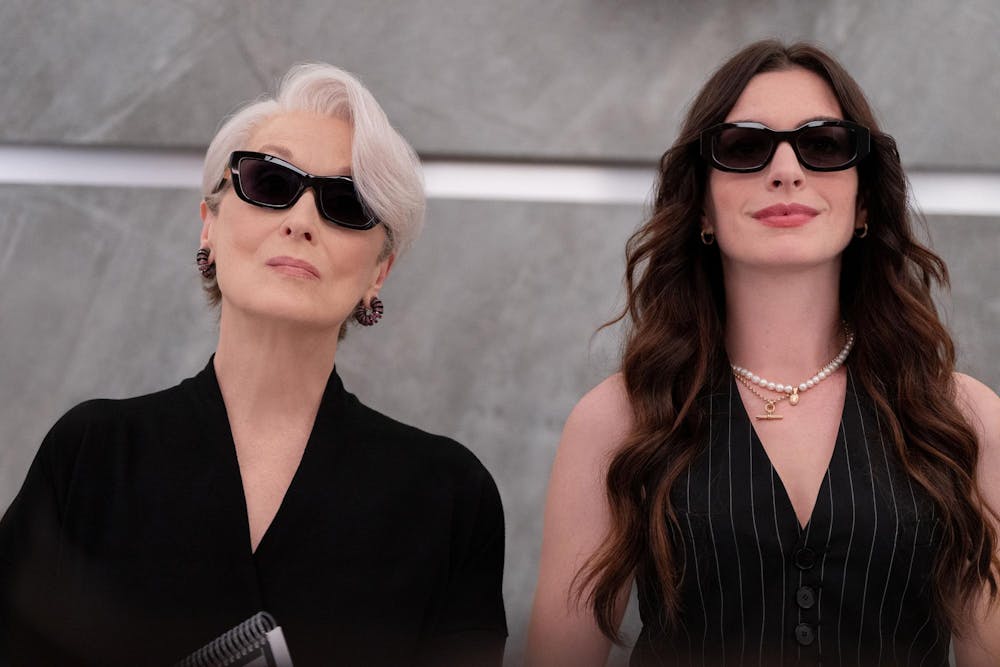
“The Devil Wears Prada 2,” released May 1, returned to the fashion world with a modern twist that blends real world issues with nostalgic callbacks that still land.
It’s a fun and upbeat film with plenty of standout moments, but even with all the sequins and glam, the sequel doesn’t surpass the original.
Set two decades after the original film, the sequel follows Andy Sachs (Anne Hathaway) as her life continues to unfold after walking away from “the job most girls would kill for” at Runway, where she once worked under the iconic Miranda Priestly (Meryl Streep).
The original film focused on themes of ambition and identity, centered on the importance of following your own path. And this sequel revisits those ideas through a more contemporary lens, while also highlighting modern issues such as the decline of print journalism, the rise of generative AI in creative industries and the ongoing struggle to preserve artistic integrity.
The sequel opens with Andy working at a traditional newspaper when, driven by the increasing use of AI in newsrooms, a public relations crisis leads to layoffs for her and her entire team. From there, she unexpectedly finds her way back at Runway, this time working as an editor and tasked with restoring credibility to the magazine as it struggles to stay relevant in a constantly changing industry.
Beneath all the humor, the film taps into a real sense of anxiety and fear within creative fields, especially journalism, as technology such as AI continues to reshape industries. It highlights a growing concern across many different fields about “being replaced” and the fear of losing authenticity in the process of it all.
The film perfectly balances highlighting those existential issues, while also creating an enjoyable and humorous watch. It never fully loses that light, comedic tone, but it also doesn’t shy away from moments that feel very real and relevant to our world today.
One of the most surprising elements of the film for me is Miranda’s evolution.
While still sharp and commanding, her character softens slightly as she navigates a workplace with more inclusivity. The film features several humorous moments that show how someone like Miranda would have to adjust to a kinder, more body-positive fashion industry, one that’s very different from what viewers saw two decades ago. She doesn’t lose her edge, but she does gain a level of dimension I don’t think we saw in the first film, offering a more human portrayal of her character.
Overall, the tone of the film feels gentler and less focused on the toxicity of the fashion industry than the original.
It spends less time critiquing appearances and more time focusing on personal growth and professional identity, especially through characters like the new first assistant Amari Mari (Simone Ashley) and Charlie (Caleb Hearon), the second assistant.
As expected, the fashion within the film was a highlight. With an estimated budget of $100 million everything to the smallest details was beautiful. From tailored suits to statement accessories, every carefully-picked piece felt intentional and visually striking.
The costuming also reflects the characters’ growth over the two-decade gap. Andy’s wardrobe leans toward structured, more confident pieces, like suits, that signal her maturity and how much she has come into her own. In contrast, returning character and somewhat villain of the story, Emily, (Emily Blunt), is frequently seen in edgier Dior looks that reinforce her established status in the industry, as well as her struggle to let others in.
However, the biggest drawback for me in the film was the lack of a true main character. Unlike the original, where it was clearly Andy’s story from start to finish, this sequel divides its attention much more equally between the cast.
I enjoyed getting more moments with characters like Nigel (Stanley Tucci), who brings back his signature charm and perfectly witty comments. But that meant the narrative overall felt less grounded than the first film. Without a clear emotional arc to anchor it, the story moves between multiple plotlines that, at times, I thought struggled to fully fit together, making it all feel a bit uneven compared to the original.
Still, the film remains an enjoyable and refreshing watch, carried by extremely strong performances, sharp visuals and relevant themes. It may not outshine the original, but it does ask big questions about our culture today while allowing viewers to revisit the beloved world of Runway once more.