
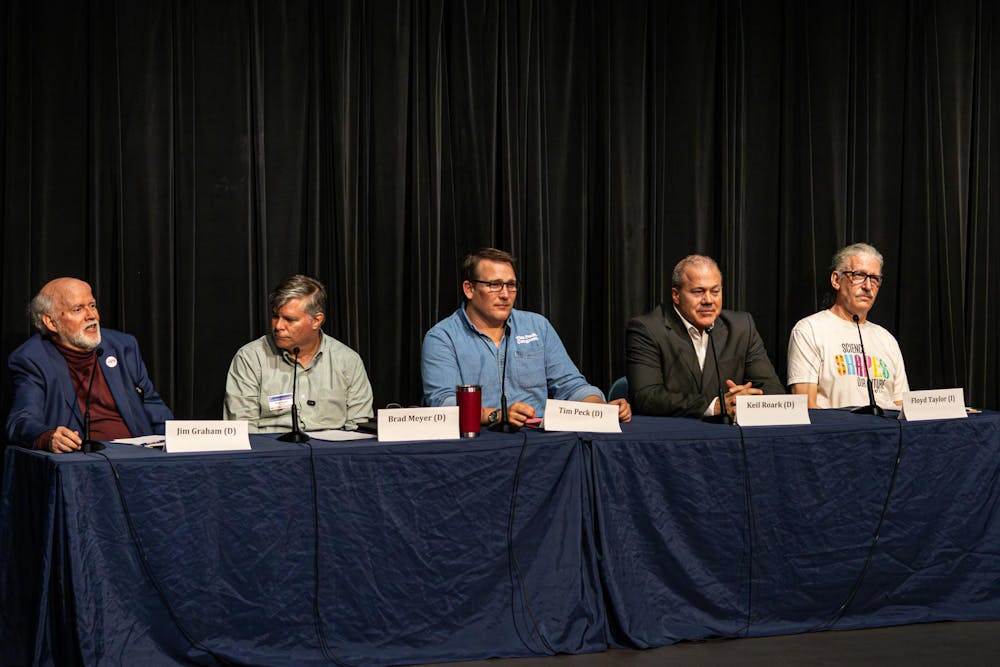
Five out of six District 9 primary congressional candidates discussed federal funding cuts, healthcare costs and data centers at a Concerned Scientists at IU forum Tuesday night at the Monroe County Public Library.
Democratic primary candidates Jim Graham, Brad Meyer, Tim Peck, Keil Roark and independent candidate Floyd Taylor participated. Incumbent representative Republican Erin Houchin was also invited but unable to attend, according to the Concerned Scientists website.
Indiana’s 9th Congressional District includes southeastern Indiana, reaching the Kentucky border and across to as far north as Franklin County on the eastern border. Houchin currently represents this area.
The event was moderated by sophomore Emma Broach and senior Tyler Morris, members of Advocates for Science at IU. Advocates for Science is a student affiliated organization of Concerned Scientists at IU.
Candidates were asked to respond to three questions from CSIU, which covered federal research funding cuts, healthcare, environmental regulation and climate change.
Federal funding for research cuts
Since 2025, the federal government canceled or suspended 5,844 National Institute of Health grants and 1,996 National Science Foundation grants. In the proposed 2027 budget, President Donald Trump suggested a 23% or $5.6 billion dollar decrease in funding for NASA.
All candidates agreed funding research was important and wanted it to be re-instated by reversing previous budget cuts.
Graham said research was an important tool in funding the economy. He said removing funding from scientific research was like “killing the golden goose.”
Roark also mentioned the importance of continuing to fund patent offices to encourage innovation.
Taylor said one of his goals, if elected, would be to protect scientific research funds from changing political views so that funding would not change based on the elections.
Healthcare
Broach asked the candidates what congressional actions they would support to strengthen public health in the United States. She cited changes to Medicaid and vaccine policies.
The One Big Beautiful Bill Act of 2025 reduces federal funding for Medicaid by an estimated $863 billion, according to the Commonwealth Fund. The bill also changes eligibility requirements, including barring non-citizens including refugees and asylees and requiring some recipients to work at least 80 hours a month or attend school at least half-time.
Roark advocated for the Affordable Care Act subsidies, which make health insurance available to more people by providing consumers with subsidies that lower costs for low-income households. It also works to expand Medicaid coverage to more adults.
On the other hand, Meyer said to strengthen public health, Medicare needs to be accessible for all. He also said that the current changes to healthcare could cause more than just a lack of accessibility for people.
“We need to stabilize hospitals, and we need to make sure that people don't go bankrupt,” Meyer said.
Peck emphasized the importance of restoring trust in healthcare institutions through transparency and investment into local healthcare. He also suggested implementing federal programs to pay off student loans for doctors who work in rural hospitals.
Climate change
Broach asked the candidates what their goals for climate change policies are, following the Trump administration pulling the United States out of the Paris Agreement in 2025 for the second time.
The Paris Agreement was originally signed by 195 parties in 2015 and is an international agreement to limit global warming.
Peck said he hoped to see more federal involvement with efforts for clean energy sources, including placing solar panels on federally owned land like highway medians or brownfields, which are abandoned locations facing hazardous contamination like a chemical spill.
“We need action now, and we have an addiction to fossil fuels that we need to rid ourselves from,” Peck said.
Roark also encouraged greater use of renewable energy and, like Peck, wants to push for less fossil fuel use. He said he wants a “shoot to the moon style” push away from fossil fuels in the next five to 10 years, referencing John F. Kennedy’s challenge to the United States when he was president to make it to the moon before the end of the 1960s.
Roark also mentioned increasing the use of concrete. According to the MIT Concrete Sustainability Hub, cement, which is an element in concrete, takes in 6.5 million metric tons of carbon dioxide annually from the earth’s atmosphere in the United States.
Data centers
In a series of lightning questions, candidates also addressed data center construction in Indiana.
Traditional data centers are used to store servers and network equipment needed to access data on the internet. Now, companies are building data centers specifically to support artificial intelligence computing. According to the Data Center Map, there are over 100 centers across Indiana.
Data center construction is facing criticism across the state because of the large amounts of energy and water they require.
In 2023, data centers used 176 terawatt-hours of electricity or approximately 4.4% of total U.S. electricity use that year, according to the Lincoln Institute of Land Policy. A 2024 United States Data Center Energy Usage Report predicts data center energy use will double or triple by the end of 2028.
Both Meyer and Peck called for greater levels of transparency when building data centers in communities. Peck also suggested data centers should be built to responsibly use energy and water by doing things like building their own transformers for energy.
Taylor also mentioned his general distrust of AI because of its tendencies to make mistakes and encouraged legislation to protect children's access to online chatbots.
Roark said there should be stricter regulations on data centers, but encouraged building them for national security. Data centers are an important part of keeping pace with China and Russia’s technological advancements, he said.
The Indiana primary election is May 5 and early voting began April 7.
Information for voter registration can be found on Indiana’s Voter Portal, along with poll locations and candidate information.


