After five hours of deliberation, the Bloomington City Council unanimously postponed a vote on the Hopewell South PUD for its third consecutive meeting. The PUD vote has been moved to the council’s next regular session April 22.
A Planned Unit Development, or PUD, is a zoning district created for a specific development project that doesn’t meet pre-existing zoning standards. The Hopewell South development is the first in a series of city-led developments on the 24-acre site of the former IU Health Bloomington Hospital on the city’s west side.
In an open letter to the community released prior to Wednesday’s meeting, councilmembers Isabel Piedmont-Smith, Kate Rosenbarger, Dave Rollo, Andy Ruff, Matt Flaherty and Hopi Stosberg called on Mayor Kerry Thomson to work with the council to update the PUD for the city-led Hopewell South development.
The letter argues the current PUD falls short in “critical ways,” including by not creating permanently affordable housing, investing in street and sidewalk improvements and ensuring energy efficient buildings.
Stosberg wrote a second open letter in which she stated the administration should have worked more with the redevelopment commission, which is the petitioner for the PUD, the plan commission and city staff to ensure the PUD meets community needs. She also pointed out suggestions made by city staff that were not followed through on, unclear definitions on street parking and uncertainty about whether homeowners' associations or the city would handle infrastructure repairs for the development.
In her letter, Stosberg called a lack of involvement from city staff and no presentation to city council “concerning” and said the mayor’s administration has pressured the council to pass the PUD as fast as possible and encouraged them to subvert normal procedure by passing the PUD at first reading instead of waiting until second reading to vote.
The open letter from six councilmembers also addressed “the mayor’s contention” that city council is one of the main reasons for the Hopewell delay.
“The executive branch of local government, under the previous mayor and this one, has taken years to bring forward a development proposal, which has been before us for consideration for less than six weeks,” they wrote.
A vote on the PUD was previously delayed by city council at its March 4 and March 25 meetings after the ordinance was first introduced on Feb. 18. Thomson has published press releases and spoken at council meetings calling on the council to pass the proposal.
One of the key requests in the group’s open letter is that 25-50% of the housing in the PUD be permanently affordable, or accessible to certain income groups in the long-term, instead of the current proposal’s 15%.
The request also stipulates that 15% of that permanently affordable housing should be affordable for household earning at or below 90% of the area median income. From 2020-24, 90% of the city’s median household income was $45,418, according to the U.S. Census Bureau.
Permanent affordability was also the subject of two reasonable conditions introduced at the last two council meetings. One, sponsored by Rosenbarger, calls for 50% of the housing in the PUD to be permanently affordable.
At Wednesday’s meeting, Rosenbarger said the Unified Development Ordinance, which governs city land use and development, has a 90% median household income requirement for affordable housing. The council passed a resolution to create this requirement in September 2025.
“While this PUD does not need to do the updated requirements, they do exist, and this council did decide that 90% AMI was what we really needed in this city,” Rosenbarger said. “So it makes sense, again, that because the city owns this land, that we could do that.”
At the meeting, attorney Clark Kirkman, contracted by the city council after the legal debate at the previous week’s meeting, addressed questions from councilmembers about what constitutes a reasonable condition — a change to a PUD that doesn’t amend what a city commission approved before sending it to city council.
Alli Thurmond Quinlan, founder of Flintlock LAB, the architecture firm contracted to design the PUD, also answered questions from the council about some of the proposed reasonable conditions.
Piedmont-Smith said she is losing trust because the city administration’s legal stance on what reasonable conditions the council can pass contradicts what the council has been doing for years.
Rosenbarger encouraged the council to vote on the reasonable conditions; Stosberg pointed out that passing reasonable conditions could serve as guidance to the plan and redevelopment commissions if the PUD is sent back to them for further changes.
David Hittle, director of the Department of Planning and Transportation, which is overseen by the redevelopment commission, said that the council’s debate over Hopewell was “staggering,” and their involvement was “meddling is the best word, in something they shouldn’t be.”
“This is plan commission material if anything,” Hittle said.
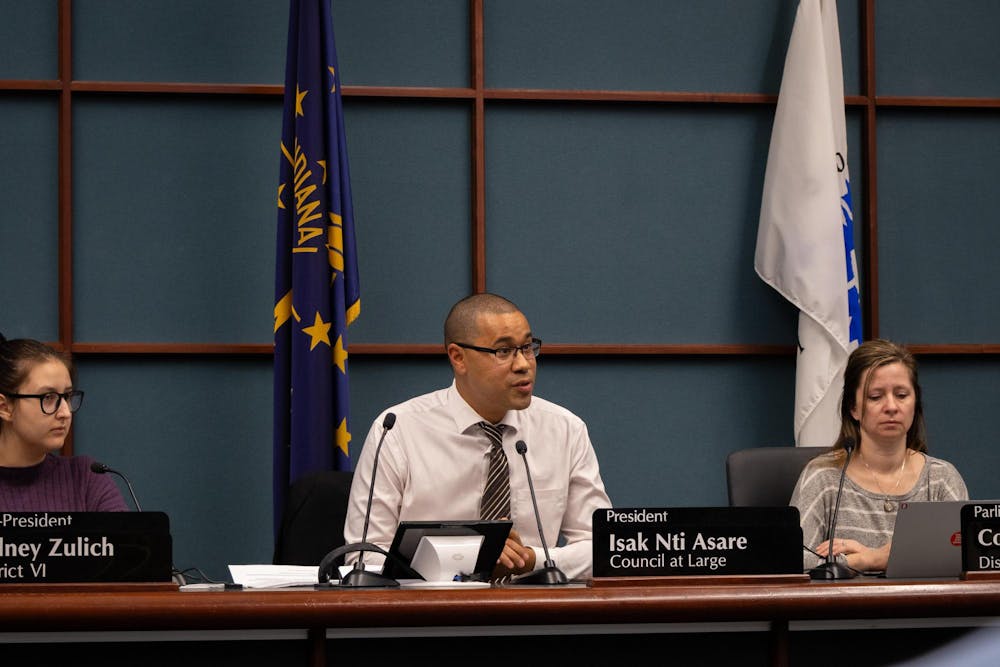
The meeting was at times contentious, with Council President Isak Nti Asare going as far as apologizing to Quinlan for the way she was questioned.
Before the council postponed the vote, Thomson said she was willing to work with the council to get the PUD finalized by its May 6 meeting, however the postponement had to be for the next regular session date, April 22.