
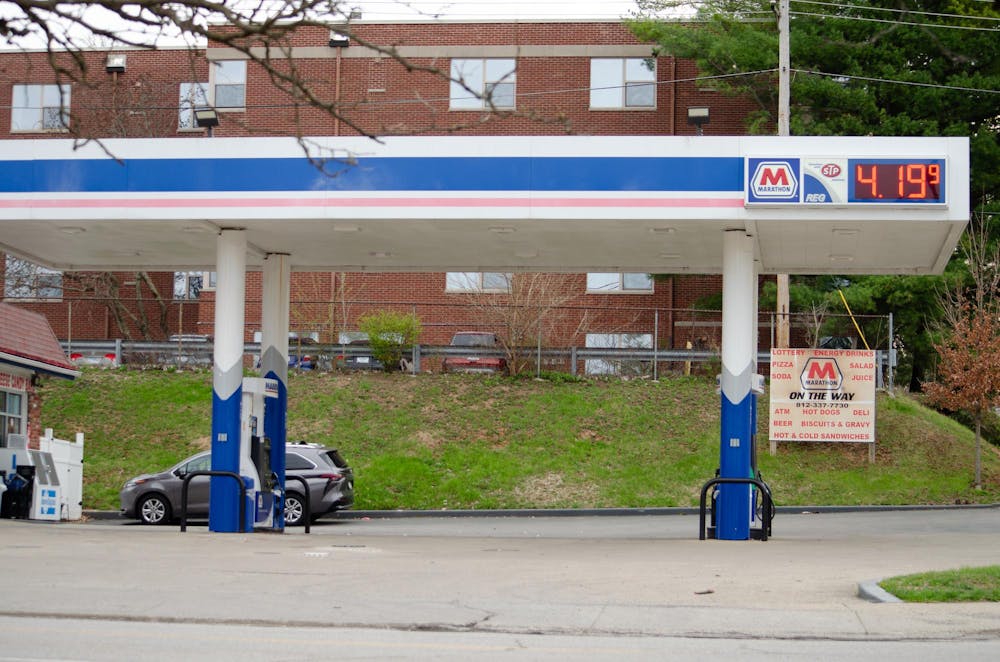
Peyton Ashley drives Garfield, her orange Jeep Wrangler, to the gas station at the start of every week to fill her tank up with $15 worth of gas.
Ashley lives on campus so she can walk to most places, but she still has to drive to her internship on weekdays. She carpools with her friends when possible. She hopes gas prices don’t rise more than they already have.
Ashley, an IU senior, hopes to move to Indianapolis for dental school after graduation and said she hopes to mostly travel via public transportation if prices continue to rise.
“I think this price right now, I can deal with,” she said. “I think nowadays, especially if you're making car payments, you have insurance and gas, it's almost cheaper to Uber everywhere.”
As of April 5, the average gas price in Indiana is $3.911 per gallon for regular gas. For Monroe County, the average is $4.156 — one of the highest in the state.
National prices rose by $0.50 per gallon in one week at the start of March, primarily because of U.S. war in Iran and the latter country’s control of the Strait of Hormuz — a shipping channel off the country’s southern coast where 30% of the world’s seaborn supply of crude oil passed through daily.
In January, the national average was as low as $2.907 per gallon. Now, after an almost 50% increase in prices, the national average is $4.11.
Gerhard Glomm, a professor in the IU Department of Economics, said the rising cost of gas came as no surprise to anyone who studied economics, but since oil is a durable good, a product that can be stored after harvesting, the future of the oil market is a bit harder to predict.
“The markets will not just respond to, say, supply and demand conditions today,” he said. “They can decide when to take the oil out of the ground. They can take it out of the ground today or they can take it out of the ground tomorrow or they can take it out of the ground next year. If firms and these oil companies are reasonably rational, they're going to make forecasts on how long this military intervention lasts.”
Glomm said that while large oil investors will not feel a great impact from the rising costs, for some time, low and middle-income people, like many IU students, will.
Census tracts 2.01 and 2.02, which make up most of IU’s on-campus housing, have an average income of $5,476 and $4,382 respectively.
Like Ashley, many students might make the choice to carpool or use public transit, he said.
But some students live far enough away from campus that driving is the only realistic option, Glomm said. If prices hold steady or continue to rise, students who must drive and do not have much disposable income will have to make sacrifices in other ways.
As people budget for rising prices, certain items typically get cut out first. Glomm predicted students impacted by the rising gas prices will eat more cost-efficient food, utilize campus food pantries and postpone shopping for nonessential goods to compensate for their gas budget.
“My guess would be for people at the bottom end of the income distribution, there are going to be all kinds of adjustments,” Glomm said. “And those adjustments are going to be even more painful if this war lasts a long time.”
A worker at the Circle K gas station on Indiana Avenue and Third Street has noticed business change as gas prices continually rise.
The worker, who requested not to be named due to not knowing the company’s policy on interviews with the press, said she has worked at the gas station for eight years.
She said the number of customers has “greatly gone down” since prices started to rise. Those that still come rarely purchase a full tank.
Most customers don’t complain to her directly about the prices, the worker said. She still wishes customers understood how little power she and other service workers have with the prices.
“Remember that we are little robots in a much bigger sea of people, and the people who are actually doing this are billionaires and have never worked in my position a day in their lives,” she said.


