The Bloomington City Council spent much of its four-hour Wednesday meeting discussing, and eventually delaying, a vote on a Planned Unit Development meant to increase the number of homes the city can build at the Hopewell South development.
The proposed PUD at Hopewell South has been hailed by Mayor Kerry Thomson as a potential test run for future changes to the city’s Unified Development Ordinance, which governs city development and land use.
The planned development, along the southern portion of the former IU Health Bloomington Hospital site, would make up 6.3 acres of the 24 acres the city purchased for the Hopewell development.
The ordinance to create a PUD at Hopewell South was introduced for second reading at the council’s Feb. 18 meeting, where the vote was delayed. The council again decided not to vote on the proposal at its March 4 meeting.
In a series of written questions from councilmembers about Hopewell included in Wednesday’s meeting packet, councilmember Matt Flaherty asked 28 of the 46 total questions, including questioning if the proposal meets the UDO standards for creating a PUD.
When speaking to the council Wednesday about Hopewell South, Thomson urged that party politics be left behind to make progress on the development.
“We have an opportunity today and an obligation into the future to set a clear path for what housing in Bloomington can be, and just as importantly, how we lead together to make it happen,” Thomson said.
Thomson also said “there is no housing utopia,” and called on other city leaders to choose a few priority areas when pushing the Hopewell development forward, saying no project can meet every single goal.
“There are trade-offs, and we need a vision that we can actually deliver on,” Thomson said. “And I believe you have that in front of you today.”
Councilmembers proposed 13 “reasonable conditions” for the PUD. Before the vote to delay considering the PUD, councilmembers voted to pass three of those conditions, which required the developer to set updated project goals, establish plans for the development phases and follow certain clean energy restrictions.
The conditions are meant to be additional requirements for the PUD that would not amend the plan already approved by the plan commission, according to a memorandum in the meeting packet from City Corporation Counsel Margie Rice. The plan commission recommended the PUD proposal to the council on Feb. 9.
Rice told the council that in Indiana, legislative bodies cannot alter or amend an already certified PUD, and that nine of the reasonable conditions proposed should be considered amendments because they were not consistent with what the redevelopment commission and plan commission approved.
“I think if you amended the PUD tonight, which I think those nine are amendments, I think it would be operating outside the bounds of law, and I think that would be impermissible,” Rice said.
Councilmember Dave Rollo asked Rice if she had discussed the conditions with the redevelopment commission, and she explained the legal standard for what the commissions have approved is based off only what they’ve previously said and approved in public meetings.
Councilmember Kate Rosenbarger said that in her opinion, reasonable conditions are meant to be open-ended, and multiple councilmembers questioned Rice’s interpretation, saying past councils had added reasonable conditions to other PUDs.
“I mean, we could say every lot needs to have chickens,” Rosenbarger said. “That’s what a reasonable condition is.”
Thomson told the council that her understanding from the approval process for past PUDs was that petitioners — in this case, the redevelopment commission — can agree to amendments that are passed as reasonable conditions, even if they don’t actually qualify as reasonable conditions. She also said some of the council’s proposed conditions contradicted each other and would create a bad financial situation.
“If we were to agree to all of these, we would then be missing the mark on affordability, and so we then are in a ‘Catch-22,’” Thomson said.
After the debate over reasonable condition legality, multiple councilmembers, including Council President Isak Nti Asare, expressed concern that the city council doesn’t have its own lawyer to consult. Rosenbarger urged the council to hire a lawyer within the coming week. The B Square Bulletin reported on Feb. 26 that both city council attorneys resigned.
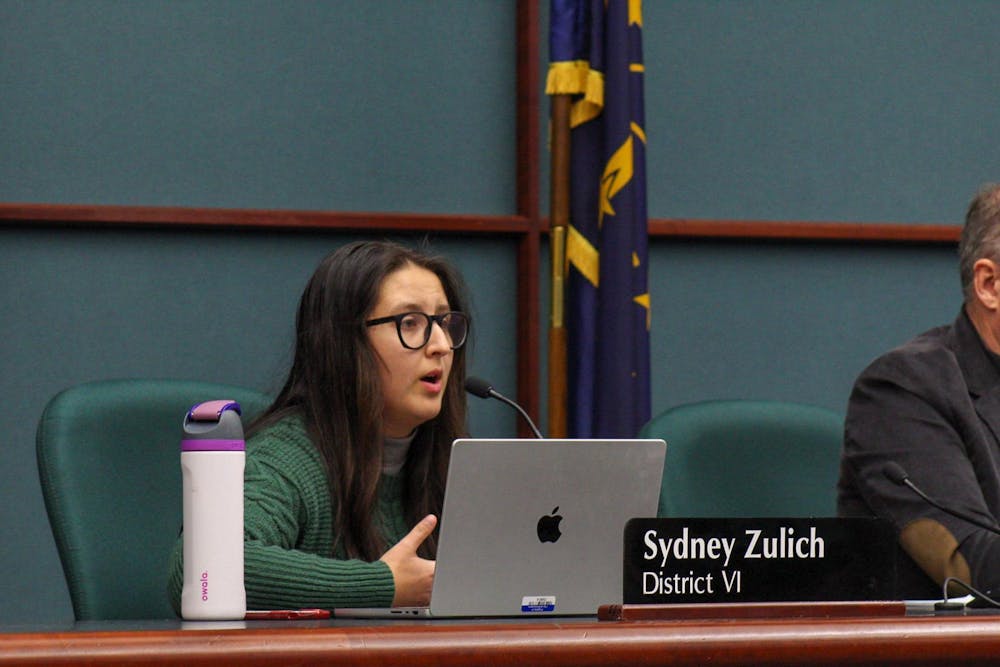
As the council decided to delay the vote, Council Vice President Sydney Zulich noted that the city’s involvement in the Hopewell development began in 2017, when she was 14 years old, and that she is the only councilmember who is not a property owner.
“So the people of this city deserve results, and that is why I’ll be voting against postponement,” she said.
The vote to postpone a decision on the PUD was 6-3, with councilmembers Zulich, Asare and Courtney Daily voting against postponement.
The council also delayed a vote on a resolution sponsored by Flaherty directing the city’s plan commission to prepare a proposal to amend the UDO. It would reduce lot sizes in four residential zoning districts and increase renewable energy requirements for developers receiving sustainability incentives, among other things. Multiple councilmembers said the resolution should wait until a vote is made on the Hopewell PUD.
Both the delayed ordinance to create a Hopewell PUD and the resolution sponsored by Flaherty were pushed to the council’s April 1 meeting.