
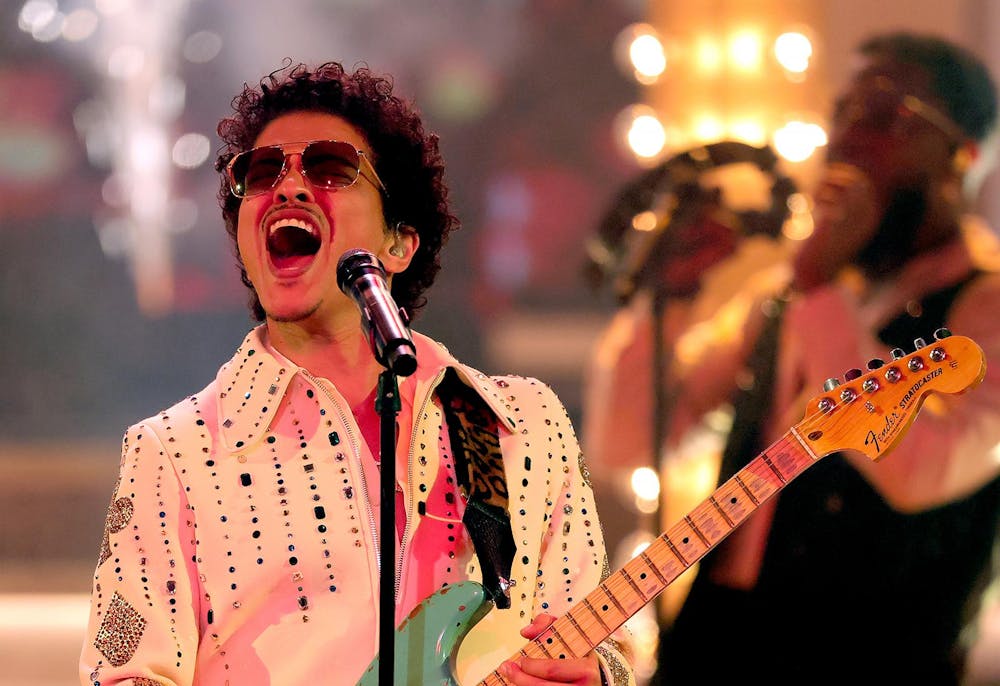
Upon first listen, I could only think, “Wow, this man cannot write a bad song.”
After a decade of solo silence marked only by the detour of his award-winning Silk Sonic, a collaboration between Bruno Mars and Anderson .Paak, Mars has finally stepped back into the spotlight with “The Romantic,” released Feb. 27.
Before the album starts, the expectation and style of a Mars record has already decided your mood. An immediate sense of warmth defines his new album and makes this record such a fascinating case study in “preservationist” production.
It’s a 31-minute masterclass where co-producer D’Mile’s analog touch meets Mars’ devotion to 1970s soul, rock and classic beats.
The tracks on “The Romantic” feel varied and experimental in instrumentation, but deeply traditional in soul. Even though Mars’ could be previously defined by the neon-soaked punch of ‘90s New Jack Swing, Mars has shifted toward an organic sound that feels like a snapshot of a golden era.
If there’s a perceived centerpiece to this new direction, his song “Risk It All” is it.
Listening to the arrangement, you can hear Mars building an emotionally-charged structure that pulses with the energy of a live performance. There are intense mariachi-style horns and nylon-string guitar flourishes followed by passages that lean into something more intimate. The song reflects the album’s tension between pop stardom and pure musicianship without ever feeling overstated.
What makes the album “musician-grade” though isn’t just its huge artistic range, but also its control.
“Something Serious,” another track on this latest album, also brings together this type of integration, where the bossa nova rhythms and electric guitar act like a second heartbeat in the song, pumping tension into the quiet moments. The music knows when to surge and when to step back, allowing the space between the notes to do its own narrative work.
On the more classic end of the soul spectrum is “Why You Wanna Fight?” Mars’ work in this song leans into an elegance of writing where the orchestration is textured and focused on a delicate mood.
There’s an old-school sensibility to the composition, with carefully placed piano motifs and raw vocal strain, yet it never feels dated. Instead, the music functions almost like a shadow, following the emotional contours of heartbreak without overwhelming them.
The sixth track on the album, “On My Soul,” might be the only outcast, with the score of this song feeling unconventional and tonally daring. It mixes heavy brass instrumentation with a manic electric guitar solo. Though it’s different than some of the other songs on this album, it’s a track that shows exactly why Mars is at the center of a high-energy, classic soul revue.
The lineup of tracks represents a new period in Mars’ writing where there’s no single style dominating the field. Instead, we see a range of music from muscular and modern to classical. And maybe that’s fitting.
Pop music in 2026 doesn’t live solely on the radio. Today, it lives in many places.
A great album elevates our mood and gives us something to take home with us. When the year-end lists are compiled, many will focus on the chart-toppers, but the music between the choruses, under the bridge and behind every emotional beat is the connective part of the entire experience. And whatever legacy “The Romantic” leaves behind will certainly say something about what Mars believes pop music should feel like right now.


