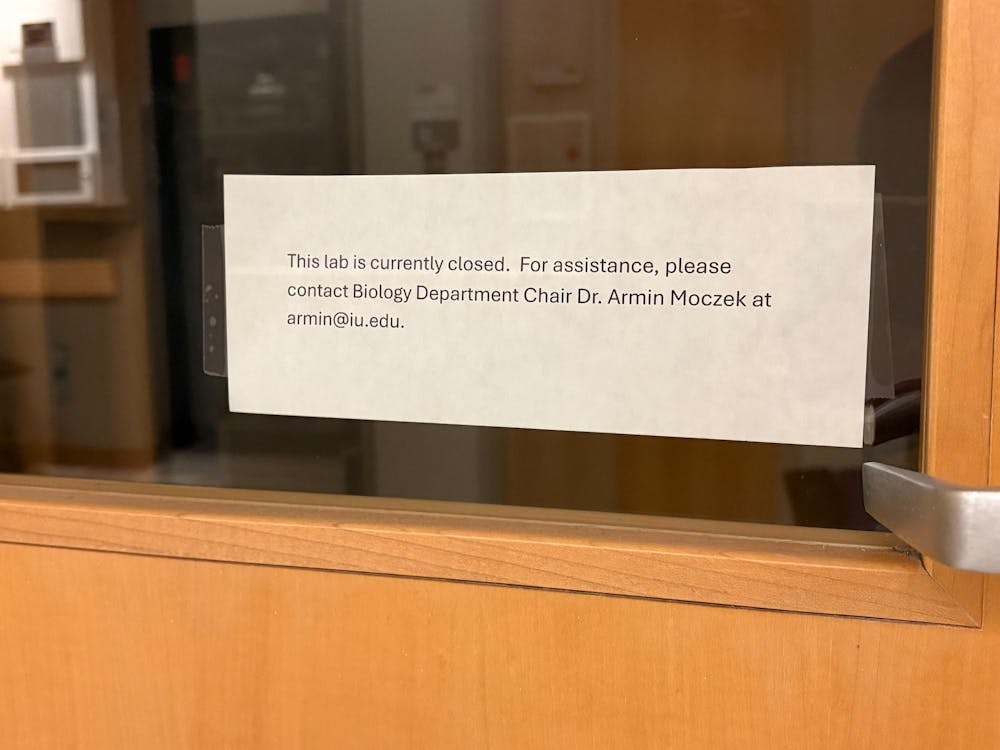
U.S. Department of Agriculture activity starting Thursday night at Indiana University’s Myers Hall left biology labs shut down and continued a chilling effect felt by researchers.
It’s become more and more common to see federal agencies targeting IU biology faculty and researchers over the past year. At least two faculty members’ labs were searched by the FBI in December, followed by a sentencing last month that deported a postdoctoral researcher.
Now Roger Innes, one of the professors who faced FBI searches last year, is facing that USDA “activity” in his lab. It’s not known when it will open again. Experiments in it are still running, one person familiar with the situation said.
Because labs in the building are connected, the activity is shutting down other labs as well.
In an email obtained by the Indiana Daily Student sent Friday, Vice President for Research Russell J. Mumper told the biology department that six rooms would be closed for USDA “activity” in a lab associated with the biology department.
“We recognize the significant disruption this has caused for the department and your research, and are committed to minimizing any inconvenience,” Mumper wrote. “We sincerely appreciate your patience and professionalism as we work as quickly as humanly possible to resolve the situation and minimize further disruption.”
History of searches
The saga started in June last year with the case of University of Michigan researcher Yunqing Jian.
She was charged with smuggling small samples of toxic fungus to the United States for research. Innes wrote a letter to the court saying that it posed “no risk to U.S. farmers, or anyone else,” countering U.S. government assertions of “national security concerns.”
“Based on the evidence, there was no intent to generate a more virulent strain,” Innes' letter said.
Jian was sentenced to time served and was deported to China. Less than a year later, one of Innes's postdocs would also be deported.
Court documents say the Michigan investigation tipped off the Indianapolis FBI office on Nov. 19 about shipments from China to IU researchers. Six days later, IU postdoc and Innes Lab researcher Youhuang Xiang would be arrested.
The U.S. government accused Xiang of smuggling plasmid DNA of E. coli bacteria in clothing. He was charged with conspiracy to commit smuggling, smuggling and making false statements.
E. coli is a common host for plasmid DNA — used to carry and replicate genes scientists are studying. That’s useful for researchers, who can splice genes of interest into bacteria for replication. The strains of E. coli used for replication and splicing are almost always harmless.
On April 7, Xiang pleaded guilty to one charge of smuggling. He was sentenced to time served, a fine and to be deported to China. Around 20 people came to support Xiang at the hearing, including Innes.
Late last year, Innes and another IU professor faced FBI searches on their labs for unknown reasons. That left many researchers, especially international students, feeling a chilling effect. One retired faculty member said the timeline was suspicious.
And some faculty are further suspicious because of the government’s framing of Xiang’s case. On Dec. 19, FBI Director Kash Patel wrote on X that he was charged for smuggling E. coli into the United States, describing it as a “global threat to our economy and food supply."
That framing blurs an important scientific distinction. Xiang was charged with smuggling the plasmids, not E. coli itself. E. coli plasmids themselves are generally harmless.
“I would like to emphasize that the use of plasmid DNA — the type of DNA Dr. Xiang is accused of having smuggled into the country — is standard practice for molecular biologists,” Biology Department Chair Armin Moczek wrote in a letter to the court defending Xiang. “So standard in fact that we teach it to freshman undergrads and high school interns.”
On the current USDA activity, one professor said he was “furious.”
What now?
Not much is known about the timeline of the current lab shutdowns or what’s next. In his email, Mumper said the university will “communicate further information once faculty and staff may return to the identified laboratory and associated spaces.”
“The university remains deeply committed to academic freedom, responsible research, and supporting the faculty, staff, and students who carry out that work,” the email said. “The actions taking place are being directed by federal authorities, and the university is cooperating as required.”
The USDA did not respond to a request for comment. IU spokesperson Mark Bode directed the IDS to Mumper’s statement, and the FBI said it was not involved in any activity.