
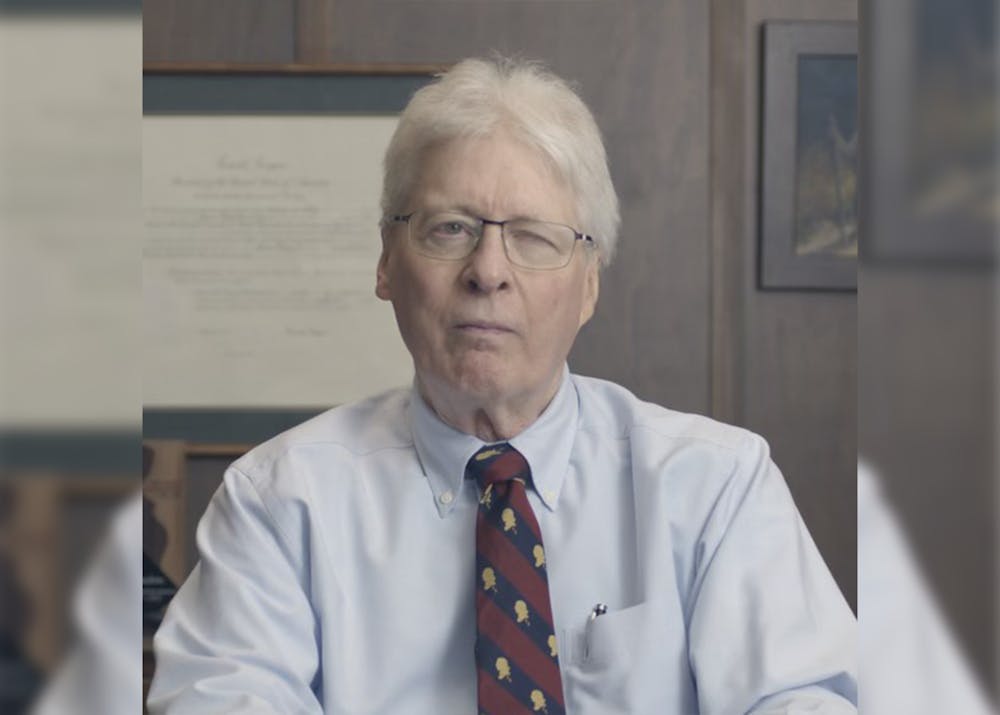
James Bopp Jr., one of IU's newest trustees, said he was appointed by Gov. Mike Braun to ensure openness and transparency in the board.
At a moment when IU has come under fire from free speech organizations and its community regarding its policies, Bopp said he didn’t want to comment on the past or ongoing events and was “forward-thinking.”
Appointed in June, Bopp was one of three trustees chosen by Gov. Mike Braun to replace three alumni-elected trustees on the board.
Bopp is a conservative lawyer and has won nine cases before the Supreme Court, including Citizens United v. FEC, which allowed corporations and unions to donate to political campaigns.
In a nearly hour-long interview with the Indiana Daily Student, Bopp talked about goals for his term and his thoughts on recent free speech controversies at IU.
He said Braun chose to appoint him because he appreciated Bopp’s nearly 50 years of experience working with nonprofit organizations, as well as his advocacy for First Amendment issues.
“I consider it a tremendous honor and a very important responsibility that I have,” he said.
Bopp emphasized he is speaking in his individual capacity and does not speak for the university or the board. He will serve as trustee until June 30, 2028.
Free speech at IU
Bopp said he was glad the board chose to revise the expressive activity policy during their June meeting.
IU policy was initially revised to prohibit temporary structures, such as tents, without prior approval from IU the day before the start of a pro-Palestinian encampment in April 2024. The revision allowed police to arrest over 50 protesters from the encampment.
In July 2024, the Board of Trustees passed a new policy to prohibit expressive activity between 6 a.m. and 11 p.m., ban camping and require approval of structures by IU at least 10 days in advance.
The ACLU of Indiana sued IU’s Board of Trustees over the policy in August 2024, arguing it was over-broad and violated the First Amendment by prohibiting unapproved expressive activity during certain hours. In May, a judge ruled IU could not enforce the part of the policy restricting activity between 11 p.m. and 8 a.m. IU has since amended the policy to remove the rule restricting overnight activity.
“I said at the time I agreed with the ACLU’s lawsuit against that part of the policy,” Bopp said. “And so I'm very pleased that the administration had taken the initiative not to fight to the death over a policy that was really, on further reflection, not consistent with the First Amendment.”
Though Bopp said he did not want to comment on past incidents regarding free speech, saying he is “forward-thinking,” he said he sees room for improvement.
“I think we’ve got to do some work on compliance with the First Amendment,” he said. “But the administration is taking the initiative to begin that process and I’m very, very happy with that.”
In an initial interview, Bopp said he wanted to “restore” the First Amendment at IU. In a follow-up phone call, he clarified that he meant to use the word “enhance” rather than restore.
“I don’t want people to misinterpret that as me commenting on previous incidents,” he said.
Bopp said he supported the administration’s recent decision to consider adopting a set of free speech principles called the Chicago Principles.
He declined to comment on the recent removal of a social work professor from the classroom due to an intellectual diversity complaint.
“I’m not going to comment on particular incidents that are ongoing,” he said.
Bopp said he supported Senate Enrolled Act 202, which requires universities to create a process for people to submit complaints if they feel a professor is not ensuring free expression and intellectual diversity.
He said professors are hired to do specific things and should do what they were hired for and teach in the way the university requires.
"They have 100% freedom to go out on the sidewalk and say whatever they want or go to Dunn Meadow and say whatever they want,” he said. “But when you're hired to do a job, you don't have a free speech right not to do your job or not to do it in a way that the employer wants you to do it.”
When asked about IU’s recent decision to fire the student media director and cut the print edition of the newspaper, Bopp said that generally, the owner of a publication is free to decide not to print a publication at any time.
“It is not a violation of the right of free speech for them to decide that it's not financially viable to print the publication,” he said.
In a follow-up phone call, he clarified that he felt if the IDS were fully independent and self-governing, and the university was not the publisher, then any attempts to stop print would have been a violation of the First Amendment.
Goals for his term
In his time as trustee, one of Bopp's goals is to improve IU’s affordability.
The cost of tuition and mandatory fees at IU Bloomington is $12,142 per year for in-state students and $42,294 per year for out-of-state students.
“One of the most horrible things is to get out of a university with hundreds of thousands in debt with a degree that doesn’t get you anywhere,” he said. “We have a serious obligation to make sure that the education we're providing students will actually help them and benefit them in life and that they can afford it.”
He pointed to Purdue’s 14-year tuition freeze as proof that affordability is achievable. For the past 14 years, Purdue has kept the cost of tuition for both in-state and out-of-state students the same. The measure is a point of pride for Purdue.
IU has held tuition flat from 2025 through to 2027.
The state budget bill, signed by the governor in May, requires programs to have at least 15 graduates for a bachelor’s degree and 10 graduates for an associate’s degree, which resulted in the elimination or suspension of over 400 degree programs at Indiana colleges. Nearly 250 programs on IU campuses were affected, 116 of them from IU Bloomington.
Bopp is supportive of the review of degrees being conducted by the Indiana Commission for Higher Education and believes such a review will help reduce the cost of an IU degree.
“There's costs associated with all those things,” Bopp said. “And if nobody wants to take a certain minor or certain major or courses in a certain area, we shouldn't be providing them.”
He also zeroed in on civics education as an area of potential improvement.
“In 1820, Indiana University was founded as a state seminary, and it's in the Indiana Constitution that we need to prepare people to be citizens in a free country,” he said. “And that includes not only critical thinking skills, but also knowledge like civics and history.”
Politics
Bopp said he believes his position as a conservative lawyer should not be alarming to students who may hold more liberal views. He said liberal students should share his goals and vision for IU.
“Liberal students should want to be able to think for themselves and be critical thinkers and be problem solvers,” he said. “Liberal students should want to know about civics and history and all that, so they can be knowledgeable citizens in participating in our government and our political system. Liberal students should want not to have debt.”
Bopp did note he considers Braun’s opinion before making decisions. Bopp said that while Braun trusts him to make decisions on his own, he is cognizant that he could be removed if Braun so chooses.
“He's appointed me for specific purposes, and he can not reappoint me if he chooses,” he said. “And so yes, I have a responsibility to him. But look, he is the representative of the people of the state of Indiana.”


