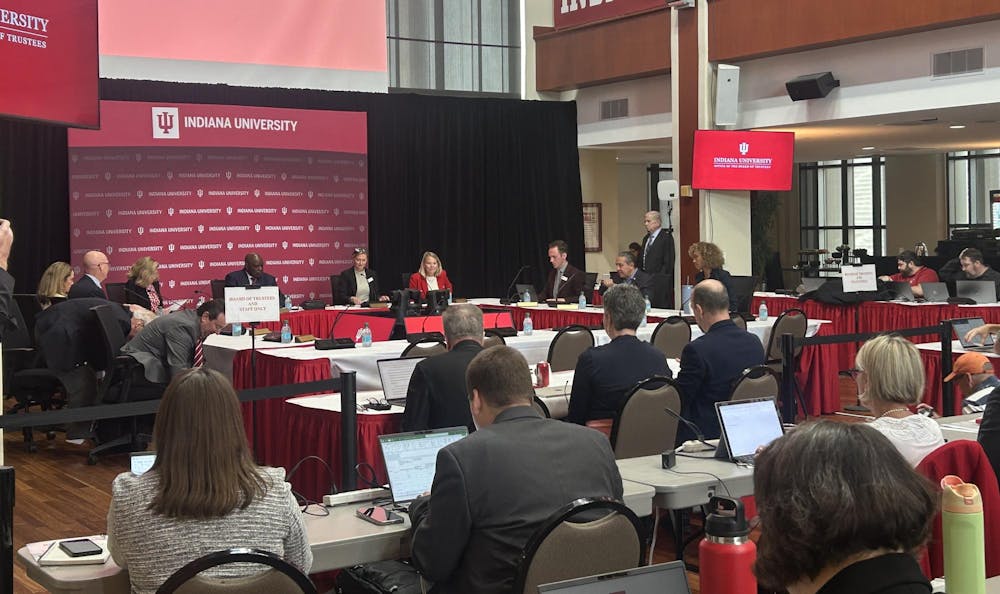
The IU Board of Trustees met June 12, the first meeting following the removal of alumni-elected trustees. The board voted to amend and create 29 university policies, with many changes occurring to meet state and federal laws. Several policies also aimed to shift administrative influence from the University Faculty Council to the Academic Leadership Council. The University Faculty Council is a body representing IU faculty, and the Academic Leadership Council consists of cabinet level administrators from all IU campuses. Because these policy changes can be difficult to understand, below are six of the most influential new policies and how they differ from previous versions.
Expressive Activity Policy UA-10
The Expressive Activity Policy was approved by the board last summer and faced criticism from students and faculty for allegedly restricting First Amendment rights and resulted in a lawsuit filed by university members and the ACLU against IU. In May, a judge ruled the policy likely violated the First Amendment.
The board approved changes claiming a stronger commitment to free speech, adding “the policy should be interpreted in favor of free speech rights.” In addition, the policy states the university recognizes the historical importance of Dunn Meadow, but the policy applies to all historical sites on IU property. The overnight expressive activity portion, which prohibited gatherings between 11 p.m. to 6 a.m., was removed and replaced with “IU Community Members may spontaneously and contemporaneously assemble and distribute literature without any prior notice or application requirement, and regardless of group size.” Lastly, a supremacy clause was added, stating the Expressive Activity Policy overrides any conflicting policy or campus procedure.
Indiana University Board of Trustees BOT-01 (formerly ACA-01)
Following a last- hour change to the Indiana state budget bill, the governor of Indiana now has the authority to appoint all nine members of the IU Board of Trustees. The policy was also changed to bar any IU employee from serving on the board. The term-length for the student trustee is now a one-year term instead of two. Furthermore, the policy eliminates outlining the explicit power of the board in favor of broader statutory authority.
Constitution of the Indiana University Faculty BOT-03 (formerly ACA-04)
In accordance with Indiana law, all faculty governance actions are now advisory only. In addition, emeriti faculty are prohibited from voting. Lastly, all faculty governance meetings must be public. Previously, Indiana law dictated a policy of shared governance between faculty, trustees, and administrators to make decisions for the university.
Financial Exigency BOT-26 (formerly ACA-41)
The financial exigency policy was updated to allow campus-specific crises, not just university-wide, to trigger exigency. Faculty input is no longer required and are now optional advisors. The updated policy also removes fixed timelines and guarantees.
Financial exigency happens when an institution faces severe financial problems that threaten the ability to maintain and operate academic programs.
Post-Tenure Faculty Productivity Review BOT-24
BOT-24 is a new policy created in accordance with new state laws mandating five-year reviews of tenured faculty. The policy creates new productivity guidelines set for each campus based on teaching, scholarship and service. The policy also outlines violations of federal and state laws, violations of IU policies and procedures or failing to perform duties as underperformance. All tenured faculty will receive a performance rating: exceeds productivity expectations, meets productivity expectations, does not meet productivity expectations or unsatisfactory productivity. Failing to meet productivity expectations can lead to administrative intervention, disciplinary actions or even dismissal.
Policy Development and Revision BOT-02 (formerly UA-08)
The revised policy again affirms that faculty governance is advisory only. The updated policy also states that university policy explicitly overrides campus/college/unit policies. Another change is stakeholder consultation on the development of new policies is explicitly required, rather than implied in the previous version.