
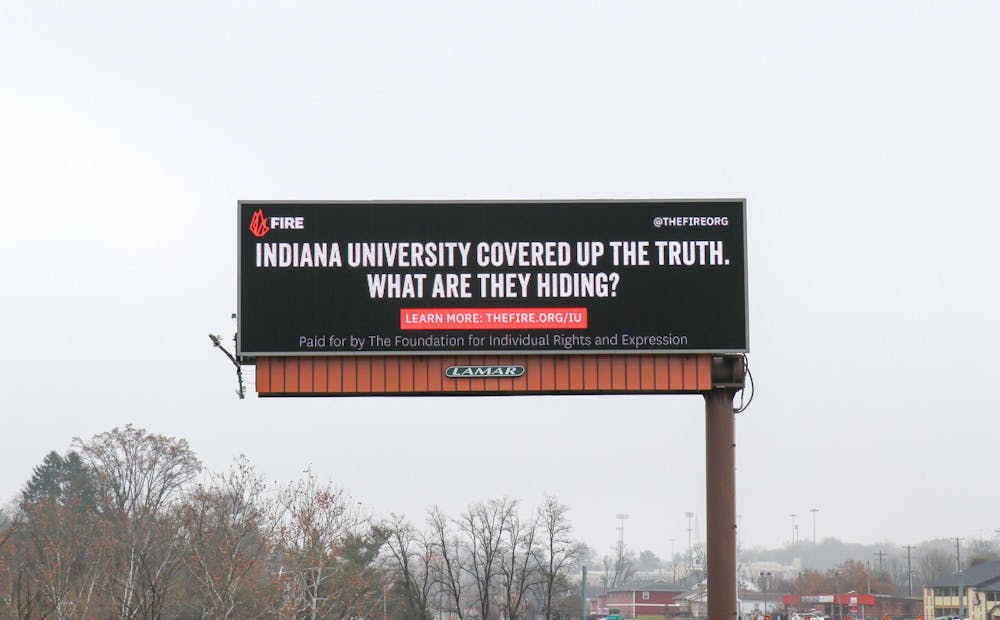
An electric billboard along the State Road 45/46 bypass near Kinser Pike accuses IU of covering up the truth as part of ongoing criticism from an organization that aims to protect free speech on college campuses.
The billboard reads: "Indiana University covered up the truth. What are they hiding?”
The Foundation for Individual Rights and Expression began the campaign with the initial billboard Nov. 10. On Nov. 15, another message appeared on the opposite side of the billboard, so drivers going both east and west in Bloomington could see FIRE’s messages.
The second billboard reads: “Indiana University censored its student newspaper. Hoosiers deserve better.”
FIRE said more signs may follow if IU does not address the group’s concerns.
FIRE program officer Dominic Coletti did not specify how much FIRE spent on the billboards but said in an email to the Indiana Daily Student the organization is “making a substantial investment in publicizing IU's grave shortcomings on free speech.”
FIRE is a nonprofit that advocates for First Amendment rights on college campuses. In September, FIRE ranked IU the third-worst university for free speech in the country. Of the 257 schools surveyed, IU was the lowest-ranked public school.
Over the past few years, FIRE has been critical of IU over actions it argues have severely undermined free speech and academic freedom on campus.
“The short answer is that we felt like enough was enough,” Coletti said. “We'd seen IU change its policies overnight, put snipers on the roof to target student protesters, suspend student organizations without giving them any indication of what they might have done wrong, cancel events on both sides of the aisle, punish faculty members for their speech. I mean, the list of abuses goes on and on.”
The “list of abuses” Coletti references spans a number of incidents over the past two years.
In April 2024, IU revised its Expressive Activity Policy to ban tents and temporary structures in Dunn Meadow without prior approval. This policy change occurred the night before the planned start of a pro-Palestinian solidarity encampment. The policy was used to arrest over 50 protesters. Coletti also brought up the visible sniper on the roof of the Indiana Memorial Union overlooking Dunn Meadow during the protests.
In August, IU placed the Palestine Solidarity Committee on cease and desist. IU mandated the group suspend all activity and turn in a full roster of members but was unclear about any specific infraction, citing “the material and substantial disruption of university operations and damage to university property,” and conduct that was “dangerous and disruptive to the university community.”
Coletti also mentioned the cancellation of events. In December 2023, IU canceled a planned art exhibit featuring Palestinian American painter Samia Halaby, which IU justified by citing “concerns about guaranteeing the integrity of the exhibit for its duration.”
Finally, Coletti referenced the punishment of faculty members. Earlier this month, IU removed lecturer Jessica Adams from her class following an intellectual diversity complaint regarding a lesson that included a graphic on white supremacy.
FIRE said such measures have created a “chilling effect” on campus, discouraging expression and undermining academic freedom.
Coletti said the decision to target IU with the billboards followed a pattern of suppressive behavior, the tipping point being IU’s firing of student media advisor Jim Rodenbush and the temporary suspension of the print edition of the Indiana Daily Student.
Coletti specified the "truth" the university attempted to cover up refers to the administration's directive that the IDS not print any news in its homecoming edition.
"It seemed like IU wanted to keep alumni from seeing the dirty truth of the way that they were acting," Coletti said.
He said people at FIRE found the firing of Rodenbush to be particularly alarming.
“For us, that was so egregious, so clear cut and so obviously censorious,” Coletti said. “That even members of the public who might not be sympathetic to every case that we had had at IU will be able to see why that's wrong and antithetical to the values a university should hold.”
He said that since IU was among the "worst actors” in the country, they needed to “go big,” hence the billboard campaign.
The billboard includes a web address to a FIRE website with more information on IU’s “free speech crisis.” The website also allows students to address IU President Pamela Whitten via an email template to urge her to “stop silencing dissent” and “end the censorship.”
FIRE’s goal is to show the gravity of its demands and for IU to take concrete steps to better free speech on campus. Coletti said there are multiple ways the university can do this, including removing policies FIRE believes to be unlawfully restrictive of expression, stop “meddling” in student journalism and “sit down and talk with FIRE.”
IU is already weighing a possible shift in its free speech policy. On Monday, the IndyStar published an undated memo showing that Whitten asked the University Faculty Council to consider adopting the Chicago Principles, a widely used report with free speech guidelines created by the University of Chicago in 2015.
FIRE policy director Laura Beltz told the IDS that adopting the Chicago Principles would only be effective if IU applies them consistently, not as a “moving target.” Without that strict commitment, Beltz said adopting the principles wouldn’t have much meaning, as they amount to a set of values and not an enforceable policy.
This echoes FIRE’s broader concern that IU has not been able or willing to live up to its commitments to free speech. Coletti recognized a starting point for a path forward.
“We think that IU acknowledging there's a problem,” Coletti said, “and coming to us to try to fix it is a tangible step they can take to show not just us, but the entire state of Indiana and really the country that's watching them right now, that they recognize there's a problem and they're taking the steps they need to make things better.”
Coletti said FIRE has not received a “substantive response” from the university since 2020. In December 2022, FIRE wrote IU a letter after the university violated public access laws in the form of “delayed or denied requests for public records submitted by student journalists,” according to FIRE’s website.
IU confirmed receipt and review of the letter, but Coletti said they did not acknowledge FIRE’s concerns. He said that regional campuses have been “slightly” more receptive than IU Bloomington.
In 2018, IU Kokomo removed an art installation bearing “resemblance to female genitalia” due to complaints from the community. FIRE and PEN America, another nonprofit that advocates for free expression, wrote jointly to IUK. IUK then addressed and resolved the organizations’ concerns by keeping the sculptures on display for the rest of the semester.
FIRE has sent three letters to IU administration and faculty since September. It sent the first to Whitten on Sept. 24 condemning the suspension of the Palestine Solidarity Committee. An Oct. 16 letter to Whitten criticized the firing of Rodenbush and the “censorship” of the IDS.
Most recently, FIRE sent a letter to the interim director of the Borns Jewish Studies program Nov. 7 after he removed a student from a Zoom call due to her profile picture that read “Free Palestine” with the image of the Palestinian flag and a woman in a keffiyeh and allegedly denied her travel funding.
Coletti said these letters “have seemed to fall on deaf ears.”
He encouraged students, faculty and Bloomington residents to visit the website listed on the billboard and share their own messages with IU via email.
“Everybody has a story about why expression, why speech, why art, why news is important to them,” Coletti said. “Telling that story alongside a demand for IU to protect and really respect that art, that news, that expression, is, we think, the best way to bring about meaningful change in your community.”


