
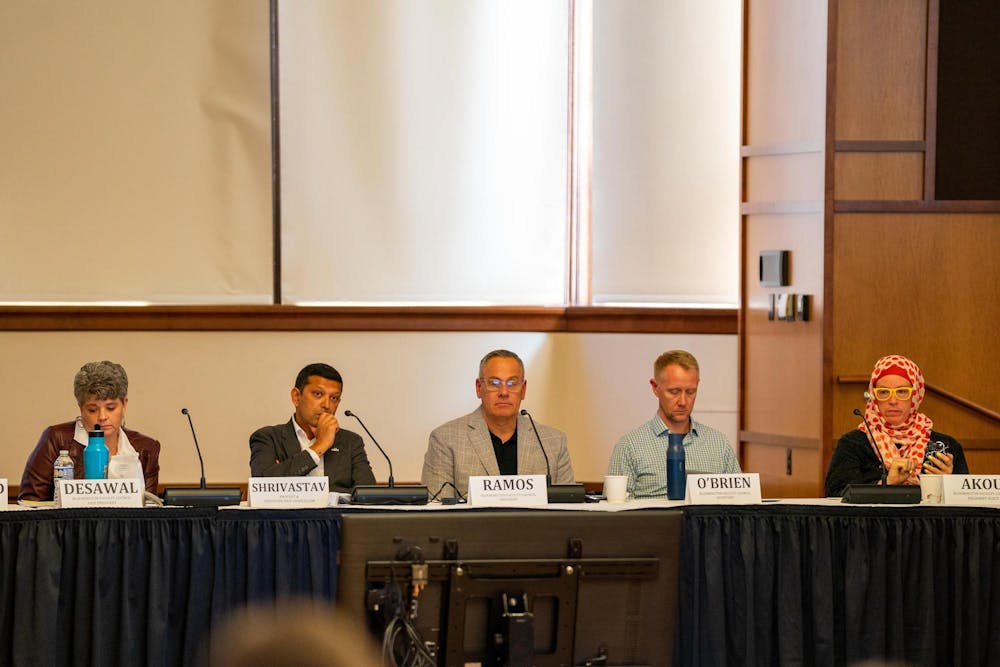
A new committee of faculty, administrators and student leaders is set to begin reviewing and developing IU Bloomington’s policies and procedures in spring.
Its goal is to streamline and centralize IU’s policies and procedures. Its power will span across every type of university policy, including human resources, fiscal management, technology and academics.
The campus committee's policy decisions are subject to approval by the Policy Executive Committee, a body of mostly administrators.
That’s concerning to some faculty leadership, who say the move adds another unnecessary layer of administrative oversight without adequate faculty representation. Faculty also question why this new structure is needed over the Bloomington and University Faculty Councils.
The campus-level committee comes after the IU Board of Trustees launched the university-wide policy committee and its “Policy Alignment Initiative” earlier this year. Like the campus committee, the goal is to consolidate and unify university-wide policies.
Bloomington Faculty Council President Bill Ramos, said during a Nov. 4 BFC meeting that IU has around 1,400 decentralized campus-specific policies. When university-wide policy changes occur, it can duplicate already existing campus-level policies, he said. For example, Ramos said each campus has different faculty misconduct policies, and the PEC could ensure each respective policy aligns at the university level.
“The reality is, we do have a very large and probably ineffective policy framework at the university. It's something that surely has grown over our last 200 and some years, and it was decided it's time to kind of revisit it and come in line,” Ramos said in an interview. “So we did some benchmarking, and we did find, compared to peers, we have an enormous policy process.”
However, Ramos said the campus-level committee will still have full authority over procedures, the step-by-step instructions, tasks and actions for how each campus implements a policy.
Who is on the campus policy committee and how will it work?
BOT-02, which Ramos jokingly described at the BFC’s November meeting as the “policy on policies”, was revised during the Board of Trustees’ June meeting. Each campus chancellor is responsible for creating a campus policy committee.
At the BFC meeting Nov. 18, Ramos presented a preliminary draft of who could potentially make up Bloomington’s committee. This included:
- The BFC president
- Three school/college policy chairs, appointed by the provost
- Three faculty at-large appointed by the BFC
- The provost
- Vice provost for Faculty and Academic Affairs
- The four vice chancellors
- The senior director of IU Human Resources
- A general counsel representative
- The IU Student Government President (non-voting if the president is not employed by the university)
- The Graduate & Professional Student Association president (non-voting if the president is not employed by the university)
- The staff council president
The committee will also have additional support staff serving as non-voting members.
Ramos is collecting feedback on who else should be included on the committee. Feedback can be submitted here. The committee membership must be finalized by the spring semester.
The campus policy committee starts by reviewing policies submitted by university departments and offices. Then, if the policy change moves forward, the CPC will “identify stakeholders to be included in the process” and send to the Policy Executive Committee — the university-wide committee.
Then, it’s up to the PEC to decide if the campus-level policy aligns with university policy and if the request can move forward. If the PEC approves, it goes back to the campus committee to gather feedback, draft the policy, vote and send the policy to IU Bloomington Chancellor David Reingold. The BFC will be involved in this policy development phase, Ramos said.
The PEC will review all policies passed by this campus policy committee. The executive committee consists of primarily university administrators and three University Faculty Council co-chairs — Ramos, Philip Goff from IU Indianapolis and Susan Popham from IU Southeast.
What is the university-wide Policy Executive Committee?
BFC President-elect Heather Akou raised concerns about the thoroughness of discussion on the PEC’s role in enacting policy at the Board of Trustees meeting in June. She said the board only discussed these changes for a handful of minutes.
“I’m not sure the trustees (especially the three new trustees appointed by Gov. Braun) had any idea what they were voting on.” Akou said in a text to the Indiana Daily Student. “They framed it as changes that were necessary to comply with new state laws, primarily SEA 289 and HEA 1001.”
SEA 289, passed in early May, defines diversity, equity and inclusion as any effort to “manipulate or otherwise influence the composition of employees with preference to race, sex, color or ethnicity.” It also says state agencies cannot treat individuals differently or with preferential treatment based on any of those four categories.
HEA 1001 is the state budget bill, passed in May. Language added to the bill allowed Gov. Mike Braun to remove alumni-elected trustees and defined faculty governance organizations as “advisory only.”
According to the recap documents from the June 12 BOT meeting, the PEC changed 26 total university-level policies, including BOT-02, without faculty input to fit new state law requirements and update appropriate officeholders of policies. The documents mention HEA1001 and 1041 and SEA 289 and 448 as laws the policies needed to fit.
HEA 1041, which bars transgender women from competing in women’s sports, is mentioned as a law requiring university policy change in the documents. No specific policy changed at the meeting, cites HEA1041 as the reason.
SEA 448 is the higher education and workforce development bill. It ensures that any student who earns the “enrollment honors plus seal,” is accepted into Indiana public colleges and universities.
According to IU’s policy portal, 79 policies have been revised since the June 12 BOT meeting. A map of the new university-wide policy process can also be found on the site.
Ramos said these policies were reviewed hastily to comply with the law but will eventually go through a full review with an opportunity for public comment. The policies being reviewed by the PEC are open to a 10-day public comment period on IU’s policy portal. The portal lists policies under current review and ones that have been reviewed in the past six months.
The PEC does not currently hold any public meetings and the only way to forward a complaint or revision during the respective policy’s public comment period is to send one to the designated email, policies@iu.edu.
Concerns persist
The changes to BOT-02 from the June 12 meeting reaffirmed faculty governance’s role as advisory-only, and stated that university policy overrides all campus, college and unit policies. It also says that appropriate policy owners — the respective university office that originally pitches a policy idea — are required to discuss policies with appropriate representatives from “target and affected audiences” for all phases and proposals of the policy development process.
The IU chapter of the American Association of University Professors called attention to the changes of BOT-25, which applies to the merging and reorganization of academic programs, pointing out several changes moving decisions away from faculty governance organizations. The changes also removed language that stressed the importance of faculty consultation on academic department reorganization through the BFC, IU Indianapolis Faculty Council or the UFC.
David McDonald, president of the AAUP’s Bloomington chapter, said the new policy procedure continues to disregard faculty opinion and governance, pointing to the disparity of administrators versus actively teaching faculty on the draft of the new committees.
“One thing I noticed is a further eliminating of faculty insight and faculty review, faculty conversation and dialogue on these committees. Take a look at who’s on the committees,” he said. “The power of creating policy is becoming further and further distanced from the faculty who work on this campus.”
Moira Marsh, chair of the BFC Student Academic Appointee Board of Review, had similar opinions on the changes, calling out what she sees as redundancies and the fast pace of the process. She also pointed out the non-elected nature of the ruling committees.
“It's creating an entire sort of parallel structure to an elected governance structure that we have long had,” she said. “You know, we've had the BFC for decades. We’ve had the UFC for decades. It's elected, it's transparent.”
Ramos acknowledged faculty concerns. He said the change in policy structure can feel like a loss for faculty, but he’s feeling “less that way” the more he learns about the process.
“I'm seeing the effect of what's happening and from, you know, an administrative end and an efficiency end how this is going to work,” he said. “But again, I fully acknowledge in the culture and climate currently, anything that feels like a loss, intensely feels like a loss.”
He said faculty will still have the opportunity to voice their opinions on the committees, with the University Faculty Co-Chairs serving on the PEC and the four potentially serving on the Bloomington campus committee.
“The question comes up, why isn't this just the BFC?” Ramos said. “I guess my answer to that is the people that, you know, at the upper levels of the administration felt there needed to be something done to make sure this happens, that this (policy) alignment happens.”


