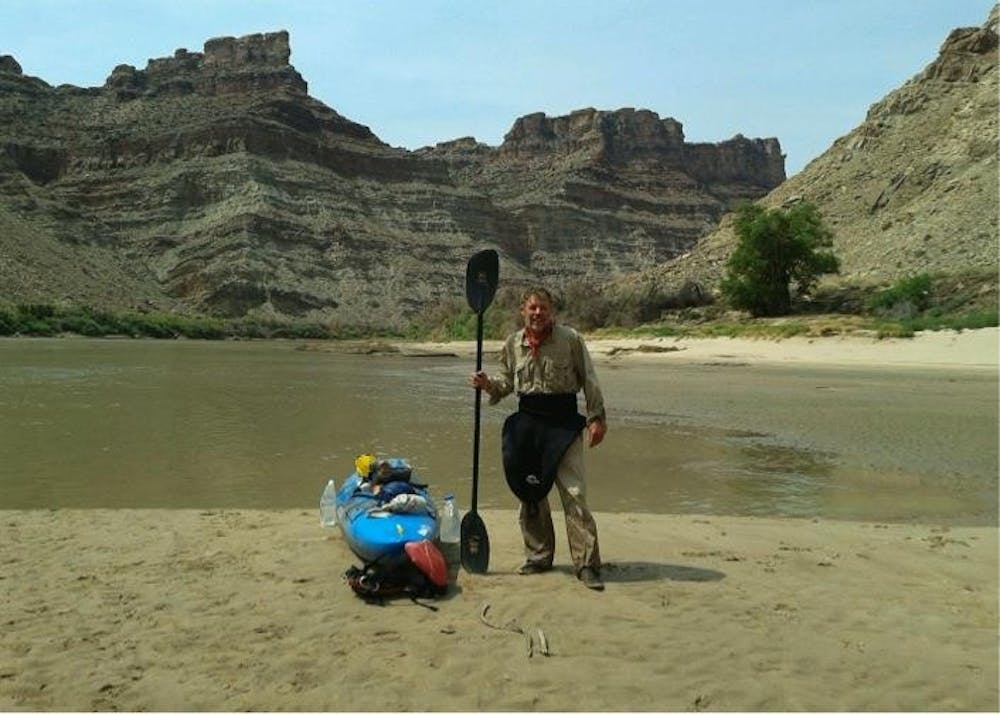
Paddling alone, Bryan Brown admired the breathtaking scene surrounding him on all sides. He dragged his kayak onto the shore and pulled out a small bag filled with ashes.
Pinching a small clump between his fingers, he sprinkled the ashes onto the water.
They were the ashes of Bruce Brown, his brother.
With Bruce’s help, Brown made a pioneer’s dream come true.
Four lost toenails, two lost fingernails, a broken rib and severe tendonitis in his left forearm didn’t stop 57-year-old Brown, an IU almnus and Indiana native. He said he would take the trip again, exactly as it was.
“The injuries were a pain in the tail, but they never really got me to the point where I would stop,” he said.
Brown completed a 2,400 mile journey, traveling from Green River Lakes, Wyo. to the dry wash end of the Colorado River near Yuma, Ariz. and then back up to Moab, Utah. He is the first person ever to complete the journey alone and unsupported.
Along the way, Brown took the time to honor his younger brother Bruce, who lost a difficult battle with muscular dystrophy in late 2012, and saw some of the darker side of environmental destruction.
He said what he saw disturbed him.
The Damage
The first leg of Brown’s journey ended in Yuma, Ariz., where the river dries up.
On the Colorado River, the first two dams built in Yuma were equipped for fishing, because there used to be a salmon run in the area, Brown said. Now, the water has dried up, and fish no longer pass through.
“We have made an incredibly negative impact on our environment,” Brown said. “There are clear signs that areas that have been abused in the past and are trying to recover.”
He found the land between these national parks has suffered the most abuse and received the least attention.
Brown said he believes this damage is due in part to the compartmentalization, or stark divisions of the area amongst federal agencies. These divisions were a major hindrance to his trip, he said.
“The rules regulating travel in this watershed are not codified,” Brown said.
Navigating bureaucracy
None of the federal agencies with territory along the Colorado River have the same land protecting regulations.
“It is hugely fragmented, and the left hand and the right hand don’t communicate,” Brown said.
Brown said there are five big, white water venues in the watershed, and each requires boat and equipment inspections.
To further complicate matters, each venue has different rules that must be upheld to pass through the area.
For example, even though Brown is a strict “leave-no-trace” traveler, meaning he doesn’t disrupt nature on his journey, he had to carry each required fire pan and an 8-pound welding blanket to place underneath it by law.
In order to appease every agency whose jurisdiction he entered, Brown had to
purchase all the fire pans, mail them to himself at different stops, and pick up the materials before his kayak was inspected again.
Brown also needed two life preservers and two helmets with him at all times, despite the fact that it was a solo journey, because there are no regulations for a solo trip.
Brown said because no one else has completed the entire trip alone before, and agencies believe traveling alone is an unnecessary risk, there’s no reason to make specific regulations.
“It totally does not make sense,” Brown said. “The policy comes down from the agency and you have to deal with it.”
A Clapper Rail and his brother’s tale
Brown said he was also able to experience many moments that most people will never encounter firsthand.
“I realized what I was doing was, you know, unique,” Brown said. “There were a few moments of sheer epiphany.”
When Brown first put his kayak in the water, it was turned around by the current. He saw the land around him and thought that view would be as beautiful as his trip could get.
One incredible encounter, he said, was with a Clapper Rail, an endangered bird that
most humans have never seen in person.
“That one singular moment was worth whatever it took to get there,” he said.
It also took a community who rallied around a family in need, he said.
The adventure was originally inspired by a book that Brown and his younger brother, Bruce, bought on a childhood trip to New Mexico. The book was written by John Wesley Powell, the first man to record his travels in the Grand Canyon.
Standing at Desert View, a site in the Grand Canyon, the brothers decided they would take the same journey.
“We said that’s what we’ll do, we’ll retrace John Wesley Powell’s steps,” Brown said.
He said they had no idea how to begin, but the idea was planted.
The idea stayed dormant for several years, he said, until tragedy shook the Brown
family.
When Bruce was diagnosed with an adult form of muscular dystrophy, Brown revived
the plan. He said he hoped that asking Bruce to develop plans for the journey would keep his mind off the crippling illness.
He said though it became obvious his brother could never make the trip, planning it gave Bruce something to live for.
Bruce lost his battle with muscular dystrophy in October 2012.
That was when the men’s journey became reality.
Carrying a small packet of his ashes along the way, Brown brought Bruce to
places he was never able to see. He scattered the ashes throughout the journey.
“Brother Bruce ultimately got to visit all the places we read about,” Brown said.
Along with Bruce’s spirit, Brown said he felt he traveled with his entire family.
“Everybody who had seen what he had wrestled with was with me,” he said. “There was a community there with me.”
By the end of the journey, Bruce’s ashes had been scattered over 2,400 miles.
“Brother Bruce wound up where Brother Bruce needed to be,” Brown said. “Serendipity dropped the Grand Canyon on my lap.”
Setting the record
Brown is the first person to travel the 2,400 miles of treacherous water by himself in a kayak, and this record might secure a place in the Guinness Book of World Records.
Guinness rejects about 99 percent of the bids that they received on a daily basis, Brown said.
After supplying Guinness with a thorough packet of information detailing his trip, Brown is about three months through what may be up to a six-month wait to see if Guinness will accept his adventure.
By the end of the journey, Brown said he felt an extraordinary sense of accomplishment in what he had done. He not only honored his brother, but he discovered places that the government can reform its policies on natural parks and the land near it.
“There is an immediacy that has a power that is nearly beyond words,” Brown said about his feelings towards the outdoors and his travels.
“If people will just get out and see things as they are,” he said, “They will become more conscious of what is critically important to all of us.”
Alumnus paddles for world record
Get stories like this in your inbox
Subscribe