
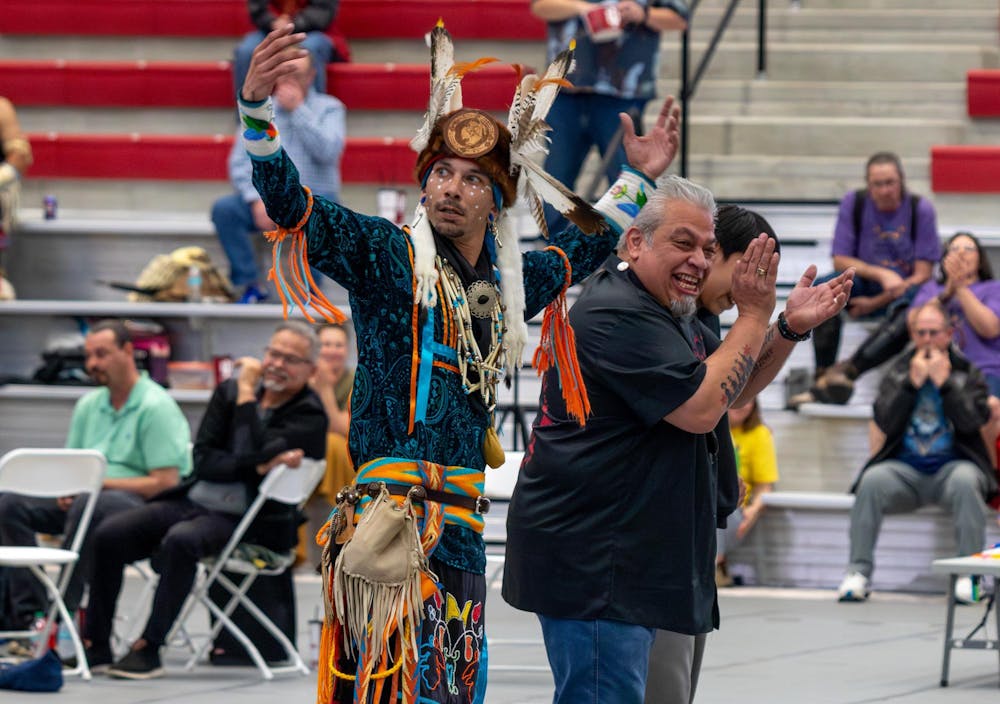
The sound of drums echoed through Wilkinson Hall on Saturday as dancers in colorful regalia moved in the middle of the arena.
The 13th annual Indiana University Traditional Powwow, held from 11 a.m. to 5 p.m., brought together Native American dancers, singers, artists and community members from IU and across the country for a day of cultural celebration.
A modern powwow is a social gathering and intertribal celebration featuring drum groups, ceremonial dances and often competitions, according to the IU First Nations Educational & Cultural Center.
While each powwow differs slightly, most include intertribal dances that invite attendee participation and include dance competitions judged on skill, energy and regalia. For many participants, the powwow is both a celebration of life and a preservation of heritage.
That sense of connection is especially meaningful for Native American students. Junior Claire Carpenter is Potawatomi and said the powwow offers a rare space for cultural belonging in Indiana, where Native American communities have historically been displaced.
“Every single person is your family,” Carpenter said. “It’s the most welcoming environment. You don't have to be native to be here. It's the most respectful and just beautiful engagement of culture and transfer of culture.”
Carpenter performs jingle dress, which is both a style of dance and the name of the regalia donned by its performers. Jingle dress dancing originated with the Ojibwe people in the early 20th century. Carpenter said the style carries deeper meaning beyond its visual flair.
The metal cones sewn onto the dress ring as the dancer moves.
“When women dance jingle, it heals people,” Carpenter said.
For many participants, powwow traditions are passed down through generations. Winfield RedCloud Woundedeye is a member of the Northern Cheyenne and said he began dancing as a child, following in his family’s footsteps.
“My mom was a powwow dancer,” Woundedeye said. “She was taught from her mom and so on and so forth. I was kind of born into it. My mom put me in a little outfit when I was like 3 years old.”
Woundedeye performs the straight dance, a style originating from Southern Plains tribes and rooted in warrior traditions. He described the movements as storytelling, with performers acting out tracking enemies and retelling experiences through dance.
“The first dances for Native Americans were war dances,” Woundedeye said. “It was the men coming back and telling their stories.”
He also emphasized the historical significance of powwows, noting that Native American traditional dances were once banned in the United States. As part of efforts to eliminate Native American culture and force assimilation, the U.S. government outlawed traditional Native American religious practices, including dances, from 1883 until the 1930s.
“It was illegal for us to dance this way,” Woundedeye said. “And to a lot of people, it was kind of viewed as demonic, satanic. But to us, it's a celebration of life.”
The powwow drew artists and vendors from across the country, including Athena Begay, a Navajo artist who traveled from Pennsylvania to sell handmade ribbon skirts and bags. Her business, Athena Crafted, sells pieces that include modern designs inspired by traditional styles.
Begay said she hopes non-Native attendees leave with a deeper appreciation and curiosity about Native American culture. She said attendees should go home and learn more about the presence of Native Americans across the country and in their communities, including the tribes native to their own regions.
“Education has so much power,” Begay said.
She said events like IU’s powwow are important not only for sharing culture, but for broader community participation.
“Letting the audience come and dance in the circle is a special feeling, like we're sharing our culture,” Begay said.



