
R Hunsicker came to the graduate research symposium from the small, close-knit environment of the gender studies department, seeking something they said their own department couldn’t quite offer: a broader community of scholars thinking deeply about gender, sexuality and race.
Hunsicker attended the two-day event to present a project they began in a Black feminist theories class that explores the intersections between Black feminism and asexuality.
“I was looking for a space where I could explore those nuances, which is what brought me to the CRRES symposium,” Hunsicker said.
At the IU Center for Research on Race and Ethnicity in Society symposium, Hunsicker attended panels that linked topics they rarely see discussed together in academic spaces. One presentation on the connections between music, criminalization and disability stood out in particular as a combination Hunsicker said they “rarely encounter,” and an example of the cross-disciplinary work they hoped to find.
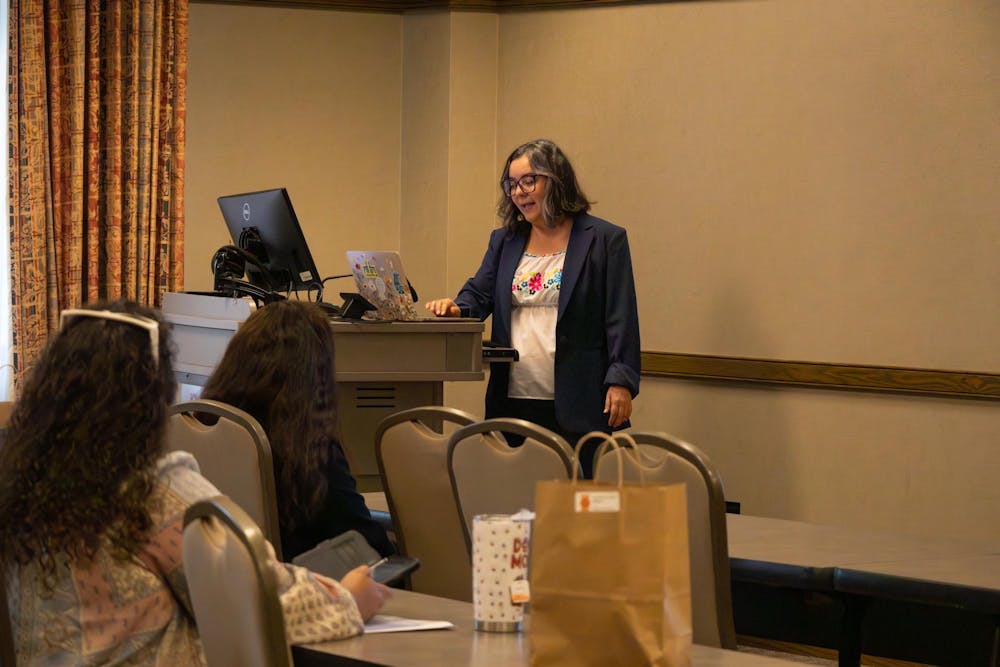
Hunsicker was one of 24 graduate students from disciplines across Indiana University gathered Thursday and Friday for a two-day symposium showcasing research on race and ethnicity. The keynote address examined how workplace dynamics further racial inequality.
According to its website, interdisciplinary focus is central to the mission of CRRES, which organizes the symposium annually. The center was established in 2012 to expand institutional support for research on race and ethnicity at IU.
Cynthia Wu, an American studies professor who moderated one of the Friday panels, said legislation in Indiana has contributed to less discussion on race and identity.
Wu’s research focuses on Asian American literature, gender and sexuality and disability studies. She said the symposium highlights how that work continues beyond formal classroom spaces amid the state and government pushback.
“It seems like a lot of the legislation in the state of Indiana is directed at this kind of analysis within classrooms,” Wu said.
State policymakers have taken many steps to limit diversity, equity and inclusion initiatives in public institutions. Indiana Gov. Mike Braun signed a executive order last January dismantling DEI in all state agencies.
Braun also signed Senate Enrolled Act 289 into law last May, which repeals provisions regarding university diversity committees.
The moves led to IU effectively closing the IU Office of the Vice President for Diversity, Equity and Inclusion in May 2025.
Student attendees at the symposium also pointed to more subtle impacts of the changes, including on how they present research.
“I definitely have felt like things that I would like to say in the classroom, maybe I have to change it a little bit,” said Katie Blandford, a history doctoral student.
Blandford also said legislation has influenced how she approaches teaching and discussion, that she has had to be “very specific” and more careful about the way she presents information in the classroom.
Still, students said the symposium allows for sharing research and building community across disciplines.
“I'm from gender studies, and we're really small,” Hunsicker said. “And although I love everybody there, we don't all overlap in terms of the stuff we do. So I was looking for community in that way.”
Hunsicker presented Friday and said the symposium exposed them to research areas they rarely encounter in their own department.
Prior to their panel on racialized aesthetics and sexuality, Hunsicker attended a panel related to music, criminalization and disability.
“Disability studies to begin with is so rare to see being talked about in research that isn't just pursued independently,” Hunsicker said. “So seeing that in relationship to conversations that are more common things for me to interact with, in terms of criminality and social justice, was really, really fun.”
For graduate students early in their academic careers, the symposium can also help shape their research trajectories.
Mia Moore, an American studies doctoral student who presented on Friday about hip hop and disability, said the presentations prompted new points of reflection. She attended presentations about how some influential Brazilian literature and music has been excluded from prominent Brazilian history.
“Just thinking about what things get recorded and what things don't, who gets respected, who doesn't,” Moore said.
She said she is still figuring out what she wants to research long -term.
“I realized that race is a part of that,” Moore said. “And so I think being surrounded by people who are also continuing to think about race and being able to learn from their methods and the scholars that they're thinking alongside, I think that would be really beneficial for me in my program as I go forward.”



