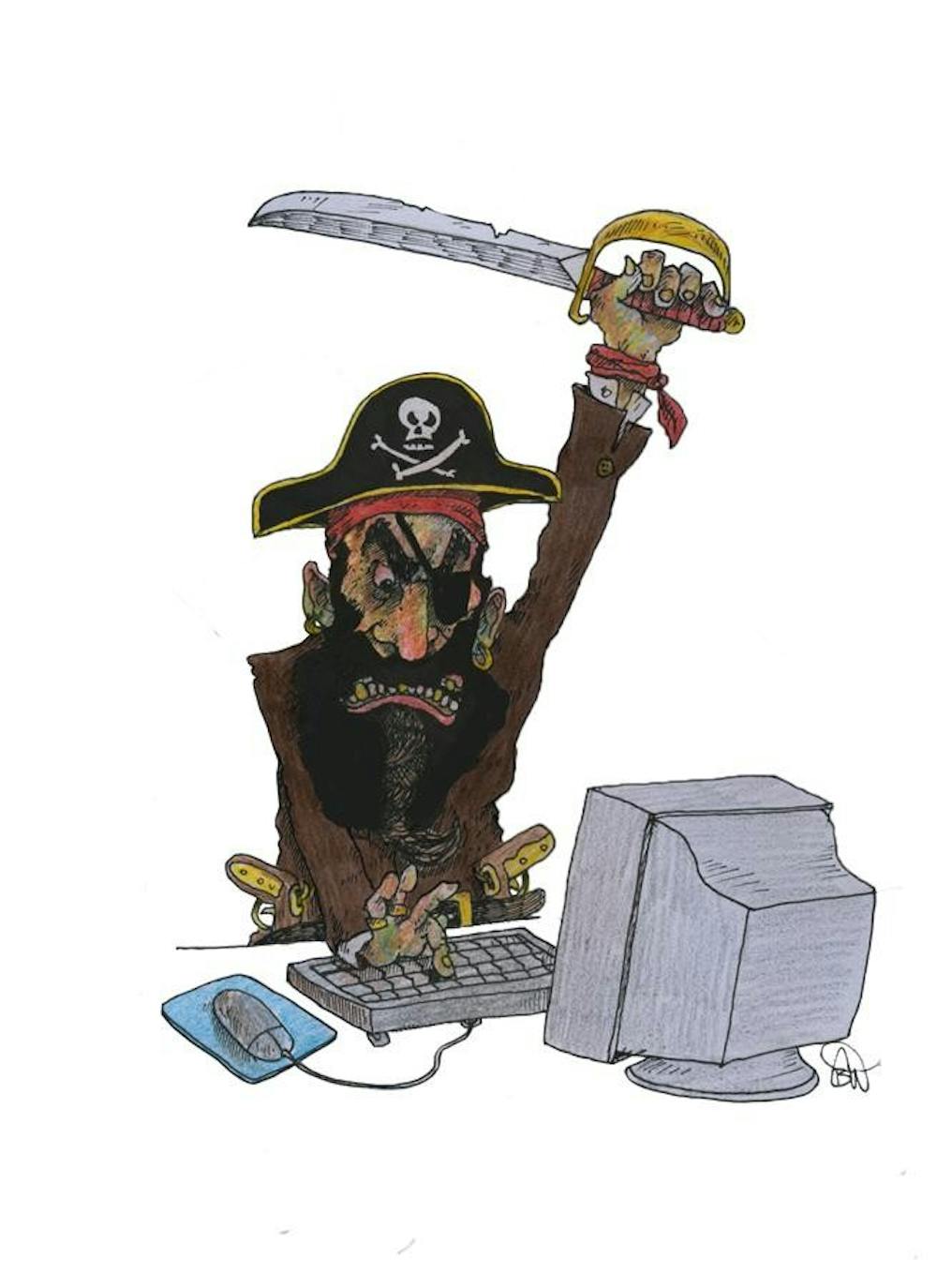
Evidently, we’re a generation of pirates.
At risk of incriminating myself, I’ll tentatively admit that I’ve done my share of sketchy downloading. If you’re halfway intelligent, it’s easy to get stuff for free on the Internet nowadays.
With the advent of digital culture, creative work has taken on a new form. With the right tools or just a familiarity with copy-paste, it’s now possible to take anyone’s content and do what you want with it, whether that means sharing, posting or recreating altogether.
As a result, the music and entertainment industries are hyperventilating. They’re demanding their creative, immaterial product be protected with the full force of the law.
First came the Digital Millennium Copyright Act (DMCA), which seemed to put a curb on some of the worst (or perhaps simply the most obvious) pirating. But the DMCA is evidently no longer enough.
In late October, a bill called the Stop Online Piracy Act (SOPA) was introduced to the U.S. Senate. SOPA is, to put it bluntly, the DMCA on crack.
It’s like the DMCA is a Bond villain who got some stuff stolen from his house and, wanting revenge, decided to just launch its entire arsenal of nuclear weaponry over the entire world to make sure any and all suspects would be incinerated.
Meanwhile, the DMCA would be on a submarine somewhere near Antarctica, stroking his chinchilla and laughing maniacally about revenge.
In short, SOPA doesn’t just stop piracy. It kills half the Internet.
It basically says that anyone and everyone can be incriminated for doing anything that is even somewhat like piracy.
If someone posts a copyrighted video on your Facebook, both of you can say hello to a felony charge. If you email anything copyrighted in an attachment, you’re a criminal. If you cannot expressly prove that your site is in no way party to the theft of U.S. property, you could get taken to court over it.
The site doesn’t even have to be made for the sole purpose of copyright violation (I’m looking at you, Pirate Bay). It just has to facilitate it.
That means all comment sections, any function that allows users to upload any material and basically anything that you yourself have not pored over to make sure is completely original material, would lead to your culpability.
Goodbye, Youtube. Goodbye, Tumblr. Goodbye, Facebook and Twitter and Wikipedia. It was nice knowing you.
To add insult to injury, all of this frighteningly applies not only to U.S. sites, but also to any site outside of the United States that can be considered “dedicated to the theft of U.S. property.”
SOPA applies all of these laws and punishments to any site that can be accessed by a U.S. citizen or handles U.S. material — so basically, the entire Internet everywhere.
If the attorney general (who seems to hold the sole, murky discretion in each case) decides the posts on a foreign site or the site itself are “dedicated to the theft of U.S. property,” SOPA gives the U.S. government the right to stop all payments to the site from any payment provider, remove the site from all search engines and indexes, ban all ads from running on the site and make all Internet service providers block access to the site within five days.
At the government’s discretion, an offending site would, for all purposes, cease to exist.
It’s eerily like Orwell’s “1984,” in which the government of Oceania destroys all offending media at their discretion and willfully alters the past. Just like “1984,” the U.S. government acts as if the First Amendment has never existed.
Creators of intellectual property and creative products deserve to be compensated for their works. But we need to be realistic about where and how compensation is obtained. We’re no longer in a world where people will go out and buy CDs for $19 or DVDs for $25.
Even if SOPA succeeded, the entertainment industry will never recoup the “lost” profits of the past 15 years. Those profits would never have existed in the first place. Talk to a computer with a CD burner if you’re curious.
Some essential things have changed since the dawn of the Internet age. Everything is democratized, and it’s only getting simpler to not only steal, but also to remix and personalize.
There’s really no good solution for preventing or even defining the “theft” of U.S. creative products.
Instead of trying to punish everyone, the creators of content need to change their business model. Making a profit off of it will be difficult at best.
Instead of making your potential customers into felons, think of other ways to make your money. SOPA or no, the old model is in decline.
If SOPA is passed, the next few years could be messy. We might all end up in jail for what are perhaps the lamest crimes of all time.
But SOPA can’t survive. The legislation is too harsh and too unspecific for it not to be almost immediately called into question or repealed.
So I say, so what, SOPA.
Try your best to control us. We’re too creative for you. It will be easier if you just let the pirate generation live our lives legally.
Argghh.
— kelfritz@indiana.edu
Hunting the pirate generation
Get stories like this in your inbox
Subscribe