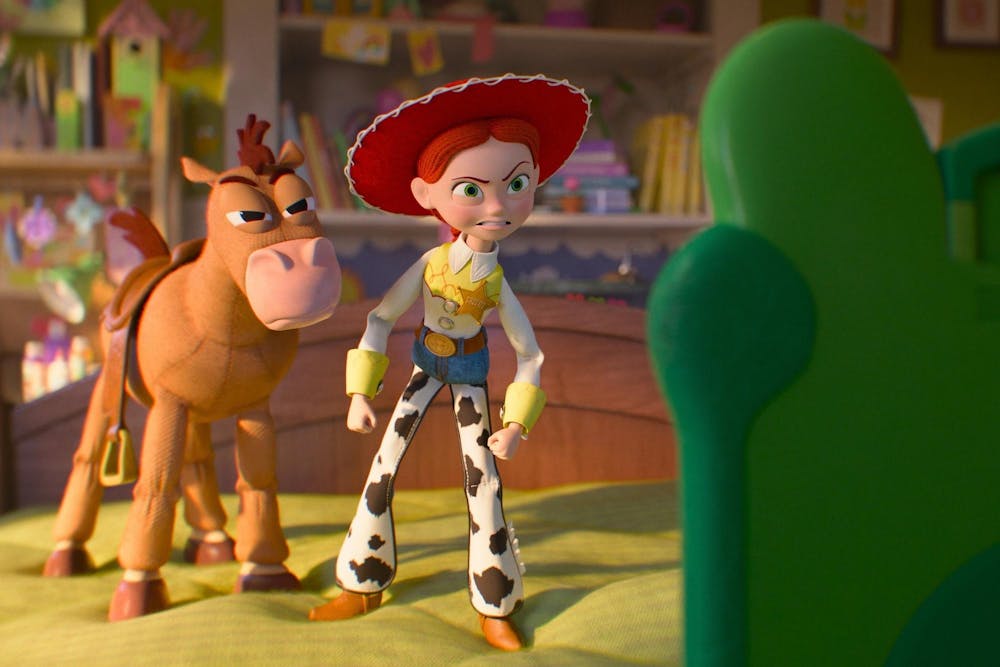
It feels like just yesterday "Toy Story 4" was released, which is why I was so surprised after looking up the film's release date to learn it’s not the brand-new film I remember. Released a whopping 7 years after the installment's 2019 release, "Toy Story 5" reheats the franchise's previous heartfelt charm and captivating visuals.
However, this time "Toy Story 5," released June 19, is used to comment on the growing issue of childhood screentime instead of just themes of growing up itself like the previous installments. Something I feel hasn't been properly discussed in films, especially films designed for kids, made in recent years.
The film primarily follows cowgirl ragdoll Jessie (Joan Cusack), who is now the leader of the toys. She notices that other kids refuse to play with their owner Bonnie (Scarlett Spears), even making fun of her for still playing with toys. That's when Bonnie's parents get her a Lilypad (Greta Lee), an electronic tablet, to help her socialize with other kids. Bonnie's "friends" forget to find her during their sleepover hide-and-seek, treating her differently for not knowing as much about tech as they do. The toys' traditional playtime dynamics are threatened by this incoming tech replacing them and are forced to find Bonnie a new friend to save playtime.
While the conflict of technology's rising impact on society is often dealt with in ways that I find unenjoyable, such as the film "M3GAN," I feel like "Toy Story 5" shows some of the real-world effects of tech in a heartfelt way. Primarily, it shows how tech negatively affects children, whether it is failing to interact with others appropriately or developing self-confidence issues.
As someone who has gone to plenty of family gatherings, I have viewed the often-negative influence tech has had on my younger relatives. I felt like Bonnie's exponential addiction to Lilypad mirrors how introducing devices to young children can develop an early dependency on these objects. While a tablet is an easy way for working parents to keep their children entertained, they might also enable the kids to compare themselves to others or engage with harmful media and opinions.
For Bonnie, after experiencing online bullying from her "friends," we can see her mood take a sharp turn. From previously being a happy young girl, she now acts reserved and afraid that every other kid she encounters will judge her. I felt physically disheartened by how these little girls treated her and angry at how the parents didn't really do much besides turning off the tablet’s messaging feature after seeing how rude her friends were. I kept waiting for them to notify the bullies' parents, but alas, they never did.
While I think the film's message is extremely powerful, I also really enjoyed stepping back into the franchise's childlike nostalgia.
What immediately stood out to me was the play scenes, which visually had a more abstract style than the rest of the movie. These scenes looked almost painted in comparison, using airbrushed visuals and brushstrokes to allow viewers to get into the imaginative mind of Bonnie, and later her new friend Blaze (Mykal-Michelle Harris).
This new film also nods to previous installments such as Jessie's origin in "Toy Story 2," which is, in my opinion, one of the most traumatically depressing scenes in cinema history. Jessie's original backstory depicted her first owner, Emily, outgrowing and later abandoning her, all while the melancholy accompaniment of "When She Loved Me" sung by Sarah McLachlan played in the background.
Jessie's efforts to help Bonnie and restore their playtime become heavily rooted in her past issues of abandonment, feeling like she was a defective toy. So, when both Bonnie and Jessie finally overcome their struggles together, the payoff was incredibly heartwarming. It even brought me back to the days I once relished in the positivity of Pixar movies like “Up” and “Ratatouille,” a space I have since left due to its oversaturation of what I think are mid-tier movies such as "Onward" or "Luca."
I also enjoyed the movie's animation of both realistic animals and their plastic counterparts. When Jessie and Bullseye venture back to Bonnie, they find a real horse. This event becomes key to introducing Jessie back to her cowgirl roots and finding another little girl that plays imaginatively, one that can be Bonnie’s friend. This beautiful blend of animation and realism made my inner animal-lover scream inside.
Using a whole collection of replica horses, all being ridden by updated tech versions of Buzz Lightyear, was icing on the cake. Seeing these mini steeds catch up to a driving donation truck to save the regretful Lilypad as well as seeing a sluggish potbelly pig block Jessie from escaping a playhouse earlier became hilarious. The pig, comically named after the sausage brand Jimmy Dean, is used as lighthearted humor, breaking up tense moments of Jessie’s journey.
Although I might have some bias as a former horse rider, the introduction of these animals added some life to the film, instead of continuing to add more toys.
While it may not live up to the emotional heights of past "Toy Story” movies, this new addition is a perfect watch for enjoyers of the franchise and those who want to watch a decent Pixar movie. Maybe the film's message and definite broad reach as a Pixar movie can do some good in terms of restricting harmful content from children — but I guess we will see.